Bigger Lines, Same Problem: 71% of Interstate Corridors Run Below 30%
India is adding a new voltage tier to its grid to move western solar power east, but the binding constraint on renewable transmission has been where lines run and when they are used, not how large they are.
India’s transmission planners have cleared the country’s first 1,150 kV corridor, a roughly ₹68,800 crore (USD 7.34 billion) project to carry renewable power from western generation zones to eastern industrial demand. The National Committee on Transmission approved the scheme in minutes released on 10 November, with a build period of about six years.
A New Ceiling Above 765 kV
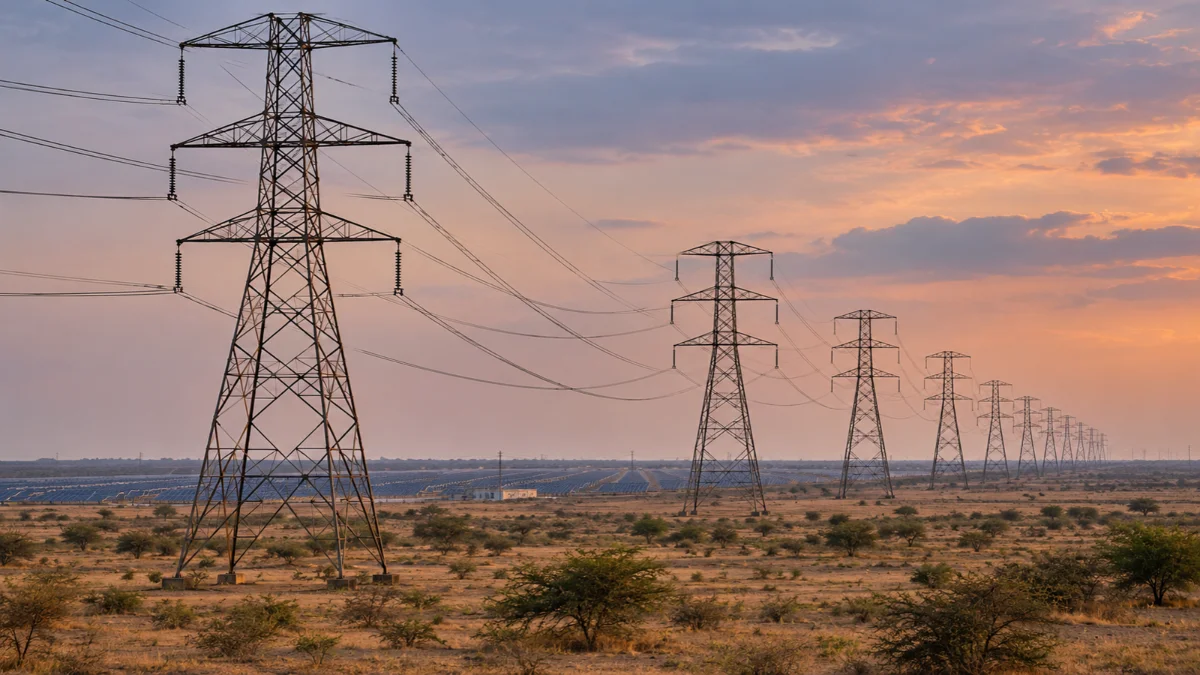
The corridor will use ultra-high-voltage alternating current, a step above the 765 kV lines that form the backbone of today’s interstate network. Higher voltage moves more power per line, which means fewer parallel corridors, less land acquisition and lower losses over long distances.
The first phase links Chhattisgarh, Odisha and West Bengal and connects to a 6,000 MW high-voltage system. Planning papers tie it to a ±800 kV HVDC link from Bhadla-IV in Rajasthan to Raigarh in Chhattisgarh. Across both phases, the corridor would span about 3,750 circuit kilometres with 66,000 MVA of transformation capacity, according to September planning minutes. Phase II will be rolled out in stages, guided by Grid-India’s assessment of actual load growth in Odisha and Maharashtra.
Reports on the approval do not specify how much of the wider scheme the ₹68,800 crore covers, nor whether it will be built by POWERGRID under regulated tariffs or bid out competitively. Those details will set the cost recovery path.
Curtailment Shows the Cost of Waiting
The economic case rests on stranded generation. India lost about 300 GWh of renewable output in the first quarter of 2026 to transmission constraints, according to a May analysis by Ember. A 2025 report by IEEFA and JMK Research estimated that over 50 GW of renewable capacity was stranded nationwide for want of evacuation.
Build rates have lagged. India commissioned 8,830 circuit kilometres of transmission lines in FY2025 against a target of 15,253, a 42% shortfall, with interstate additions at their lowest in a decade. The government has moved to widen the funding base: in February it raised POWERGRID’s equity limit per subsidiary from ₹5,000 crore to ₹7,500 crore to support bids for ultra-high-voltage and HVDC projects. Separately, the Green Energy Corridor Phase III scheme, valued at ₹1.86 lakh crore, was cleared in October.
Capacity Is Not the Same as Utilisation
The counter-evidence is in the existing network. National Renewable Energy Laboratory analysis, cited in the IEEFA report, found that up to 71% of interstate corridors run below 30% utilisation. Part of that reflects deliberate overbuilding ahead of demand. Part reflects solar’s shape: lines built for midday peaks sit lightly loaded through the evening.
That creates the central question for a ₹68,800 crore asset. Transmission charges are pooled and passed through to distribution companies, so an underused corridor raises the per-unit cost of every unit delivered. A 1,150 kV line justified on load expected in the early 2030s could be paid for by discoms well before that demand materialises, unless eastern industrial and green hydrogen loads grow on schedule.
The phased design of Phase II signals planners are aware of the risk. Tying later stages to observed load growth limits the chance of stranded transmission.
For equipment suppliers, the new voltage tier is a separate test. With no 1,150 kV line yet operating in India, transformer, insulator and conductor makers will need to qualify products for the rating, which bears directly on supply timelines over a six-year build.
What to Watch
The Ministry of Power’s notification will confirm the implementing route, regulated allocation or tariff-based competitive bidding, and the scope covered by the cost estimate. Watch also the commissioning of the Bhadla-Fatehpur HVDC link, due in 2029, as the first test of whether new western evacuation capacity cuts curtailment, and whether CEA publishes corridor-level utilisation data to replace the 2025 estimate.
For more climate news click here