India’s E-Scooter Market Outgrows PM E-DRIVE
India’s electric scooter market has passed its first test without central subsidy, and the constraint now is factory output and magnet supply rather than buyer demand.
Electric two-wheeler registrations hit a record 2.24 lakh units in October 2026, the third month after the central purchase subsidy ended. Share of the overall market slipped to 9.7%, from 11.6% in September, as festive buying lifted petrol two-wheeler sales to a record 23.1 lakh units.
Subsidy Exit Did Not Stall Demand
The PM E-DRIVE incentive for electric two-wheelers closed on 31 July 2026, after a four-month extension at a reduced rate of ₹2,500 per kWh, capped at ₹5,000 per vehicle. Support continues to March 2028 for electric three-wheelers, buses and trucks, which the government judged still needed help.
The two-wheeler market’s response has been unambiguous. September registrations rose 85% year on year to about 2.03 lakh units, according to Vahan data compiled by Nuvama, taking the first half of FY27 past 11 lakh units, up 73%. October volumes grew 48% year on year. Penetration a year earlier stood at 4.7%.
Calendar 2026 registrations reached roughly 17.9 lakh by the end of October, already about 4.5 lakh units above the full-year 2025 total of 13.4 lakh. For context, FY2026 closed at 14 lakh units and 6.54% penetration.
Rising pump prices strengthened the operating cost case. Petrol crossed ₹100 a litre in many cities this spring after hikes of about ₹10, as the Middle East conflict pushed up crude.
Legacy Makers Now Lead the Segment
The market’s structure has shifted toward incumbents with established dealer and service networks. TVS Motor registered 60,490 electric units in October, its first month above 60,000. Bajaj’s Chetak followed with about 49,000. Hero MotoCorp’s Vida grew 81% to 29,923 units.
Ola Electric, the FY2025 leader, registered 12,098 units in October, down 26% year on year.
Ather Energy, the largest pure-play maker, shows what scale does to unit economics. It reported its first consolidated net profit in Q2 FY27, at ₹1.26 crore against a loss of ₹154.07 crore a year earlier. EBITDA margin reached 4.9%, an improvement of 1,450 basis points, and wholesale volumes rose 42% to 93,211 units. Ather held 17.2% of the segment in the quarter and is adding 2.25 lakh units of annual capacity across Hosur and its AURIC plant in Maharashtra, citing demand ahead of supply.
Supply Chain Is the New Bottleneck
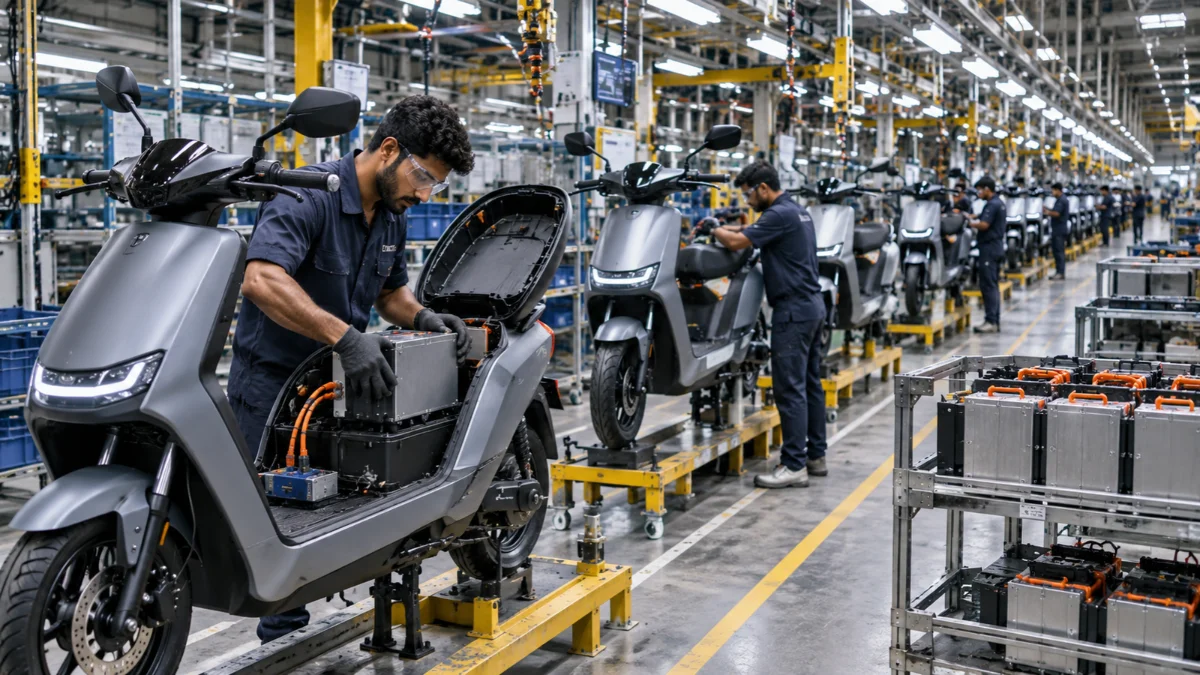
The October share dip signals a different constraint. Electric volumes rose month on month, but not fast enough to match the festive surge in petrol models. Makers are capacity-bound rather than demand-bound.
Magnets are the structural exposure. Between 2022 and 2025, imports, primarily from China, met roughly 60% to 80% of India’s rare-earth magnet demand by value and up to 90% by volume. China’s 2025 export curbs disrupted output at several makers, and Bajaj described magnet availability as a critical bottleneck at the time. The Union Budget 2026-27 announced dedicated rare earth corridors in Odisha, Kerala, Andhra Pradesh and Tamil Nadu, but plant gestation runs about two years.
The policy implication is that India’s two-wheeler transition has moved from a demand problem to an industrial one. Subsidy money that once lowered sticker prices now matters less than component localisation, magnet sourcing and production lines. That favours makers with balance sheets to fund capacity, and raises the barrier for the long tail of smaller brands.
There is a credit signal too. Ather’s move into profit, achieved without the central subsidy in its second half, gives lenders and investors a reference point for pricing EV manufacturing risk in India.
What to Watch
November registrations will show whether electric share returns above 10% once festive petrol demand fades. Ather’s Q3 FY27 results, due by mid-February, will test whether profitability survives a full quarter without subsidy. On supply, watch for the first production approvals under the rare earth corridors and any renewed Chinese export restrictions on magnets.For more climate news click here