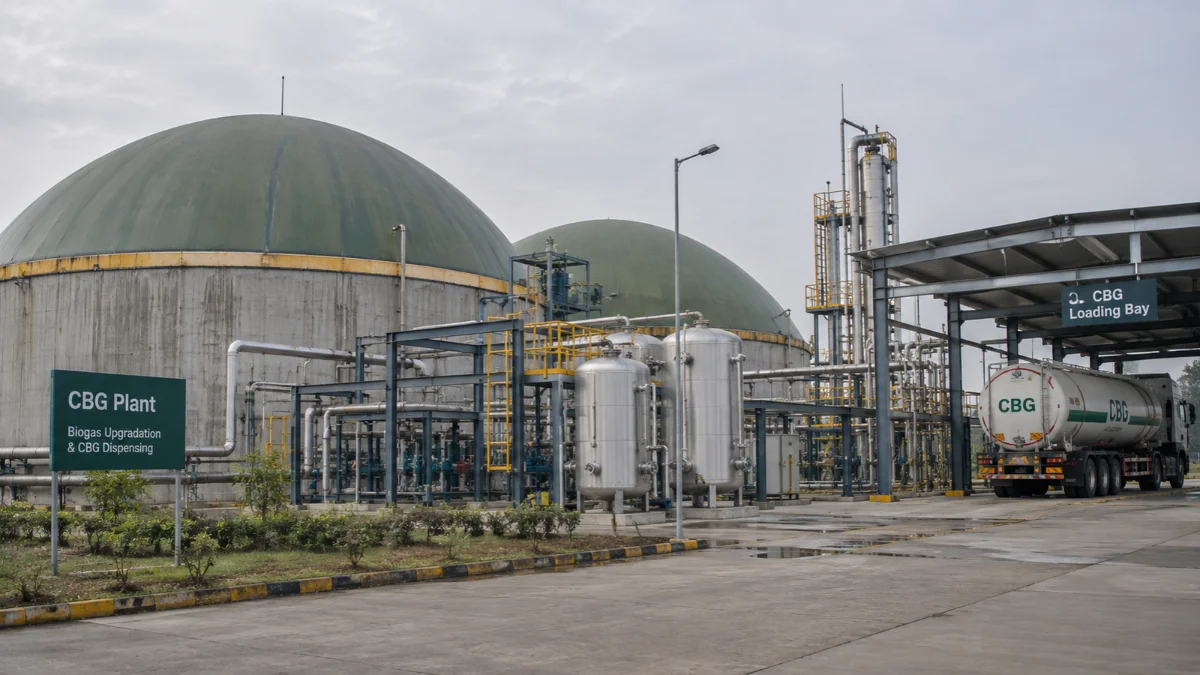
City Gas Distributors Face 3% Biogas Mandate as Plant Capacity Lags
A blending mandate that tripled this financial year has turned biogas from a rural subsidy story into a capital-allocation problem for city gas distributors.
Investment pledges of ₹3,200 crore for compressed biogas (CBG) from the Renewable Energy India Expo 2026 cover roughly 13% of the ₹24,000 crore that ICRA says the sector must deploy between FY2027 and FY2029 to keep pace with India's blending obligation.
Blending Mandate Steps Up From 1% to 3% of City Gas Demand
The Indian Biogas Association (IBA) reported the figure on November 1, a week after the October 22 to 24 expo in Greater Noida. Before the event opened, the association had forecast a pipeline above ₹2,800 crore. The timing matters because demand is no longer voluntary. Under the CBG Blending Obligation approved by the National Biofuels Coordination Committee, city gas distributors must blend CBG into transport CNG and household piped gas at 3% of consumption in 2026-27, up from 1% last year, rising to 5% from 2028-29. ICRA's June 2026 sector report says the 1% target, about one lakh tonnes a year, was met in FY2026.
ICRA Puts the Capacity Gap at 3,100 Tonnes a Day
According to ICRA, installed CBG capacity stood at roughly 900 tonnes per day (TPD) in FY2026. Keeping up with the obligation requires adding at least 1,000 TPD every year to reach about 4,000 TPD by FY2029. The rating agency prices that build-out at about ₹24,000 crore over three years. The plant record shows how wide the gap remains. SATAT, launched by the Ministry of Petroleum and Natural Gas in 2018, targeted 5,000 plants by 2023; 132 had been completed by June 2026. Public money is now on the table. The Union Cabinet approved the ₹23,731 crore GOBARdhan National Circular Bioenergy Scheme in August 2026, effective September 1, which IBA credits with locking in prices and assured buyers for developers.
Expo Pledges Measure Intent, Not Financial Close
IBA's 2024 expo figure of ₹1,850 crore was assembled from joint ventures, memoranda of understanding and letters of intent, which the association expected to be realised over two to three years. IBA has not reported how much of its earlier tallies reached financial close. The exposure sits with city gas distributors. They carry the compliance obligation but depend on third-party developers to build plants. ICRA also flags patchy gas-grid access, seasonal feedstock and the CO₂ released during processing as unresolved threats to plant economics. The upside, if conversion holds, accrues to the import account. With roughly half of India's gas demand met through LNG, ICRA estimates domestic CBG could cut the import bill by about ₹17,000 crore a year by FY2029. IBA President A R Shukla set out the sector's pitch before the expo: "India is no longer looking at biogas as just a rural solution." The measure of that claim will be tonnes per day, not pledge totals.
What to Watch
Three markers will show whether the pipeline is real. The first is whether IBA or MNRE publishes how much of the 2024 and 2025 expo pledges became commissioned plants. The second is GOBARdhan disbursement data from the scheme's first year. The third, and the hardest signal, is city gas distributor compliance for 2026-27. A missed 3% obligation would show that pledges have not become capacity, and would put the 4% step due in 2027-28 under immediate pressure.
For more climate news click here