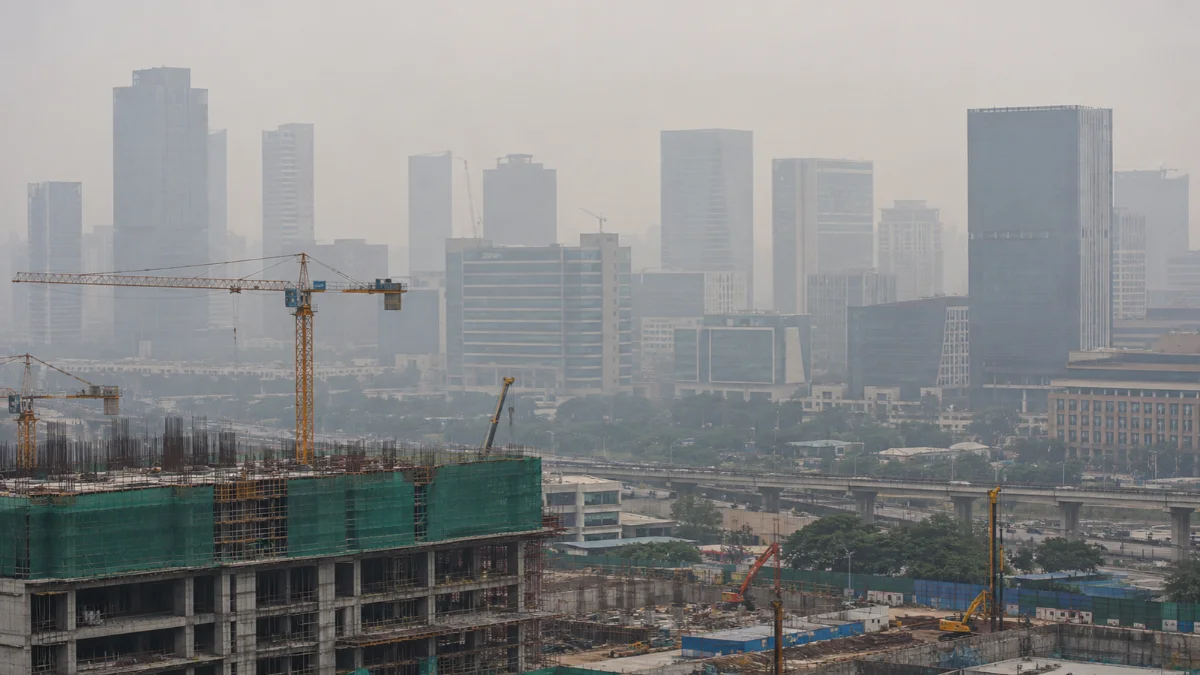
Mumbai's 48% PM10 Cut Leaves Chembur, BKC at Double Legal Limit
Mumbai reports a 48% fall in PM10 since 2017-18, yet its own station data shows the national standard still breached across most of the city.
Annual average PM10 exceeded India's 60 µg/m³ limit at 13 of Mumbai's 14 monitoring stations in 2025-26, according to the Brihanmumbai Municipal Corporation's (BMC) Environment Status Report, as reported by The Times of India. Chembur and Bandra Kurla Complex (BKC) each averaged 125 µg/m³, more than double the standard set by the Central Pollution Control Board (CPCB).
Citywide Progress and Station Data Point in Different Directions
The figures surface days after BMC said city PM10 concentrations fell roughly 48% between 2017-18 and 2025-26, citing the Union environment ministry's PRANA portal. The corporation also counted 231 days of good or satisfactory air in 2026 as of October 22, against 218 in all of 2025. Both claims can hold at once. A citywide trend can improve sharply while individual neighbourhoods remain far above the legal limit. Which number counts matters for money. Under the National Clean Air Programme (NCAP), cities were set a 2025-26 deadline to cut PM10 by up to 40% from 2019-20 levels or meet the 60 µg/m³ standard. Since 2021-22, air quality grants under the 15th Finance Commission have been disbursed on performance, and performance is judged on PM10 reduction. A city can pass the percentage test while most of its residents still breathe non-compliant air.
Eastern Suburbs and the Business District Lead the Exceedances
The dataset combines nine stations under SAFAR-Mumbai, run jointly by BMC, the India Meteorological Department and the Indian Institute of Tropical Meteorology, with five BMC continuous ambient air quality monitoring stations. Every SAFAR station breached the standard. After Chembur and BKC came Malad (100), Colaba (95), Andheri (90), Borivali (87), Worli (79), Mazgaon (71) and Bhandup (64). On BMC's network, Shivaji Nagar in Govandi recorded 93 µg/m³, 55% above the limit, followed by Ghatkopar (84), Sewri (75) and Byculla (69). Kandivali, at 59, was the only compliant station. BKC's annual PM2.5 reading of 48 µg/m³ also exceeded the national limit of 40. The three-year series is uneven. Chembur slipped from 128 in 2023-24 to 125 and held there, Malad climbed from 88 to 104 before easing to 100, and Bhandup fell steadily from 77 to 64.
Construction Enforcement Becomes the Pressure Point
With about 3,000 construction projects active across Mumbai, site dust is the leading suspect, and BMC has issued 28 guidelines for builders. Avinash Kate, BMC deputy municipal commissioner (environment and climate change), described the problem as "largely a post-monsoon concern." Annual means of 125 µg/m³ sit uneasily with that framing, since they already average in the cleaner monsoon months. Bhagwan Kesbhat, founder of the Waatavaran Foundation, questioned compliance, noting that sites often screen only the section under active work. He linked BKC's readings to infrastructure projects including the bullet train corridor and Metro 2B, which places public agencies, not just private developers, inside the enforcement problem. Kate attributed part of Govandi's reading to road works and a bakery burning wood, which has since closed. The pattern extends beyond Mumbai. Pune Municipal Corporation's own 2025-26 Environment Status Report recorded PM10 and PM2.5 above national standards at most stations, with unchecked construction cited as a driver. Mumbai's coastal ventilation, an advantage landlocked Delhi lacks, has not been enough to close the gap.
What to Watch
BMC plans five additional monitoring stations over the coming year, which will sharpen the hotspot map and may expose readings the current network misses. The nearer test is this winter, when Mumbai's air typically deteriorates: it will show whether the Winter Air Pollution Mitigation and Enforcement Action Plan 2026 produces measurable declines at Chembur and BKC. The structural question is NCAP's next phase. If performance funding continues to reward percentage cuts over compliance, Mumbai's 48% headline will keep coexisting with neighbourhoods breathing twice the legal limit.
For more climate news click here