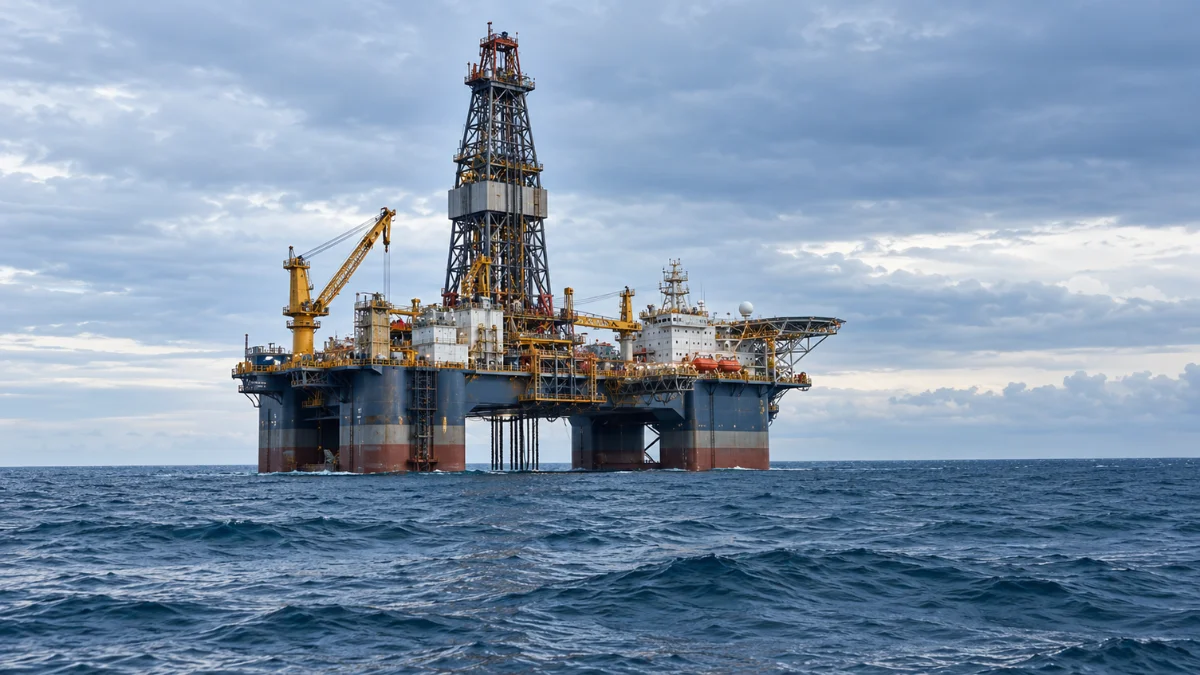
₹43,200 Crore Drilling Fund Caps State Support at ₹675 Crore per Well
As institutional capital edges away from upstream oil, India’s exchequer is stepping in to carry the costliest stage of the search for it.
New Delhi will write off its contribution to any deepwater well that comes up dry under the ₹84,084 crore Samudra Manthan scheme, and will recover support on successful wells only years into production, with no interest or inflation adjustment. The terms are set out in operational guidelines the Ministry of Petroleum and Natural Gas (MoPNG) issued on 22 October.
Guidelines Settle Who Pays When a Well Fails
The Union Cabinet approved the National Offshore Exploration Scheme on 31 July, with a Phase I outlay running to FY2030-31. That approval left the commercial terms open. The guidelines close that gap, and they matter because the stakes per well are large: PIB puts the cost of a single deepwater exploratory well at USD 125 to 150 million.
The timing sets India against a wider capital trend. European public investors are reducing oil exposure, as Climate Watch reported on 23 October. India is moving the other way, using budget funds to absorb geological risk that private operators have been reluctant to carry alone in its frontier basins.
Every Well Is Budgeted at Its Maximum Draw
The drilling component, worth ₹43,200 crore, covers 60 wells. For 56 exploratory wells in water deeper than 400 metres, the state pays up to half of actual cost, capped at ₹675 crore per well. Four stratigraphic wells, drilled to map basin geology, can be funded in full up to ₹1,350 crore each, but only state-owned companies or consortia they lead may apply.
The arithmetic is exact. Fifty-six wells at ₹675 crore plus four at ₹1,350 crore equals ₹43,200 crore, so the allocation assumes every well claims its ceiling. Cost overruns fall entirely on operators, and blowout control costs are excluded outright. Funds are released in two tranches: 40% when a well reaches 40% of approved depth, the balance on completion and approval of the well report.
Repayment Terms Function as a Concessional Loan
Where a funded well yields a commercial discovery, support is recovered from the operator’s revenue. Repayment begins after seven years of commercial production, or once the operator has recouped half its exploration and development cost, whichever comes first. Instalments are annual and carry no indexation or time-value adjustment.
PIB’s own estimate of 5 to 10 years from block award to production matters here. A well funded in FY2029 could begin repaying in the 2040s, in rupees worth materially less than those disbursed. The structure is a grant on failure and an interest-free loan on success.
Public Sector Explorers Gain, and the State Holds the Transition Risk
Eligibility favours newer acreage. Only blocks under revenue sharing contracts qualify; production sharing contract blocks and coal-bed methane acreage are excluded unless the government notifies otherwise, and development wells receive nothing. ONGC and Oil India gain exclusive access to the fully funded stratigraphic wells.
Petroleum Secretary Neeraj Mittal, in his preface to the guidelines, described the scheme as “the most ambitious upstream oil and gas intervention undertaken in recent times.”
The scale of that ambition carries a climate cost the guidelines do not price. PIB targets 600 MMTOE of added reserves and domestic output rising from about 62 MMTOE to 80 MMTOE a year, volumes that would be produced deep into the decades India has committed to decarbonising ahead of its 2070 net-zero target. The drilling allocation alone is more than double the ₹19,744 crore outlay of the National Green Hydrogen Mission, approved by the Cabinet in January 2023. Because repayment is drawn from revenue, any discovery stranded by prices or policy before it produces leaves the state’s support unrecovered.
What to Watch
Mid-term evaluation is scheduled after 30 deepwater wells, and a final independent review will decide whether a Phase II is funded. The Directorate General of Hydrocarbons must launch a single-window clearance portal within six months. The open question is whether the Technical Assessment Board, which vets each well proposal, applies any methane or flaring standard before public money is committed.
For more climate news click here