Gulf Import Dependence Halts India's LPG Growth for First Time in Decade
India's first contraction in household LPG connections in a decade shows how a clean cooking programme built on imported fuel absorbs a Gulf supply shock.
India ended August with 6.2 million fewer active household LPG connections than it had in April, the first contraction in the customer base in about a decade. The count fell from 333.9 million to 327.7 million over five months, according to Ministry of Petroleum and Natural Gas data released in late September.
Import Dependence Turned a Supply Shock Into a Customer Shock
India imports roughly 60% of the LPG it consumes, and before the West Asia conflict close to 90% of those imports came from the Gulf. Disruption to shipping through the Strait of Hormuz showed up in demand early. PPAC data put April 2026 LPG consumption at 2.2 million tonnes, 13.1% below April 2025.
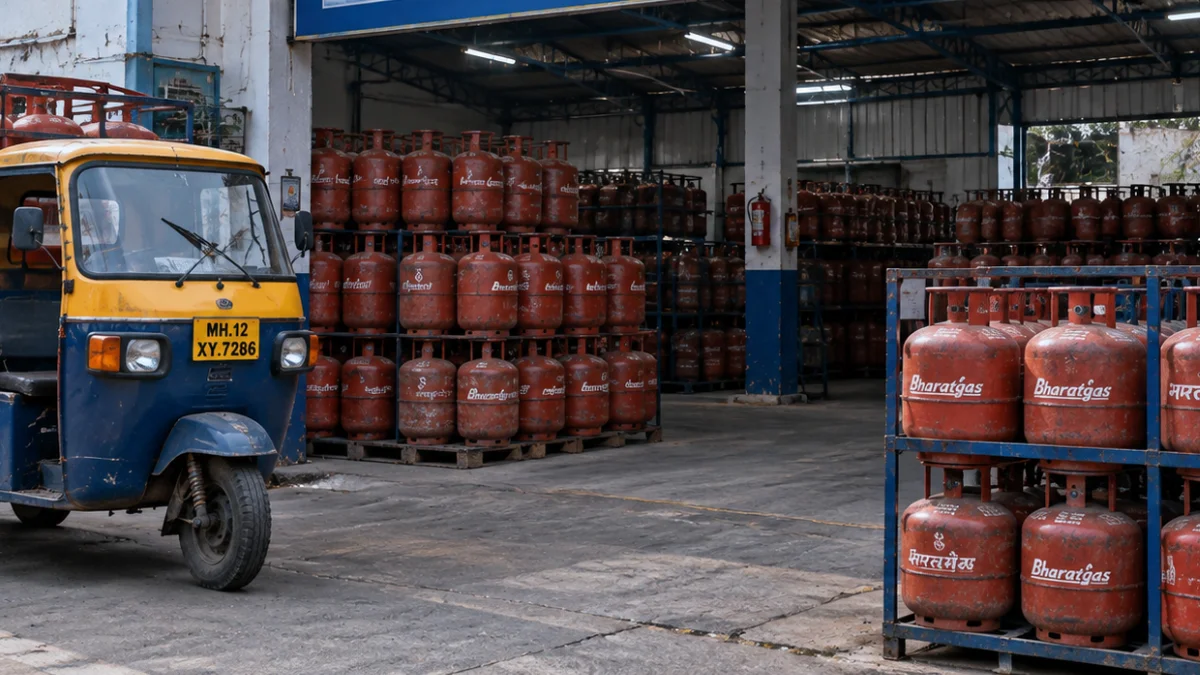
Public sector oil marketing companies responded by halting new connections. That switched off the engine that took the base from 148.6 million at the start of 2015-16 to 333.9 million by April 2026. Annual growth, between 11.9% and 19.6% up to 2018-19, had already slowed to about 5% before this year's contraction of roughly 1%.
Three Forces Sit Behind the 6.2 Million Figure
Aadhaar-based biometric verification has flagged dormant and duplicate accounts, a cleanup that shrinks the count without any household changing how it cooks. Piped natural gas explains another slice: city gas networks added close to 600,000 PNG customers by July, taking the total to about 17.5 million. That covers roughly one-sixth of the lost LPG base.
The remainder is harder to read. Published data does not separate accounts removed in verification from households that stopped refilling because cylinders were scarce or costly. Only the second group represents a real step back in clean cooking access.
Southern States Absorbed the Largest Losses
Southern India lost about 2.63 million customers, against 1.62 million in the west, 1.5 million in the north and 0.34 million in the east. The south still holds 79.8 million active customers, behind the north's 99.3 million.
Pradhan Mantri Ujjwala Yojana (PMUY), the scheme for low-income households, lost about 600,000 beneficiaries and now stands at 105.7 million. That is a proportionally smaller dent than the overall base, which suggests the decline is not concentrated among the poorest connections, at least on paper.
Price Controls Hide the Fiscal Cost
Retail prices have masked the shock. Global LPG prices rose 40% to 50% during the crisis while domestic prices moved only 6% to 7%, according to figures reported by Down To Earth in May. A 14.2 kg refill retails at Rs 913 against a cost of Rs 1,300 to 1,400, leaving the government and oil marketing companies to absorb Rs 300 to 400 per cylinder.
Holding prices does not solve availability. Speaking in May, Anil K Sood, professor at the Institute for Advanced Studies in Complex Choices, said "rationing was the only alternative." When refills are rationed, rural households with access to firewood, dung cakes and crop residue have a fallback that urban PNG users do not need. That fallback carries a health and emissions cost, which is why the composition of the 6.2 million matters more than its size.
Policy Is Tilting Toward PNG and Electric Cooking
The Centre is steering urban households toward PNG, and electric cooking is estimated to cost about 20% less than LPG or PNG in many cities. Both reduce exposure to imported LPG, but neither reaches most rural households quickly. Diversifying away from a single imported cooking fuel has become an energy security question, not only a climate one.
What to Watch
Aadhaar authentication becomes mandatory for subsidised refills from October 1, which is likely to remove more inactive accounts and push the headline number lower. The more useful signal will be refill frequency per active PMUY household in PPAC's monthly releases. A falling refill rate alongside a stable customer count would indicate households are keeping the connection but returning to solid fuels. Watch too whether oil marketing companies resume new connections once Gulf supply normalises.
For more climate news click here