EU Transition Fund Claims Face Scrutiny Before SFDR 2.0 Category Exists
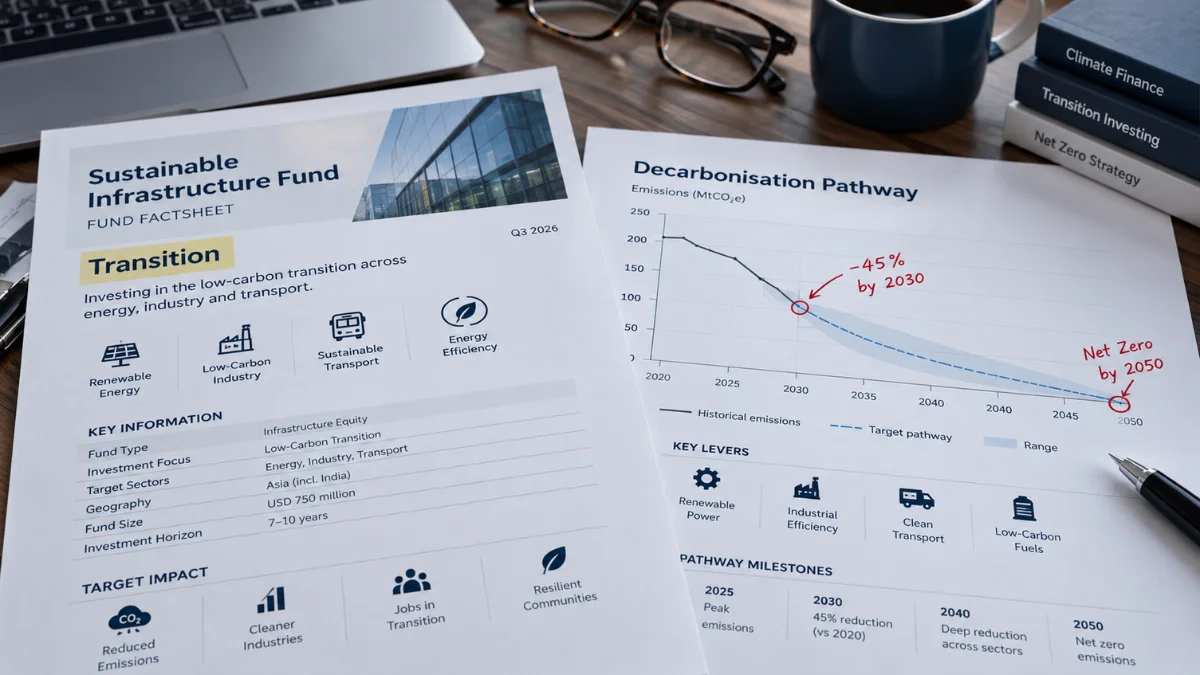
Europe's markets regulator has defined what impact and transition labels must prove, a year or more before SFDR 2.0 is expected to make transition a legal fund category.
Fund managers, bond issuers and benchmark administrators selling impact or climate transition products in the EU now have a supervisory reference point for those claims. Two thematic notes published by the European Securities and Markets Authority (ESMA) on October 12 set out the substantiation regulators expect, with examples of good and poor practice drawn from observed market behaviour.
Guidance Fills the Gap Before SFDR 2.0 Takes Effect
The European Commission's SFDR 2.0 proposal of November 20, 2025 replaces the Article 8 and Article 9 regime with three voluntary categories, including a new Transition category under a proposed Article 7. Each requires at least 70% of a portfolio in eligible assets. Final text is not expected in the EU Official Journal before the second quarter of 2027, according to analysis published by Rankia Pro in September 2026.
Until then, managers can market transition and impact strategies without a legal definition of either term. ESMA's notes occupy that space. The authority states the notes "do not create new regulatory requirements," but national supervisors now hold a common yardstick for what counts as clear, fair and not misleading.
Impact Claims Must Separate Investor and Investee Effects
The first note covers positive impact claims in funds and bonds. ESMA asks providers to state the environmental or social problem targeted, how impact will be generated and how it will be measured, using KPIs tied to outputs, outcomes or impact. Intentionality, additionality and measurability are the reference points.
The sharpest instruction concerns attribution. A fund that holds a solar developer has not necessarily caused new solar capacity, and ESMA treats blurring investee impact with investor impact as a route to misleading claims. Products also cannot qualify as impact on the basis of asset class, sector or exclusion screening alone.
Transition Note Extends Scrutiny to Benchmarks
The second note covers funds, bonds and benchmarks. Because transition claims are forward-looking, ESMA expects disclosure of the ambition, the implementation plan, the assumptions behind it and how progress will be reported. Its list of poor practices includes presenting portfolio decarbonisation as equivalent to real-economy emissions cuts.
That distinction carries commercial weight. A portfolio can cut its financed emissions simply by selling high emitters, with no change in the underlying economy. Managers marketing transition funds on portfolio carbon intensity alone now face a supervisory reference against that framing.
Trillions in Labelled Assets Sit Inside the Scope
Combined assets in Article 8 and Article 9 funds stood at EUR 7.1 trillion at the end of 2025, according to Morningstar, while Article 9 funds posted outflows for a ninth consecutive quarter. Around 310 EU funds carried the word transition in their names as of September 2025, Morningstar data show.
The industry's response to ESMA's 2024 fund naming guidelines indicates the likely pattern. An estimated 1,450 funds, roughly 31% of those in scope, were renamed between January 2024 and September 2025. Managers with thin transition plans behind transition-branded products are the most likely candidates for the next round.
SEBI Has Impact Rules but No Transition Category
For Indian asset managers, the logic is familiar. SEBI's July 20, 2023 circular split ESG mutual funds into five strategies, including impact investing, and required the strategy to appear in the scheme name. Since October 1, 2024, ESG schemes must hold at least 65% of assets under management in listed companies with assured BRSR Core disclosures.
None of SEBI's five ESG fund strategies covers transition. As Indian steel, cement and power companies raise capital for decarbonisation, ESMA's transition note offers a tested template for how such products could be labelled and policed.
What to Watch
The European Parliament is expected to adopt its SFDR 2.0 position in plenary this month, opening trilogue negotiations that will set how strict the Transition category becomes. The next signals are national supervisors citing the thematic notes in enforcement, and Morningstar's third-quarter 2026 data on whether funds drop impact and transition from their names.
For more climate news click here