Railway Lender's Solar Bet Tests How Far IRFC Can Diversify
A lender built to fund trains for Indian Railways is now financing solar panels on a coal utility's reservoirs. Both institutions are testing whether legacy balance sheets can fund the transition.
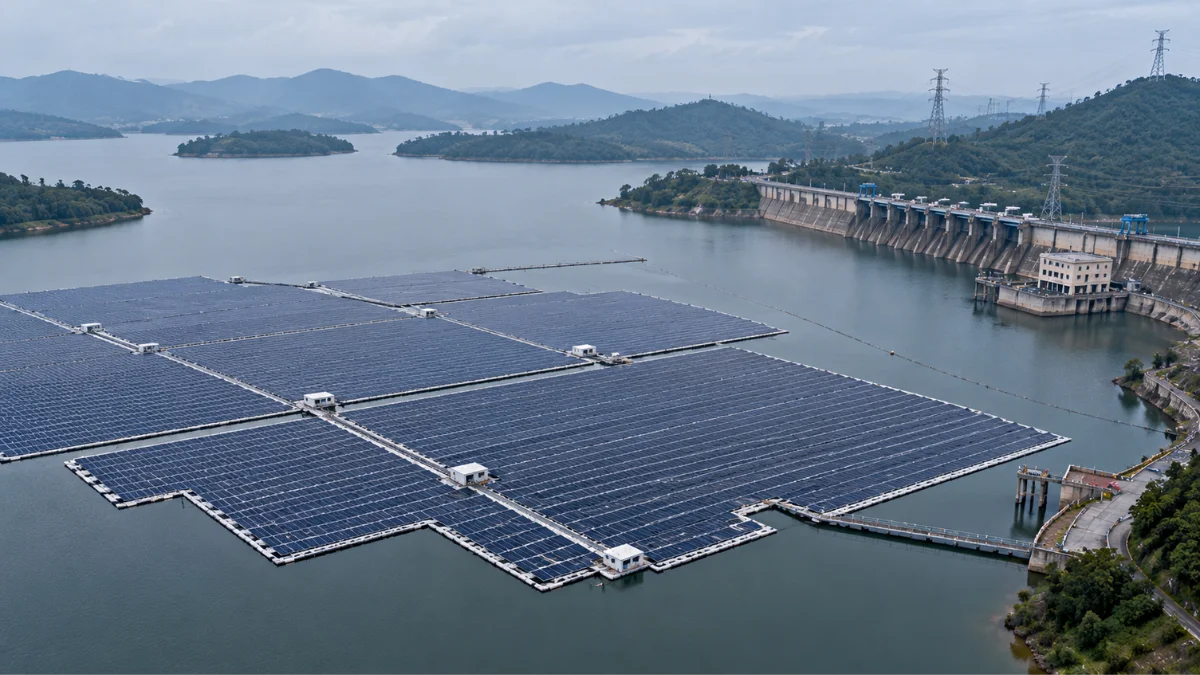
Damodar Valley Corporation has secured ₹4,200 crore in term debt to build floating, ground-mounted and rooftop solar with battery storage across Jharkhand and West Bengal. The lender is Indian Railway Finance Corporation (IRFC), and the agreement was signed on 28 September 2026.
A Rail Financier Moves Deeper Into Power
IRFC's core business is funding rolling stock and rail assets for the Ministry of Railways, a book that is large, safe and thinly priced. The company reported assets under management of ₹4.79 lakh crore and an annualised net interest margin of 1.48% for the quarter ended June 2026, according to its Q1 FY27 disclosures. Management has guided towards a margin of about 2% by 2030.
Lending outside the railway ministry is how IRFC intends to close that gap. By June 2026 it had executed ₹92,799 crore of non-railway agreements, of which power accounted for ₹44,614 crore and renewables only ₹5,000 crore. A single ₹4,200 crore facility to DVC therefore nearly doubles its dedicated renewables exposure in one transaction.
What DVC Is Building, and What Is Still Missing
The financing covers four asset types: floating solar, ground-mounted solar, rooftop installations and battery energy storage systems (BESS). DVC plans to site them on land, reservoirs and transmission lines it already controls, which removes two of the costliest risks in Indian solar development: land acquisition and grid connection delays.
Neither party has disclosed the capacity in MW, the loan tenure or the interest rate. Without those figures, the cost per megawatt and the spread IRFC is earning cannot be assessed. That gap matters for investors in a listed lender whose diversification thesis rests on pricing.
A Coal Utility Repurposes Its Water Assets
DVC, jointly owned by the Union Ministry of Power and the governments of West Bengal and Jharkhand, runs roughly 6.5 GW of coal-fired capacity across six thermal stations against about 147 MW of hydro. Its four multipurpose reservoirs at Tilaiya, Konar, Maithon and Panchet were built in the 1950s for flood control. They now double as the utility's most valuable renewable real estate.
DVC has discussed 1.7 to 2 GW of floating solar on these reservoirs since at least 2020, according to company statements reported at the time. In 2023, then chairman R N Singh outlined a ₹70,000 crore capex plan to 2030 that also included brownfield thermal expansion. The IRFC loan funds the renewable leg of that plan. It does not signal that DVC is retiring coal.
Why Storage Is the Detail That Counts
Including BESS alongside solar indicates DVC is planning for evening peak demand, not just daytime generation. For a utility supplying industrial loads in eastern India's coal and steel belt, firm supply matters more than headline capacity. Storage also reduces the need to cycle coal units hard as solar output rises and falls each day.
The broader signal concerns capital sources. India's clean energy finance has leaned heavily on dedicated lenders such as IREDA, PFC and REC. A AAA-rated, government-owned rail financier entering the same market adds competition for utility-scale renewable debt, which could tighten spreads for state-owned borrowers.
What to Watch
The first test is disclosure: DVC's tender documents or IRFC's next quarterly filing should reveal the MW figures and the loan's pricing. The second is execution speed on floating solar, where DVC's reservoir projects have moved slowly since they were first proposed. The third is whether IRFC's renewables book grows beyond one-off utility loans in its Q2 FY27 results, or stays marginal against its ₹44,614 crore power exposure.
For more climate news click here