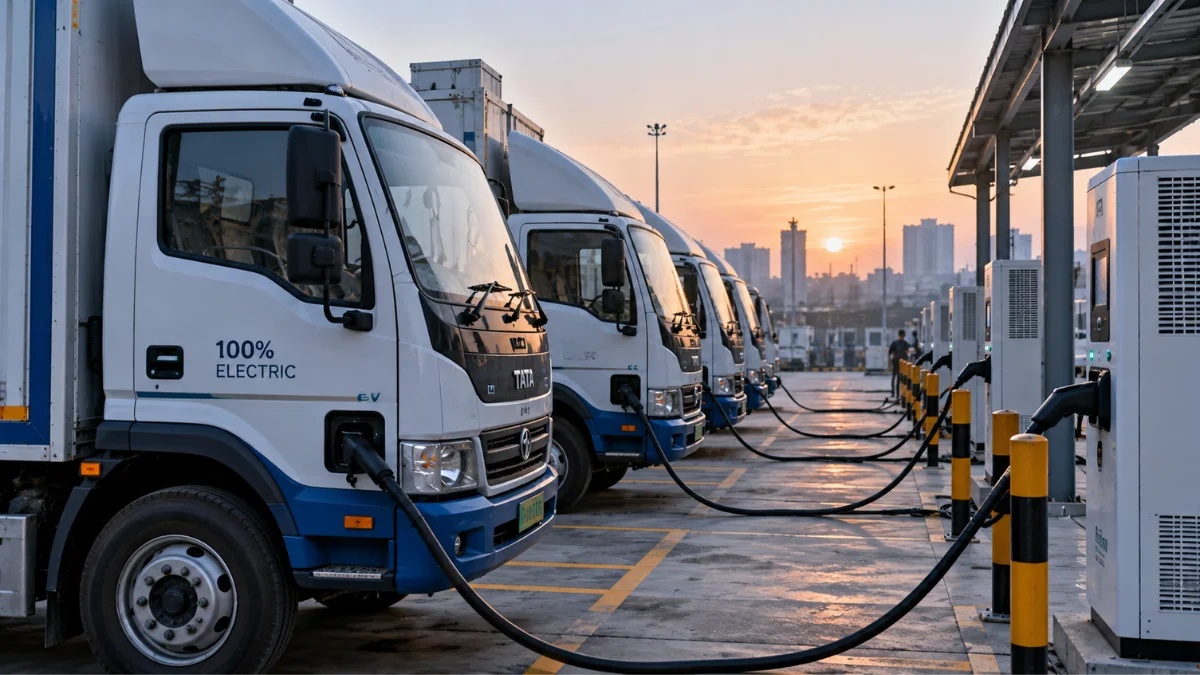
FedEx's Electric Truck Bet Backs a Startup It Already Funds
A $300 million order moves electric delivery trucks from pilot fleets into mainstream procurement, and tests whether the fuel savings case holds at scale.
Two thousand medium-duty electric trucks will enter FedEx pickup and delivery service across the United States and Canada by the end of 2027, under a binding order worth more than $300 million placed with California manufacturer Harbinger. The two companies project about $40 million a year in combined fuel savings once the full fleet is running.
Last-Mile Routes Are Where Electric Truck Economics Close First
Parcel delivery suits batteries better than any other freight segment. Routes are fixed, daily mileage is predictable, and trucks return to the same depot every night to charge. That removes most of the range and charging risk that still holds back long-haul electrification.
The barrier has been upfront price, not running cost. An order of this size signals that a major carrier now sees total cost of ownership favouring electric over diesel, and is willing to commit capital on that basis rather than run another trial.
The Order: 38 Times Larger Than the Last One
FedEx placed its first Harbinger order, for 53 vehicles, in November 2025. The new contract is roughly 38 times that volume. At just over $300 million for 2,000 units, the average works out to about $150,000 per truck (a Climatora calculation from the disclosed totals).
According to the companies, each truck should save around $20,000 a year in fuel compared with a diesel equivalent. Over an assumed 20-year service life, that adds up to roughly $800 million across the fleet. The same lifetime comparison produces the headline emissions figure: 1.7 million tons of CO₂ avoided, or about 850 tons per truck.
Both numbers are projections, not measured results. They depend on the 20-year life assumption, on diesel prices, and on electricity tariffs at FedEx depots, none of which the companies have broken out.
The Buyer Is Also an Investor
The deal carries a commercial subtext that the announcement does not foreground. FedEx co-led Harbinger's $160 million Series C round in November 2025. The order therefore does two jobs at once: it electrifies FedEx's fleet, and it gives a company FedEx partly owns the revenue base it needs to scale manufacturing.
That makes Harbinger the clearest winner. A manufacturer founded in 2021, which builds its chassis and major systems in-house in the U.S., now has a contracted path from dozens of vehicles to thousands. Rival electric van and chassis suppliers competing for parcel-fleet contracts face a harder sell to the second-largest U.S. carrier for the next two years.
The risk sits on the delivery side. Producing 2,000 trucks in roughly 15 months is a large jump for a young manufacturer, and any slippage would push back FedEx's own fleet targets. The company has committed to carbon-neutral operations by 2040 and to converting its entire parcel pickup and delivery fleet to zero-emission vehicles.
Vinay D'Souza, FedEx senior vice president for global assets and infrastructure, framed the order as structural: "electrification is set to play a pivotal role in the future of commercial fleets."
The open question is depot charging. The announcement does not say what FedEx will spend on chargers and grid connections, which can rival the vehicle premium at large sites.
What to Watch
The first test is delivery pace through 2027, and whether FedEx reports measured fuel cost per truck rather than projected savings.
For India, the comparison is direct. The e-truck component of the PM E-DRIVE scheme, notified by the Ministry of Heavy Industries in July 2025, budgets ₹500 crore to support 5,643 electric trucks nationwide, with incentives of up to ₹9.6 lakh per vehicle tied to scrapping an old diesel truck. A single U.S. parcel carrier has just ordered more than a third of that national target. Watch whether Indian e-commerce and logistics fleets claim support in the N2 category (3.5 to 12 tonnes), the class closest to Harbinger's medium-duty trucks, before the scheme's funds run out.
For more climate news click here