Five-Year Transmission Lag Threatens India's 2030 Wind Build-Out
India's wind supply chain can now build turbines faster than the country can build the lines to carry their power.
India must add roughly 44 GW of wind capacity before the end of 2030 to reach its 100 GW target, a pace above 9 GW a year against a record of 6.05 GW. The binding constraint, according to Suzlon co-founder Girish Tanti, is transmission rather than turbine supply.
Official Data Leaves a Gap That "On Track" Glosses Over
Speaking at WindEnergy Hamburg 2026, Tanti said India is broadly on course for 100 GW by 2030, with the industry seeing around 85 GW of capacity before that date. MNRE data put cumulative installed wind at 56.09 GW on March 31, 2026, after a record 6.05 GW addition in FY2025-26. That was 46% above the 4.15 GW added the year before.
The two figures do not fully reconcile. If the 85 GW refers to cumulative capacity, it implies a shortfall of about 15 GW against the target. Meeting the goal requires annual additions more than 50% above a record set only in the last fiscal year (Climatora calculation from MNRE data).
Transmission Takes Five Years; Wind Farms Take Two
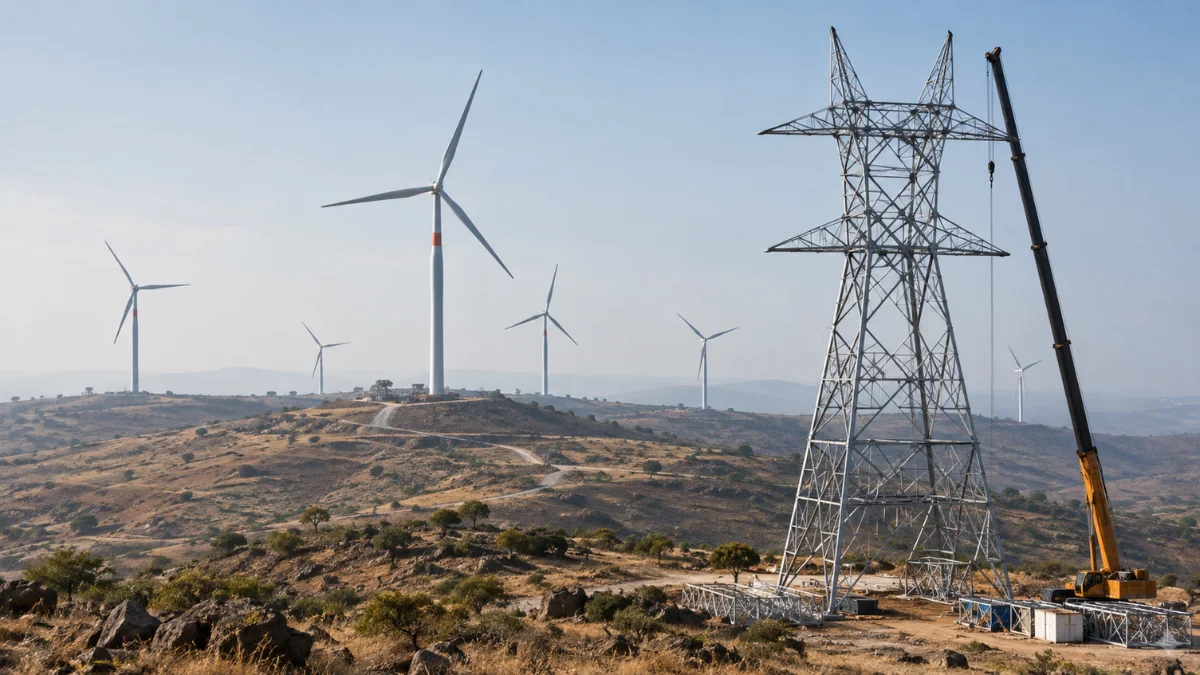
The mismatch Tanti flagged is one of build cycles. A wind or solar project can reach commissioning within two years, while the transmission needed to evacuate its power currently takes about five, he said. Tanti argued grid development must compress to 12 to 18 months.
"We should bridge this gap in the build-up time for development of grid infrastructure," Tanti said. The practical risk is generation that sits idle or curtailed while evacuation lines are completed. Developers bidding today for 2028 and 2029 commissioning dates are effectively betting on corridors that may not yet be sanctioned.
Factory Capacity Now Runs Far Ahead of Installations
Manufacturing has moved faster than deployment. India can produce 24 GW of wind equipment a year across all major components, per Tanti, close to four times the record domestic installation rate. Wind equipment exports reached 4 GW in 2025, and he projects 16 GW by 2040.
Adding FY2025-26 domestic installations to 2025 exports gives utilisation of roughly 10 GW, well under half of stated capacity (Climatora estimate; periods differ slightly). Idle capacity at that scale pressures margins and pushes OEMs toward overseas orders.
Developers Carry Timing Risk; OEMs Hedge Abroad
For turbine makers, including Pune-headquartered Suzlon, exports are becoming a hedge against domestic grid delays. Tanti sized Europe's repowering opportunity at 50 GW and EUR 50 billion, which makes it the obvious target market.
For developers, the exposure is timing: a project finished ahead of its evacuation line earns nothing while it waits. For grid planners at the Central Electricity Authority and the Central Transmission Utility, the pressure is to shorten approval and construction cycles, not only to expand corridor plans.
One question remains open. A turbine manufacturer declaring the target achievable is also making the case for faster public grid spending, and the MNRE numbers support the urgency more than the optimism.
What to Watch
MNRE lists the graded waiver of inter-state transmission charges among its main wind support measures, and that waiver tapers out by June 2028. Projects that miss grid connection before then face a higher cost base, which compresses the window for the current pipeline. The next test is MNRE's FY2026-27 wind addition figure: anything well below 9 GW would push the 100 GW target beyond 2030 on current trajectory.
For more climate news click here