Climate Finance Gap of $1 Trillion Has No Assigned Payer by 2035
A demand for dated fossil-fuel exits lands on the G20 weeks before a US-hosted summit whose agenda omits decarbonisation.
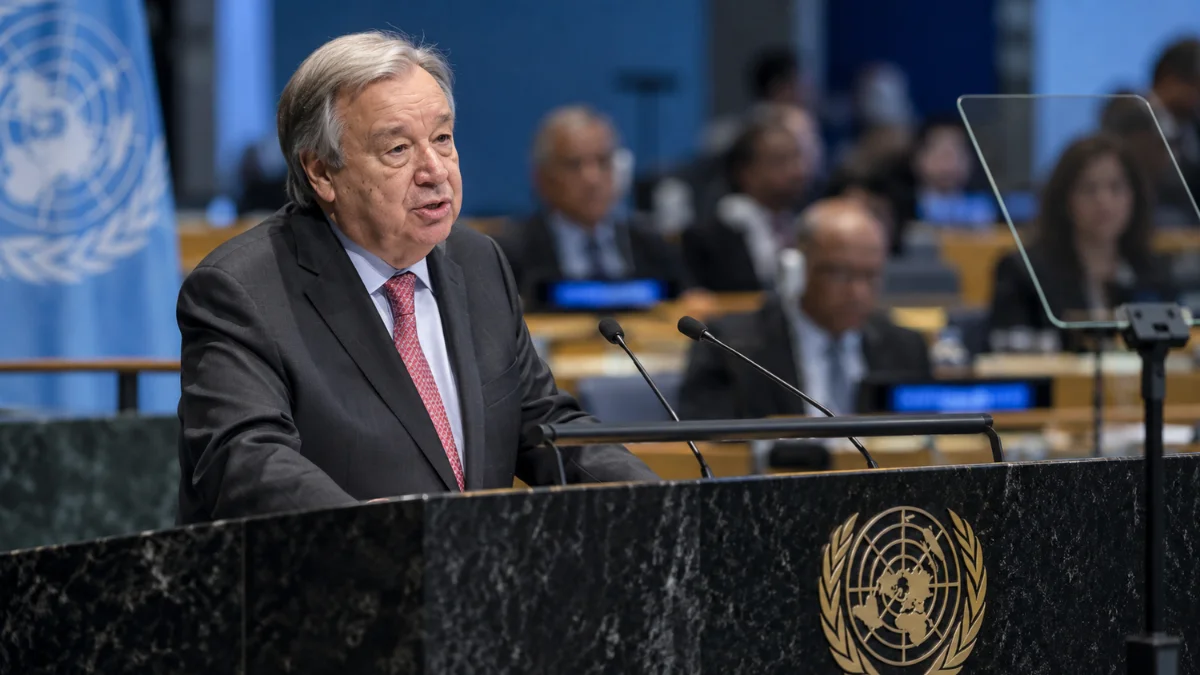
Developing economies now have a price tag and a deadline for the finance they say they need: $1.3 trillion a year by 2035, against a firm commitment of only $300 billion. At the UN Climate Summit in New York on September 23, Secretary-General António Guterres tied that shortfall to the G20, asking its members to publish fossil-fuel exit plans with fixed dates.
G20 Singled Out as the Bloc Behind 80% of Emissions
Guterres, addressing his last high-level week before his term ends on December 31, said the G20 accounts for 80% of global emissions and must lead. He asked every government to submit credible national roadmaps for ending coal, oil and gas use, each carrying a timeline.
The request reopens a fight that stalled at COP30 in Belém, where a push by more than 80 governments for a transition roadmap was blocked from the final decision, pushing the work outside the formal UN process. Two venues will test it before year end. COP31, co-led by Türkiye and Australia, convenes in November. The G20 leaders meet in Miami on December 14 and 15 under a US presidency whose published priorities are deregulation, affordable and secure energy supply, and artificial intelligence. Decarbonisation is absent from that list.
The Finance Figures Are Two Targets, Not One Trajectory
Under the New Collective Quantified Goal (NCQG) adopted at COP29 in Baku in November 2024, developed countries are to take the lead in mobilising at least $300 billion a year for developing countries by 2035. A separate, wider call asks all actors, public and private, to scale flows to $1.3 trillion a year by the same date.
Guterres restated both numbers. The distance between them, roughly $1 trillion annually, has no designated payer. Only the smaller figure carries developed-country responsibility. The larger one depends on private investors, multilateral development banks and domestic budgets, none of which is bound by the Paris Agreement's finance obligations. Absent a burden-sharing formula, the headline target works as an aspiration rather than a claim any party can enforce.
India Is Exposed on Both Sides of the Ledger
India sits in an awkward position. As a G20 member, it falls within the scope of the timeline demand, one New Delhi has resisted since COP26 in Glasgow, where it secured phase-down rather than phase-out wording on unabated coal. As a finance claimant, it led objections to the Baku outcome. Chandni Raina, Adviser in the Department of Economic Affairs, rejected the $300 billion goal at the COP29 plenary as too small and too distant.
If the $1 trillion gap is to be closed largely through private and blended capital, the pressure moves toward instruments India already operates: sovereign green bonds, BRSR disclosures for listed companies, and the Carbon Credit Trading Scheme underpinning the Indian Carbon Market. The question is whether a dated coal exit becomes an informal condition for accessing that capital at a lower cost.
Who Gains and Who Carries the Risk
Dated exit plans turn policy intent into bankable demand. Grid developers, storage suppliers and clean-power manufacturers stand to benefit, as would lenders seeking predictable pipelines. The summit itself launched a Global Grids Accelerator aimed at transmission upgrades in Africa and Southeast Asia.
Coal-reliant economies with young generating fleets carry the most stranded-asset exposure, and fixed dates would crystallise that risk on balance sheets. Guterres framed the choice as generational, describing today's leaders as "the first generation with the tools to end the fossil fuel age." The rhetoric is clear. The allocation of cost is not.
What to Watch
COP31 in November is the first test of whether roadmap language returns to the negotiating text after its failure in Belém. The Miami communiqué in December will show whether the G20 references a fossil-fuel transition at all under a presidency that has not prioritised one. For India, the signal to track is whether multilateral lenders and green-bond investors begin pricing coal timelines into the cost of capital, with or without a formal UNFCCC mandate. The succession at the UN adds a further variable: a new Secretary-General takes office in January, and whether fossil-fuel exit remains central to the office's agenda is not yet settled.
For more climate news click here