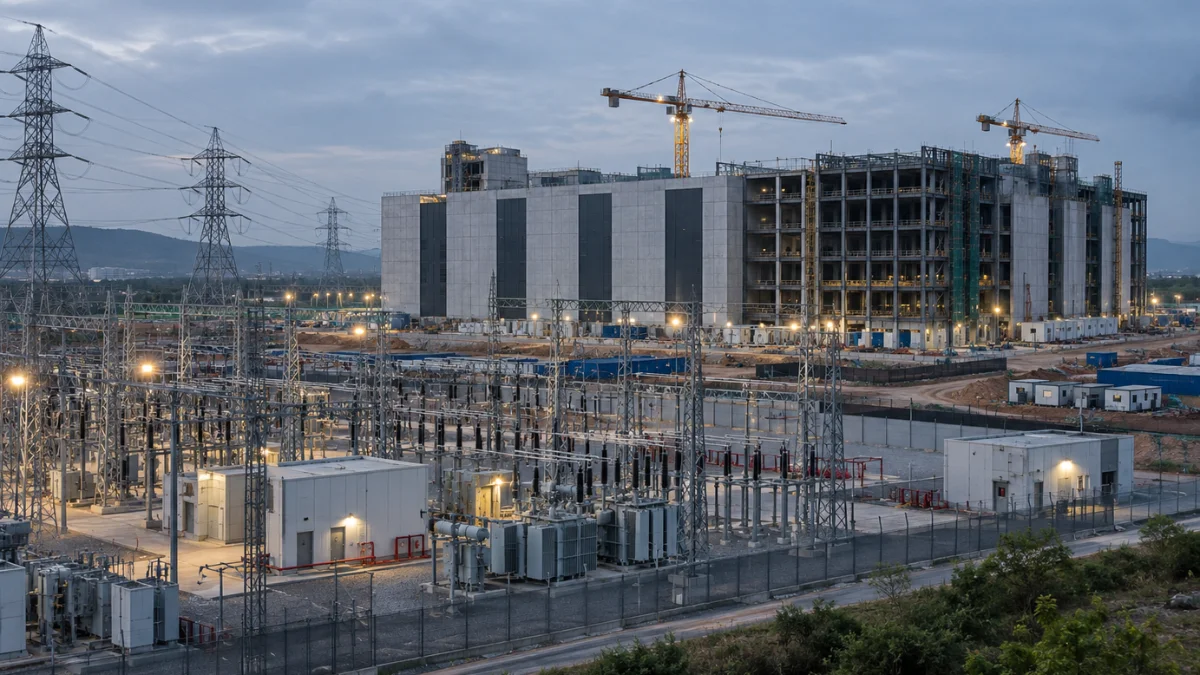
Howden: India Data Centre Capacity Grew 68-Fold Since 2016
As data centres multiply across Maharashtra, Telangana and Karnataka, India's power grid, water systems and cyber defenses face a stress test few operators have priced in.
India's data centre power consumption grew 68-fold between 2016 and 2025, according to new research from insurance broker Howden, a compounding rate of roughly 60% a year. That growth is now colliding with three infrastructure constraints at once: grid capacity, water availability and the shared-tenancy cyber exposure built into how these facilities are run.
The scale of the buildout explains the urgency. India added 7 million square feet of data centre capacity in 2025 alone, with construction volumes compounding at 37% a year since 2016. Average facility size has grown from 59,000 square feet in 2016 to 276,000 square feet in 2025, and the expansion planned for 2026 to 2030 equals 78% of the capacity that already exists. Maharashtra, Telangana and Karnataka together hold roughly 70% of that footprint, concentrating the risk in a handful of state grids and watersheds rather than spreading it nationally.
Grid Capacity Growth Has Not Kept Pace With 37% Annual Construction
Energy accounts for about 65% of a data centre's operating cost, and Howden identifies reliable grid connectivity and substation capacity as the sharpest constraint facing new projects. More than 90% of Indian facilities already carry redundant UPS, generator and cooling systems as a hedge against outages, a buildout of backup capacity that itself signals how little operators trust grid reliability to hold as demand scales toward a projected 57 terawatt-hours by 2030.
Shared Colocation Ownership Concentrates Cyber Risk Across Tenants
Wholesale and retail providers operate 86% of India's data centres, meaning most facilities host multiple tenant organizations on shared infrastructure. Howden's research flags this as a structural cyber exposure: a single compromise can affect hundreds of thousands of tenant organizations at once, and the interconnection between tenants raises the risk of lateral movement once an attacker is inside.
Cooling Load Adds Pressure in Already Water-Stressed Cities
Cooling a single 1-megawatt facility requires about 25.5 million litres of water a year, and much of India's data centre capacity sits in urban centres already under water stress. As facility sizes nearly quintuple and total footprint grows, that per-facility water draw compounds across a state's grid of properties rather than staying contained to one site.
The three risks do not sit in separate silos. A grid-driven outage forces reliance on diesel generators, which raises both emissions exposure and insurance cost. A cyber incident at a shared colocation site creates liability that spans every tenant on the floor, not just the one initially targeted. Water stress narrows where new capacity can be sited at all, pushing developers toward fewer, larger sites in the same three states that already hold 70% of national capacity. For insurers and lenders underwriting this buildout, the signal is that risk assessment has to move from single-facility to portfolio-level, across power, cyber and water simultaneously.
"These risks need to be identified early and managed together," said Amit Agarwal, chief executive of Howden India.
What to Watch
Watch how Maharashtra, Telangana and Karnataka handle data centre-specific power procurement and dedicated feeder approvals as the 2026-2030 expansion pipeline comes online, and whether state electricity regulators introduce differentiated tariff or connectivity frameworks for the sector. Also watch whether any state moves to condition new data centre water access on independent cooling audits, given how concentrated both capacity and water stress already are in the same three states.
For more climate news click here