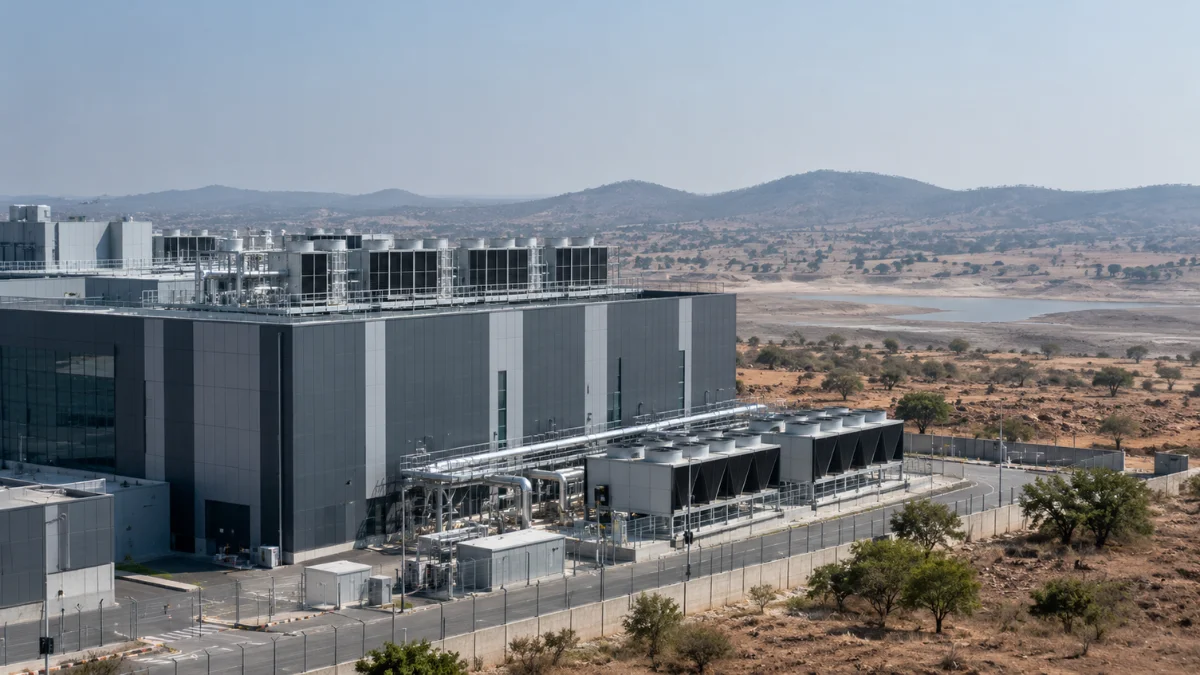
Data Centres Adopt Air Cooling to Curb India's 358-Billion-Litre Water Demand
As India's data centre capacity races toward 17 GW by 2032, operators are betting that air cooling can defuse a resource conflict already visible in cities like Visakhapatnam.
India's data centres are projected to consume 358 billion litres of water annually by 2030, more than double the 150 billion litres used in 2025, according to Uptime Institute estimates. The country holds 18% of the world's population but only 4% of its freshwater resources, per World Bank figures, a mismatch that is now colliding with a sector expected to grow more than tenfold in power demand over the next six years.
Capacity Is Concentrating Where Water Already Runs Short
Seventy percent of India's data centre capacity sits in Bengaluru, Mumbai, and Chennai, three cities with their own histories of water rationing. The newer wave of hyperscale investment is spreading the strain further: Amazon's 53-acre facility spanning Balkum and Majiwada in Thane, and the Adani-Google joint venture's 1 GW, roughly 600-acre campus in Visakhapatnam, are among the largest single sites under construction. Visakhapatnam's own utility already supplies 400 million litres daily against 480 million litres of demand, a deficit the Andhra Pradesh government has flagged independent of any data centre load.
Air Cooling Is Displacing Water-Intensive Systems
Cooling typically accounts for 30-40% of a data centre's total energy draw, and traditional evaporative cooling towers convert a large share of that into water loss. Yotta Data Services, CtrlS, Equinix, OVHcloud, Google, and Amazon have each pointed to air-cooled chiller systems as their default in India rather than water-cooled alternatives. OVHcloud's direct-to-server liquid loop, which recirculates in a closed system rather than evaporating, allows roughly twice the server density of conventional layouts, according to the company. Google says its Visakhapatnam campus will run on air cooling and green power, with water use it compares to that of a corporate office.
So What: A Policy Vacuum Meets a Capital Boom
The shift favors hyperscalers who can absorb the capital cost of air-cooled or liquid-loop infrastructure, while smaller regional operators and the municipalities hosting them carry the reputational and resource risk if claims do not hold at peak summer load. The National Data Centre Policy 2025, still under consultation, has not yet settled whether water-use disclosure will be mandatory; Maharashtra is weighing a parallel state policy. Grid investment to support the sector's growth could reach 0.4-0.9% of GDP over the next decade, per Moody's, a scale that raises the stakes on getting the water question resolved in the same policy cycle rather than after the fact.
"Indian data centres use air-cooled chillers, not water-cooled ones," said Sunil Gupta, CEO of Yotta Data Services.
What to Watch
Whether the National Data Centre Policy 2025, once finalised, mandates water-use disclosure and independent verification rather than relying on operator self-reporting will determine if air cooling's water savings are auditable at scale. Also watch Visakhapatnam, where the Adani-Google facility's actual water draw at full 1 GW load will be the first real test of whether "office-like" usage claims survive summer peak demand.
For more climate news click here