Voltage Fix Could Move Cobalt-Free LMR Batteries Toward Commercial EVs
A voltage-control fix from LG Energy Solution and Seoul National University could unlock cobalt-free lithium manganese-rich batteries for large-format electric vehicle cells, addressing a stability flaw that has kept the chemistry out of commercial EVs.
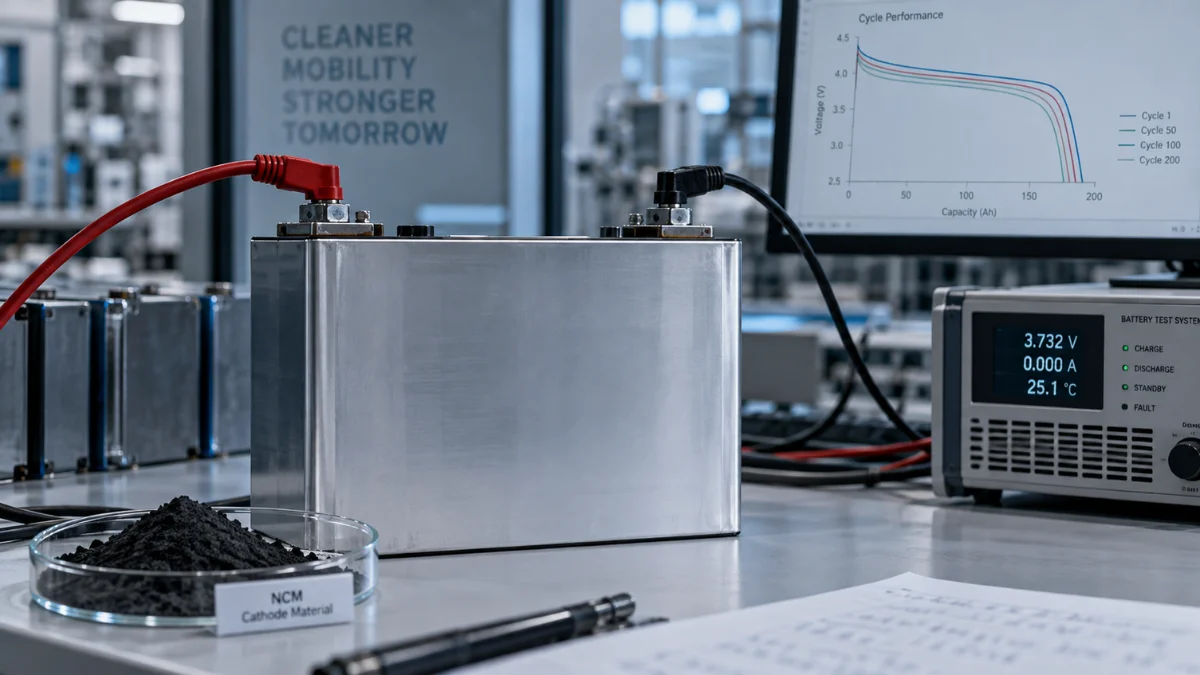
Large-format lithium manganese-rich (LMR) battery cells retained 92.2% of their initial energy after 883 charge-discharge cycles, LG Energy Solution and Seoul National University reported, after identifying a voltage protocol that curbs the gas generation that has long undermined the chemistry's stability.
LMR cathodes substitute manganese for cobalt, cutting material costs while promising higher energy density than conventional nickel-cobalt-manganese (NCM) chemistries. In earlier designs, oxygen released from the cathode during charging failed to fully reverse on discharge, causing structural damage and gas buildup. That flaw is magnified in the space-constrained large-format cells EV packs require.
The defect has confined LMR mostly to small-format, lab-scale cells despite years of industry interest in a cobalt-free alternative to NCM. The joint study, published in Nature Communications, is the first to show the chemistry holding up at production-relevant scale.
Voltage Window Determines Oxygen Reversibility
The research team, led by Professor Jongwoo Lim at SNU, found that oxygen recovery depends on both the upper charging voltage and the discharge cutoff voltage, not cathode composition alone. Lowering the upper charge voltage from 4.6V to 4.3V raised oxidized-oxygen reduction from 86% to 97%. Dropping the discharge cutoff from 3.0V to 2.0V pushed oxygen recovery close to complete, sharply cutting the gas generation responsible for cell swelling and capacity fade.
LG Applied the Findings to 40Ah Production-Scale Cells
LG Energy Solution translated those lab findings into operating voltage ranges and a lower-temperature formation process for 40Ah-class cells, the format used in EV packs rather than coin cells. The resulting cells retained 92.2% of initial energy after 883 cycles, the first demonstration of that stability level in large-format LMR hardware. "Cell stability can be improved through electrochemical protocol design alone," said Professor Jongwoo Lim of Seoul National University.
Cost Pressure Makes Cobalt-Free Chemistry a Competitive Question
LMR's appeal rests on removing cobalt, a material automakers have flagged for years over price volatility and sourcing scrutiny. A commercially viable large-format LMR cell would let LG compete more directly with lithium iron phosphate (LFP) suppliers on cost while claiming an energy-density advantage LFP lacks. The unresolved question is pace: 883 cycles is well short of the multi-thousand-cycle life EV makers require, and LG has not disclosed how it plans to close that gap.
India's Cell Manufacturers Face a Chemistry Decision
The finding lands as India's Advanced Chemistry Cell Production Linked Incentive scheme pushes domestic gigafactories to lock in a cathode chemistry for the next decade of capacity. Most sanctioned ACC-PLI lines, including those tied to Ola Electric and Reliance, have committed to NCM or LFP production. A cheaper, cobalt-free chemistry with LFP-beating energy density would give Indian cell makers a reason to revisit those commitments, but only once LMR clears far longer cycle-life thresholds than the 883 cycles demonstrated here.
What to Watch
LG has not named an EV program or a commercialization date for large-format LMR cells. The disclosure to track next is cycle-life data beyond 883 cycles, the threshold at which the chemistry would need to match NCM and LFP cells already qualified for production vehicles, including those now being localized under India's ACC-PLI scheme.
Write a message…
For more climate news click here