Europe Warmed 0.5C a Decade Since 1991, Fastest Globally
This year's European heat records are not an anomaly sitting on top of normal variability. They are the visible edge of a warming rate the region's own climate monitors have been tracking for three decades.
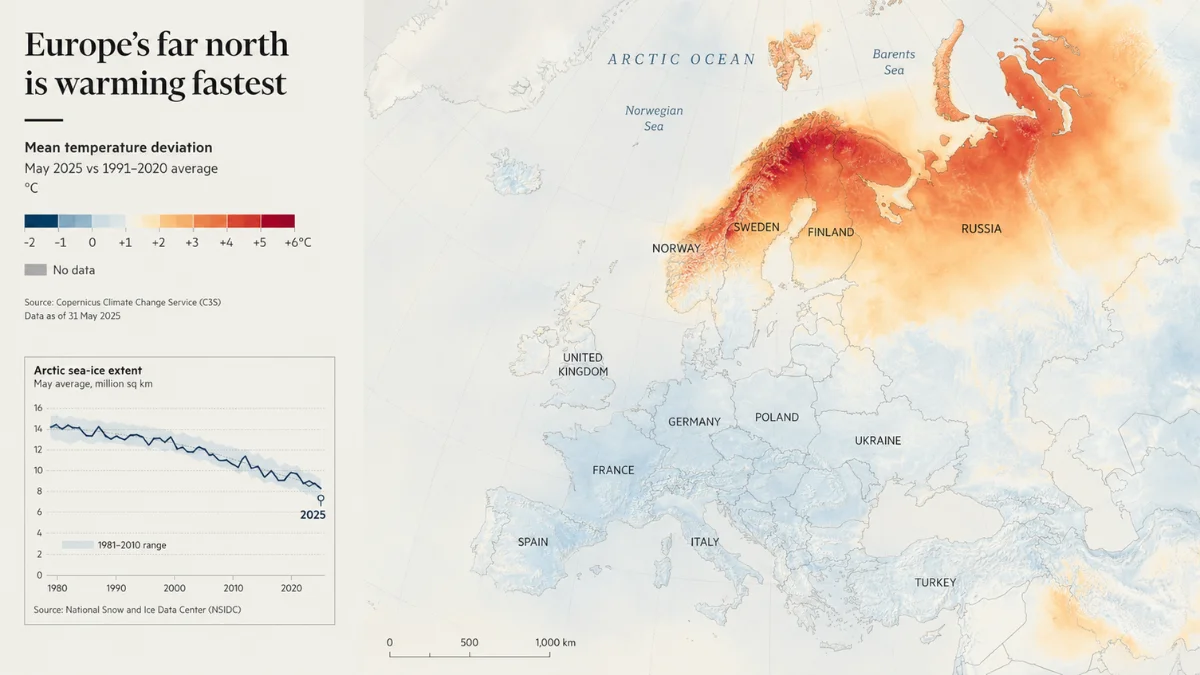
Paris recorded its highest 2026 temperature at 40.9C, with Madrid reaching 39.5C, Brussels 35.3C, London 35.1C and Bern 35.0C. Spain posted the highest national July average among major European economies at 34.1C, 6.5C above normal, while France's July average of 32.9C ran a full 10.1C above normal. Those figures sit on top of a longer trend: Europe has warmed by roughly 0.5C per decade between 1991 and 2021, close to twice the global average, making it the fastest-warming continent on record, according to the World Meteorological Organization and the Copernicus Climate Change Service.
Europe Is an Outlier Even Among Warming Continents
WMO regional assessments, which use somewhat different geographic boundaries and measurement windows by continent, still show a consistent pattern: Asia has warmed at roughly 0.4C per decade from 1991 to 2024, Africa at about 0.3C per decade from 1991 to 2023, and South America and the Central America and Caribbean region at roughly 0.26C and 0.25C per decade respectively over 1991 to 2025. The global figure, combining land and ocean since 1982, sits at about 0.2C per decade. Oceans absorb heat but warm more slowly at the surface, which explains part of the gap between Europe's land-based figure and the global blended number, though WMO researchers note the land-ocean split alone does not account for how far ahead of the pack Europe sits.
Three Physical Mechanisms Are Doing the Work
Northern Europe's proximity to the Arctic matters most. As sea ice retreats, the region loses a reflective surface and exposes darker ocean water that absorbs more solar energy, a feedback known as Arctic amplification that is most pronounced across Scandinavia and northern Russia. A parallel mechanism operates on land: earlier snowmelt exposes darker soil and vegetation for longer, and once soils dry out in the Mediterranean and continental Europe, incoming solar energy heats the air directly instead of evaporating moisture. A third factor cuts the other way in terms of intent but not effect: decades of successful sulphur dioxide and pollutant controls across industrialised Europe reduced the aerosols that once scattered sunlight and boosted cloud reflectivity, unmasking greenhouse warming that had been partly hidden.
Atmospheric Circulation Can Turn a Warm Spell Into a Record
A 2022 study in Nature Communications linked the rising intensity and frequency of Western European heatwaves to more persistent "double-jet" conditions, in which the jet stream splits into two branches and allows a slow-moving high-pressure zone to trap heat between them. A separate 2020 study found a connection between declining Arctic sea ice, reduced Eurasian snow cover and increased European heatwave frequency, though researchers remain uncertain how much of the trend toward more frequent double-jet patterns is directly attributable to human-caused warming rather than natural atmospheric variability.
So What
The aerosol finding creates a genuine policy tension rather than a simple villain-and-victim story: reducing sulphur dioxide pollution delivered substantial public health benefits and remains the right call, even though it removed a cooling effect that had been masking underlying greenhouse warming. Reinstating pollution to slow warming is not a viable option on health grounds, which leaves adaptation, not aerosol policy, as the near-term lever available to European governments and insurers pricing heat-related risk. For countries and companies benchmarking against Europe's climate targets and disclosure timelines, a warming rate running at twice the global average also means European heat-exposure planning, from grid demand to crop yields, needs a shorter runway than global-average assumptions would suggest.
What to Watch
Watch WMO's and Copernicus's provisional 2026 confirmation of these city and country temperature records later this year, and watch whether double-jet stream patterns recur through the remainder of the 2026 European summer, the atmospheric signature researchers now associate with the most severe and prolonged heatwaves.
For more climate news click here