Poor Planning Cost Green India Mission Rs 10,600 Crore in Funding
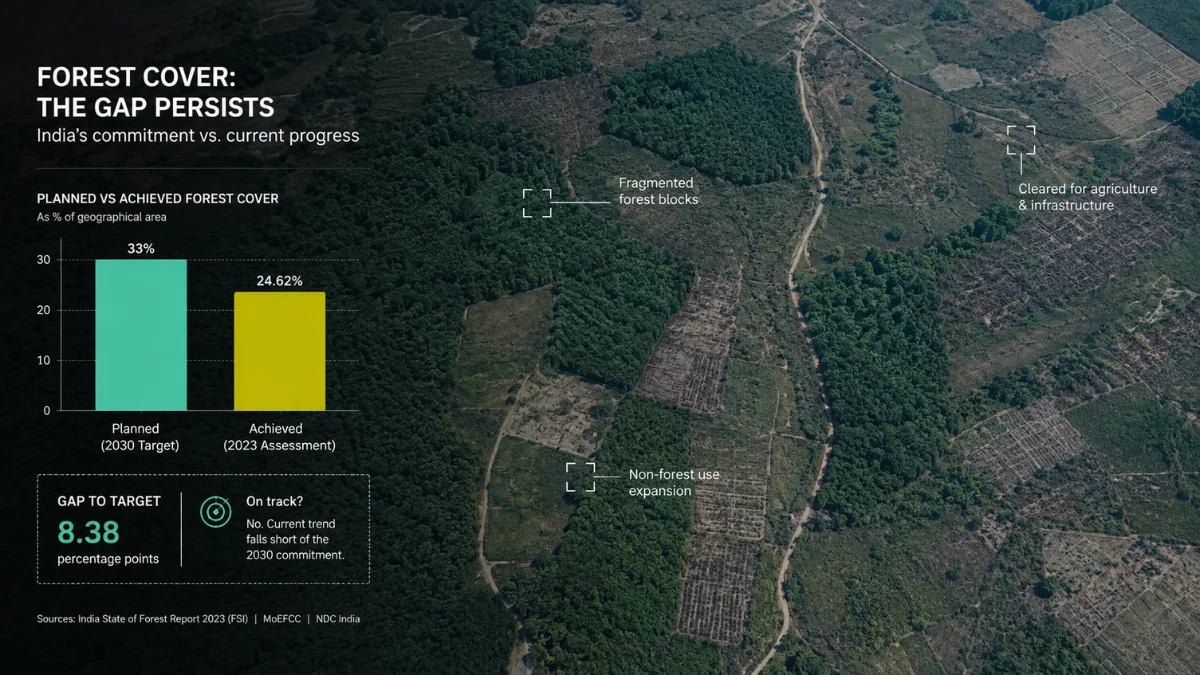
A decade-long flagship afforestation scheme has produced an audit trail that undercuts the forest-carbon numbers India has been building its NDC case around.
The Comptroller and Auditor General has found that the Green India Mission increased forest cover by just 0.034 million hectares against a ten-year target of 1.4 million hectares, a shortfall of 97.57%. The report, tabled in Parliament on August 13, examined implementation across 16 states and union territories between the 2015-16 and 2024-25 financial years.
A Second Metric Fails Almost as Badly**
Forest cover quality, a separate CAG measure tracking density and ecological improvement rather than raw area, showed gains of just 0.1 million hectares against the same 1.4 million hectare target, a 91.8% shortfall. The audit attributes both failures to poor financial planning, weak coordination with parallel schemes, and inadequate monitoring rather than to any single external constraint like land availability.
The Funding Gap Behind the Numbers
The Cabinet Committee on Economic Affairs approved Rs 2,000 crore for the mission's first four years under the 12th Plan, with a further Rs 400 crore earmarked from 13th Finance Commission grants for state contributions, a combined Rs 2,400 crore base. Over the full ten-year implementation period, the mission received only Rs 1,149.14 crore, 47.88% of what was approved. Separately, CAG found that the mission's failure to align with other afforestation programmes, including CAMPA, the MGNREGS rural jobs scheme, Nagar Van Yojana and School Nursery Yojana, cost it access to Rs 10,600 crore in funding support that convergence with those schemes could have unlocked.
Data Quality Problems Compound the Shortfall
Eight states and union territories did not maintain annual accounts at all; where accounts existed, they were frequently unaudited or inconsistent with subsidiary records. GIS analysis of sampled project sites found no measurable change attributable to the mission at 70% of locations, while CAG separately flagged inflated data and overstated achievement claims tied to non-validated KML geographic files. Only Madhya Pradesh and Chhattisgarh carried out any carbon sequestration assessment across the full 2015-2025 period, meaning most states cannot say what carbon benefit, if any, their afforestation spending produced.
So What
The site-selection finding carries its own climate-adaptation implication: CAG found that project areas were frequently chosen in landscapes with low to moderate climate vulnerability rather than the higher-vulnerability areas the mission's own criteria prioritised, meaning the mission may have missed not just its area target but its intended risk-reduction purpose. For India's broader climate accounting, the absence of verified carbon sequestration data across all but two states leaves a hole in any forest-carbon contribution claimed toward the country's NDC commitments. The mission's data problems also raise a harder question for auditors and Parliament: if 70% of sampled sites show no measurable change, how much of the reported national forest-cover gain from other, non-audited components of India's forest strategy deserves the same scrutiny.
What to Watch
Watch for the Environment Ministry's formal response to the CAG report in Parliament, and whether the Standing Committee or Public Accounts Committee mandates a convergence framework with CAMPA and MGNREGS before the mission's next funding cycle is approved.
For more climate news click here