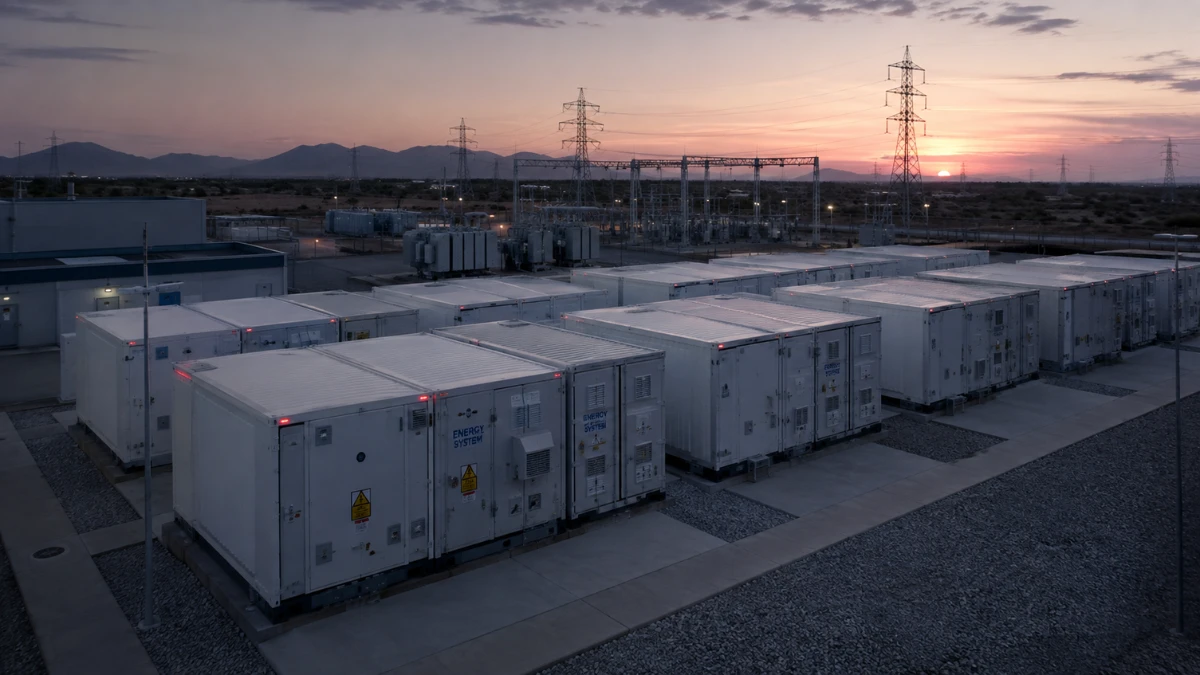
Serentica's Bikaner Battery Anchors a Time-Block RTC Power Deal
A Vedanta-backed renewable developer has put utility-scale batteries behind one of the first contracts promising Indian factories genuinely round-the-clock clean power, a structure buyers have wanted without much to point to yet.
Serentica Renewables has commissioned the first 200 MWh phase of a planned 1 GWh battery storage project in Bikaner, Rajasthan, its first entry into utility-scale storage and the backbone of what the company describes as one of the world's first time-block round-the-clock renewable power arrangements for industrial buyers.
Industrial buyers sourcing power on open access face a persistent mismatch: solar and wind generate on their own schedule, not the buyer's, and matching the two without fossil backup has mostly stayed theoretical. A time-block round-the-clock structure commits a set volume of renewable power to specific hours of the day, which only works if a battery sits between the generation and the contract.
The Bikaner project is built to be that bridge. It stores surplus daytime solar and wind output and discharges it during peak demand and night hours, letting Serentica back its round-the-clock commitment with dispatchable capacity rather than a generation forecast.
Phase 1 Delivers 200 MWh Toward a Planned 1 GWh System
The commissioned phase uses a modular battery architecture designed for operational flexibility, scalability and rapid response, which the company says also supports broader grid stability as more renewable capacity comes online. The full Bikaner system is planned at 1 GWh, meaning the commissioned phase represents a fifth of the eventual target.
Storage Entry Follows a Broader FDRE and Financing Push
Serentica has said it plans to build a 7 GWh battery storage pipeline over the next two years, extending work it began in June 2024 when it sought global expressions of interest for 800 MWh of standalone storage under long-term service agreements starting in 2026. The Bikaner commissioning follows a run of related deals: a power purchase agreement with NTPC for 200 MW of firm and dispatchable renewable energy to Uttar Pradesh discoms, a 600 MW/2,400 MWh PPA with the Solar Energy Corporation of India under its FDRE VII tender, and a $345.1 million debt package led by the Asian Development Bank in July 2026 to finance a solar-wind hybrid project in Koppal, Karnataka.
Storage-Backed Contracts Could Reset What "Round-the-Clock" Means for Industrial Buyers
Industrial buyers seeking genuine 24/7 clean power without captive fossil backup are the direct beneficiaries if this model holds, and it separates Serentica from developers still selling generation alone. The unresolved question is scale: 200 MWh is a fraction of the 1 GWh Serentica has committed to at this single site, and whether that capacity can sustain a round-the-clock commitment today or is functioning as proof of concept ahead of the remaining 800 MWh is not yet demonstrated.
What to Watch
Watch the pace of the remaining 800 MWh buildout toward the 1 GWh Bikaner target, and whether Serentica's 7 GWh two-year storage pipeline draws project debt on terms similar to the Koppal financing, given that standalone storage assets carry a different risk profile than paired generation-and-storage projects.
For more climate news click here