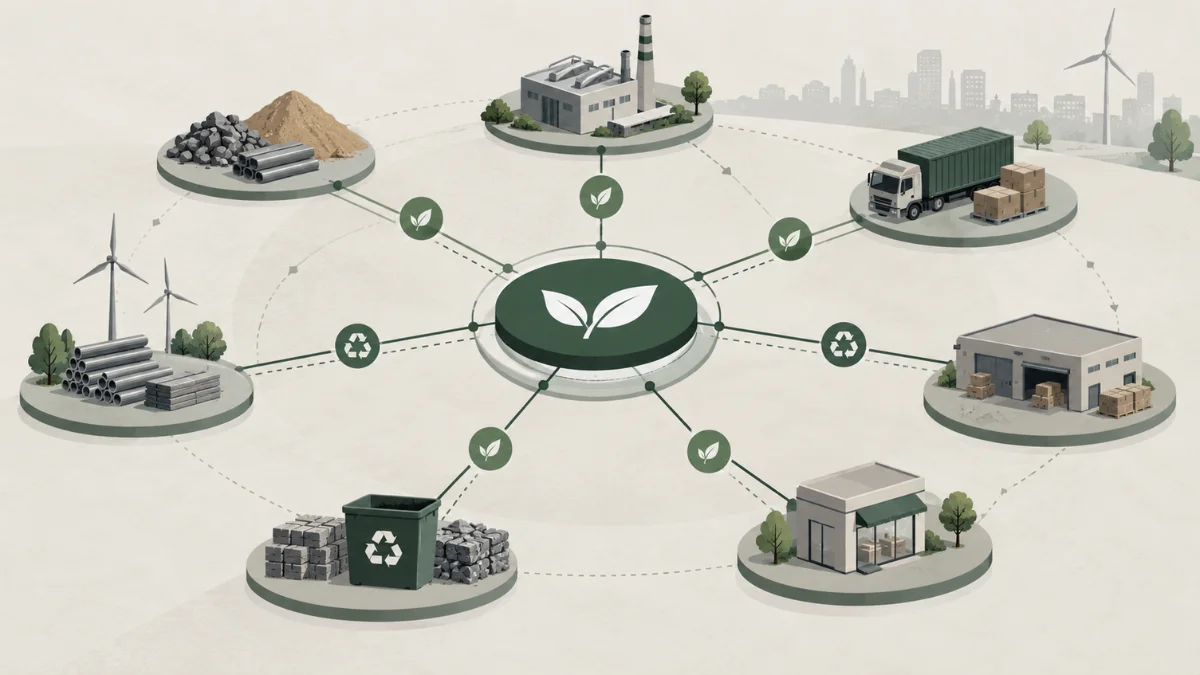
Sustainability is no longer stopping at the factory gate. Leading businesses are taking it deep into their value chains.
A company can install solar panels across its facilities.
It can reduce office waste.
It can switch to electric vehicles.
It can publish a net-zero target.
And yet, a significant part of its environmental footprint may still sit outside its own four walls.
It may be embedded in the raw materials it purchases, the products manufactured by suppliers, the logistics providers moving those products, the packaging used across the value chain, or the way products are eventually used and disposed of.
This is the challenge of Scope 3 emissions and value-chain sustainability.
The GHG Protocol notes that Scope 3 can often represent the largest share of a company’s emissions and can include emissions from purchased goods and services, transportation, product use and other upstream and downstream activities. It also identifies supplier and value-chain engagement as a key opportunity for companies seeking to reduce these emissions.
For businesses, therefore, the sustainability question is changing.
It is no longer simply:
“How green are our operations?”
It is becoming:
“How sustainable is the ecosystem that enables our business?”
This is why leading principal companies—the businesses that anchor large networks of suppliers, manufacturers, distributors, contractors and other partners—are increasingly looking beyond their own operations.
And they are doing it in five important ways.
1. They Are Moving From Supplier Questionnaires to Supplier Sustainability Assessments
The traditional approach to supplier sustainability was often straightforward:
Send a questionnaire.
Ask whether the supplier has an environmental policy.
Collect a few certificates.
File the responses.
Move on.
That model is rapidly becoming insufficient.
Principals are increasingly looking at their suppliers as partners in achieving sustainability outcomes, rather than simply entities that need to complete compliance forms.
The questions are becoming more specific:
- What is the supplier’s carbon footprint?
- How much energy does it consume?
- What percentage comes from renewable sources?
- How much water does it use?
- How is wastewater managed?
- What happens to its waste?
- Does it monitor hazardous materials?
- How sustainable are its raw materials?
- Does it have climate or ESG targets?
- Does it measure Scope 1 and Scope 2 emissions?
- Can it provide reliable data for the principal’s Scope 3 reporting?
The shift is significant.
From “Do you have an ESG policy?”
to
“Show us your ESG performance.”
And eventually:
“Let’s improve that performance together.”
Why this matters
A supplier assessment allows the principal to identify:
Who is already performing well?
Who needs support?
Where are the biggest environmental hotspots?
Which suppliers should be prioritised?
This is much more useful than treating every supplier identically.
The GHG Protocol specifically recommends identifying relevant suppliers and prioritising primary supplier data where appropriate, while recognising that secondary data may be necessary when supplier-specific data is unavailable.
The future of supplier sustainability is therefore likely to be risk-based, data-driven and prioritised.
2. They Are Bringing Scope 3 Into the Supply Chain Conversation
For years, sustainability discussions inside companies largely focused on:
Scope 1: What happens directly within the company’s operations.
Scope 2: What happens through purchased energy.
But increasingly, the difficult question is:
What happens before the product reaches us—and after it leaves us?
That is where Scope 3 enters.
For many businesses, purchased goods and services can be a major source of emissions.
Consider a consumer brand.
Its direct offices may have a relatively small carbon footprint.
But the emissions associated with:
- raw materials,
- manufacturing,
- packaging,
- transportation,
- distribution,
- product use,
- product disposal
could be substantially larger.
The GHG Protocol’s Scope 3 framework covers 15 categories of upstream and downstream value-chain emissions and is designed to help companies identify where their greatest reduction opportunities lie.
This is changing how principals interact with suppliers.
Instead of asking only:
“Can you deliver this product at this price?”
the conversation increasingly includes:
“What is the environmental impact of producing this product?”
That can influence supplier selection, procurement decisions, product design and long-term partnerships.
The important shift
Supplier data is becoming corporate sustainability data.
A principal cannot credibly manage its Scope 3 footprint if it has no meaningful visibility into the environmental performance of its value chain.
3. They Are Helping Suppliers Build Sustainability Capability—Not Just Demanding Data
Here is where many value-chain sustainability programmes can go wrong.
A large company asks hundreds or thousands of smaller suppliers to submit:
- carbon data,
- energy data,
- water data,
- waste data,
- ESG information,
- sustainability targets.
But many smaller suppliers may not have:
- dedicated sustainability teams,
- trained personnel,
- sophisticated software,
- GHG accounting expertise,
- ESG reporting systems,
- resources to interpret complex questionnaires.
The result?
The principal gets frustrated.
The supplier gets overwhelmed.
The data remains weak.
This is why leading value-chain programmes are increasingly moving from supplier compliance to supplier capability building.
That can include:
- ESG training,
- GHG accounting workshops,
- sustainability toolkits,
- standardised templates,
- digital data-collection platforms,
- technical guidance,
- energy-efficiency support,
- waste-management guidance,
- renewable-energy transition support,
- peer-learning programmes.
The GHG Protocol itself recognises challenges such as large supplier numbers, limited supplier data and data-quality concerns, and recommends approaches such as automated data collection, coordinated requests and capacity-building with suppliers.
This leads to an important principle:
You cannot expect a value chain to report what it has never been taught to measure.
If principals want better sustainability data, they need to help build the capabilities required to generate it.
4. They Are Making Sustainability Part of Procurement Decisions
This could be one of the biggest changes taking place inside supply chains.
Traditionally, procurement has largely been driven by:
Cost + Quality + Delivery
Increasingly, another variable is entering the equation:
Sustainability.
This can change supplier evaluation.
Imagine two suppliers offering similar products at comparable prices.
Supplier A:
- has no emissions data,
- relies heavily on fossil fuels,
- has weak waste management,
- has no sustainability targets.
Supplier B:
- measures its emissions,
- uses renewable electricity,
- tracks water,
- has resource-efficiency initiatives,
- can provide verified sustainability data.
If sustainability becomes part of procurement scoring, Supplier B may have a strategic advantage.
This does not mean every supplier needs to become perfect before doing business.
It means sustainability performance can increasingly become one of the criteria by which supplier relationships are managed.
That can lead to:
- ESG-weighted supplier scorecards,
- sustainability clauses in contracts,
- minimum environmental standards,
- supplier improvement plans,
- preferred-supplier programmes,
- sustainability-linked procurement targets.
And that creates an important market signal.
When principals reward sustainable suppliers, sustainability stops being a CSR exercise and becomes a business advantage.
5. They Are Moving From “Greening Suppliers” to Building a Shared Sustainability Roadmap
The most mature approach goes beyond assessment, reporting and procurement.
It asks:
What can the principal and its value-chain partners achieve together?
This is where value-chain sustainability becomes genuinely transformational.
Imagine a principal with 500 suppliers.
Instead of simply asking each supplier to submit an annual ESG questionnaire, the company could establish a structured programme:
Step 1 — Baseline
Understand the current sustainability maturity of suppliers.
Step 2 — Measure
Collect priority data on emissions, energy, water, waste and other material indicators.
Step 3 — Prioritise
Identify the suppliers and activities responsible for the greatest impacts.
Step 4 — Build capability
Provide training, tools and technical assistance.
Step 5 — Set targets
Develop realistic supplier-level improvement targets.
Step 6 — Implement
Support energy efficiency, renewable energy, water reduction, waste management and other interventions.
Step 7 — Track
Measure progress over time.
Step 8 — Recognise
Reward suppliers that demonstrate meaningful improvement.
This creates something much more powerful than a supplier compliance programme.
It creates a supplier sustainability ecosystem.
The Next Frontier: From Supplier Data to Supplier Transformation
There is an important distinction between the two.
Supplier reporting asks:
“Can you give me your sustainability data?”
Supplier transformation asks:
“What can we do to improve your sustainability performance?”
The first creates information.
The second creates impact.
Both are necessary.
But ultimately, a principal’s sustainability programme should not be judged by how many suppliers completed a questionnaire.
It should be judged by questions such as:
- How much energy was saved?
- How much carbon was reduced?
- How much water was conserved?
- How much waste was diverted?
- How many suppliers improved their ESG maturity?
- How much renewable energy was adopted?
- How much environmental risk was reduced?
- How much better is the value chain compared with its baseline?
That is the difference between reporting sustainability and creating sustainability.
Why This Matters Particularly in India
India’s supply chains are incredibly diverse.
A large principal may work with:
- multinational suppliers,
- large domestic manufacturers,
- MSMEs,
- family-owned businesses,
- contractors,
- farmers,
- logistics providers,
- informal or semi-formal enterprises.
Their sustainability maturity can vary dramatically.
One supplier may have a dedicated ESG team.
Another may not even have calculated its electricity-related emissions.
That creates a significant challenge—but also a significant opportunity.
India’s regulatory direction is also making value-chain sustainability increasingly relevant.
SEBI’s framework for the country’s largest listed entities introduced value-chain ESG disclosure provisions on a comply-or-explain basis, with the framework covering the top 250 listed entities by market capitalisation.
The implication is important:
A principal’s sustainability performance increasingly depends on the quality of information and action coming from its value chain.
And that means the sustainability conversation will increasingly move downstream—from corporate headquarters to the suppliers that actually make, move, process and support the products and services being sold.
The MSME Question: Who Pays for the Transition?
This is where responsible value-chain greening becomes particularly important.
Large companies cannot simply transfer every sustainability requirement to smaller suppliers.
If a principal wants a supplier to:
- measure emissions,
- install energy-efficient equipment,
- switch to renewable energy,
- improve waste systems,
- obtain certifications,
- collect ESG data,
there may be significant costs involved.
A mature programme therefore needs to consider:
Who provides the training?
Who provides the tools?
Who funds the intervention?
Who shares the efficiency savings?
What happens to suppliers that are willing but not yet capable?
This is especially important for MSMEs.
The objective should not be:
“Comply or lose the contract.”
A better model is:
“Measure, improve, demonstrate progress and grow with us.”
That approach can create a more inclusive transition.
The New Supplier Scorecard
The traditional supplier scorecard might have looked something like:
Parameter Weight
Cost. High
Qualit High
Delivery High
Reliability. High
The emerging scorecard could add:
Sustainability Parameter. Possible Focus
Carbon GHG emissions, reduction targets
Energy Energy efficiency, renewable energy
Water Consumption, recycling, water risk
Waste Reduction, recovery, circularity
Materials Recycled/responsibly sourced inputs
ESG Policies, governance, labour practices
Data Quality, traceability and reporting
Improvement Year-on-year sustainability progress
The exact weighting will differ by sector.
But the direction is clear:
Sustainability is becoming part of supplier performance.
Five Questions Every Principal Should Ask About Its Value Chain
Before launching another supplier questionnaire, ask:
1. Do we know where our biggest value-chain environmental impacts are?
If not, start with a materiality and Scope 3 assessment.
2. Do we know which suppliers matter most?
Prioritise based on spend, emissions, strategic importance, environmental risk and influence—not simply supplier count.
3. Are we asking suppliers for data they actually know how to produce?
If not, provide training and simple measurement tools.
4. Are we using supplier sustainability data to make business decisions?
If sustainability data does not influence procurement, supplier development or investment decisions, it risks becoming another reporting exercise.
5. Are we measuring improvement—not just compliance?
A supplier that moves from no measurement to a credible baseline may be making significant progress.
Progress should matter alongside performance.
The Future Is Not a Green Supply Chain. It Is a Green Value Network.
The language matters.
A supply chain can sound transactional.
A value network recognises that multiple organisations contribute to creating economic, social and environmental value.
The future therefore isn’t simply about finding “green suppliers.”
It is about creating greener relationships between principals and their value-chain partners.
That means:
- Measure together.
- Build capability together.
- Set targets together.
- Invest in improvements together.
- Track progress together.
- And ultimately:
- Create value together.
The Bottom Line
The first wave of corporate sustainability focused largely on the company’s own operations.
The next wave is moving beyond the factory gate.
The most forward-looking principals are beginning to understand that:
Their carbon footprint does not stop at their premises.
Their ESG performance does not stop at their annual report.
Their sustainability responsibility does not stop with their own employees.
It extends into the network of organisations that make their business possible.
That is why the five most important shifts are:
1. From supplier questionnaires to supplier assessments.
2. From Scope 1 and 2 to value-chain Scope 3.
3. From demanding data to building supplier capability.
4. From procurement based primarily on cost to procurement that also rewards sustainability.
5. From supplier compliance to shared supplier transformation.
The ultimate goal is not to make suppliers look greener.
It is to make the value chain genuinely more sustainable.
And that requires one fundamental shift in thinking:
Don’t ask your value chain merely to report sustainability. Help your value chain become sustainable.
Measure. Enable. Transform.
At Climatora, we see the next frontier of ESG as moving beyond the principal organisation and into the ecosystem that creates its value. From GHG accounting and ESG reporting to supplier sustainability assessments, capability building and digital measurement tools, the opportunity is to make value-chain sustainability measurable, actionable and scalable.
Because the greenest company of tomorrow may not be the one with the greenest headquarters.
It may be the one that successfully transforms the ecosystem around it.
For more such blogs click here