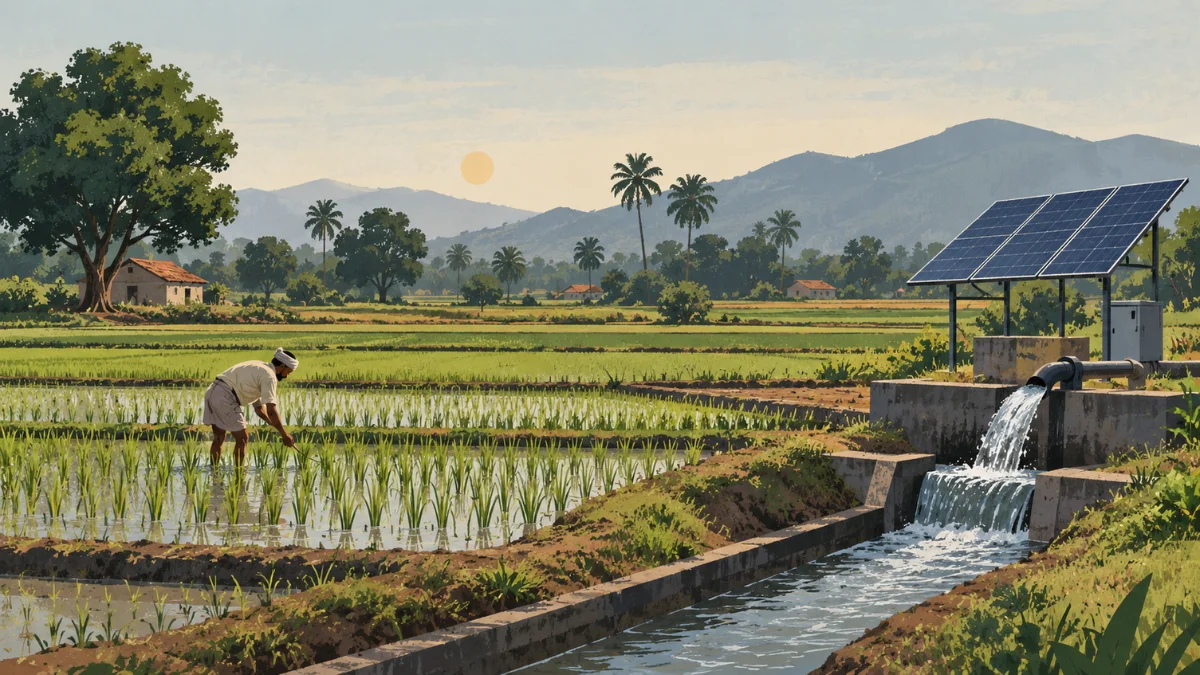
India cannot build a resilient economy if the sector that feeds, employs and sustains millions remains vulnerable to environmental stress.
India’s agricultural story is no longer simply about how much food the country can produce.
It is about how much food we can produce, for how long, with how much water, at what environmental cost—and whether farmers can earn a secure livelihood while doing it.
That distinction matters.
Agriculture and allied activities remain deeply embedded in India’s economic structure. The latest Economic Survey estimates that the sector contributes nearly one-fifth of national income at current prices and accounts for 46.1% of India’s workforce. (India Budget)
At the same time, Indian agriculture faces a difficult combination of climate variability, water stress, soil degradation, fragmented holdings, resource-intensive production and changing market expectations.
This creates a fundamental reality:
For India, agricultural sustainability is not an environmental side project. It is an economic necessity.
And there are at least three compelling reasons why sustainability needs to move from the margins of India’s agricultural strategy to its core.
1. Because India’s Food Security Depends on Resource Security
Food security is often framed around one question:
Do we produce enough food?
But the more important question for the future may be:
Can we continue producing enough food without exhausting the resources required to produce it?
A farm does not operate in isolation.
It depends on:
- soil,
- water,
- biodiversity,
- predictable weather,
- energy,
- pollinators,
- healthy ecosystems,
- agricultural inputs,
- functioning supply chains.
Damage those foundations, and agricultural productivity eventually becomes more difficult and more expensive.
Water is a particularly important example.
Indian agriculture is heavily dependent on irrigation, and water availability is becoming increasingly important as climate variability intensifies.
NITI Aayog has highlighted improving water-use efficiency as a key priority for Indian agriculture, while government programmes are increasingly focused on micro-irrigation and more efficient water management. (NITI Aayog)
The issue isn’t simply that agriculture needs more water.
It is that India needs more agricultural output per unit of water.
That is a very different objective.
Instead of asking:
“How much water can we provide to agriculture?”
we should increasingly ask:
“How much food, nutrition and farmer income can we generate from every unit of water?”
That shift—from resource consumption to resource productivity—is at the heart of sustainable agriculture.
The same principle applies to soil.
A farming system that continuously extracts nutrients while degrading soil health may deliver productivity today while creating a productivity problem tomorrow.
Sustainability therefore means protecting the productive capacity of the agricultural system itself.
The equation is simple:
Healthy soil + efficient water use + biodiversity + climate resilience = stronger long-term food security
Sustainability isn’t the opposite of productivity.
It is what makes productivity possible over the long term.
2. Because Climate Change Is Already an Agricultural Business Risk
Agriculture is uniquely exposed to climate.
A factory can potentially relocate.
A farm cannot relocate its growing season quite so easily.
Agricultural productivity is influenced by:
- rainfall,
- temperature,
- heatwaves,
- drought,
- floods,
- changing pest patterns,
- water availability,
- soil moisture,
- extreme weather.
This makes climate change not just an environmental challenge for agriculture, but a livelihood and economic risk.
The Economic Survey has noted that weather conditions remain an important factor influencing agricultural performance, while diversified income sources such as livestock, fisheries and agroforestry can help farmers manage uncertainty. (India Budget)
This is why climate resilience needs to become part of mainstream agricultural planning.
Think beyond the crop.
A climate-resilient agricultural system could involve:
- diversified cropping,
- drought- and heat-resilient varieties,
- efficient irrigation,
- soil-health management,
- agroforestry,
- integrated farming systems,
- livestock diversification,
- better weather information,
- improved storage,
- climate-smart technology,
- stronger crop insurance and risk-management systems.
India is already investing in this direction.
A 2026 government backgrounder on climate-resilient farming notes that nearly 60% of India’s net sown area is rainfed, accounting for approximately 40% of total food production. It also reports that 2,996 climate-resilient crop varieties were released between 2014 and 2025. (Press Information Bureau)
These interventions matter because sustainability is ultimately about reducing vulnerability.
A farmer who uses less water, maintains healthier soil, diversifies income and has access to climate information is not simply being “green.”
They are potentially becoming more economically resilient.
3. Because Agriculture Must Become Part of India’s Low-Carbon Growth Story
There is another reason sustainability must become central to India’s agricultural economy:
Agriculture is both affected by climate change and contributes to it.
That makes it a critical part of India’s transition towards a lower-carbon economy.
NITI Aayog’s recent analysis estimates that agriculture contributes approximately 14% of India’s greenhouse gas emissions, with methane from enteric fermentation and rice cultivation and nitrous oxide from agricultural soils among the important sources. It also highlights the sector’s significant electricity use, particularly for groundwater irrigation and mechanisation. (NITI Aayog)
This creates an important opportunity.
Agriculture should not be viewed only as a sector that needs to reduce emissions.
It can also become a sector that creates climate solutions.
Consider the possibilities:
Better water management
Efficient irrigation can reduce energy requirements associated with groundwater pumping while improving water productivity.
Better soil management
Healthy soils can support productivity, improve water retention and contribute to broader ecosystem resilience.
Crop diversification
Moving away from highly resource-intensive cropping patterns in suitable regions can reduce pressure on water and other inputs.
Agroforestry
Integrating trees with agricultural systems can provide additional income, ecosystem services and carbon benefits.
Better livestock management
Improved feed, animal health and manure management can help address emissions while improving productivity.
Renewable energy
Solar-powered irrigation and other renewable-energy applications can reduce dependence on fossil fuels, provided they are integrated with responsible groundwater management.
Circular agriculture
Crop residues, livestock waste and other organic materials can be converted into useful inputs rather than treated simply as waste.
The objective is not to make farmers carry the burden of India’s climate transition.
It is to design systems where climate action and farmer economics reinforce each other.
Sustainability Should Not Become Another Burden on Farmers
This is perhaps the most important distinction.
Sustainability cannot mean telling farmers:
“Use fewer resources, reduce emissions, protect biodiversity—and somehow absorb the additional cost.”
That approach will not scale.
For sustainability to become core to India’s agricultural economy, it must create economic value for farmers and the wider agricultural ecosystem.
That means sustainability interventions should ideally contribute to one or more of the following:
Lower input costs
Higher productivity
Reduced climate risk
More stable income
Better market access
Premium or differentiated products where markets support them
New income streams
Lower resource dependence
Greater resilience
This is where the future of sustainable agriculture becomes particularly interesting.
The opportunity is not merely to create “green farms.”
It is to create more profitable, resilient and resource-efficient farming systems.
From Sustainable Farming to a Sustainable Agri-Economy
There is a difference between encouraging farmers to adopt individual sustainable practices and redesigning the agricultural economy around sustainability.
The first might look like:
- use drip irrigation,
- reduce chemical inputs,
- plant trees,
- compost waste,
- diversify crops.
All of these can be valuable.
But the bigger opportunity is to connect these practices across the entire value chain.
Think about the journey of a food product:
Seed → Farm → Irrigation → Inputs → Harvest → Storage → Processing → Transportation → Retail → Consumer → Waste
Every stage has:
- resource consumption,
- emissions,
- costs,
- potential inefficiencies,
- sustainability opportunities.
Therefore, sustainable agriculture cannot stop at the farm gate.
It needs to extend across the entire agri-value chain.
What Does This Mean for Businesses?
This is where sustainability becomes particularly relevant for India’s agricultural businesses.
Food processors, retailers, exporters, agri-tech companies, input manufacturers, cooperatives, logistics providers and consumer brands increasingly need to understand the environmental footprint of their supply chains.
For example, a food company may eventually need better answers to questions such as:
- How much water is associated with our raw materials?
- What is the carbon footprint of our agricultural supply chain?
- Which crops or regions are most climate-vulnerable?
- How much agricultural waste is generated?
- How much of it is recovered?
- What percentage of suppliers follow responsible agricultural practices?
- Can we trace sustainability performance back to the farm?
- Can farmers benefit economically from improved sustainability?
This is where measurement becomes critical.
What cannot be measured consistently is difficult to improve, compare or communicate credibly.
And as sustainability expectations rise, agricultural businesses will increasingly need reliable data around GHG emissions, water, soil, biodiversity, waste, inputs and supply-chain practices.
The Rise of the Sustainable Farmer
The farmer of the future may need to be more than a producer.
They may increasingly become:
A food producer + resource manager + climate-risk manager + data participant + entrepreneur.
Technology can support this transition.
Digital tools can help with:
- weather intelligence,
- precision irrigation,
- soil monitoring,
- crop planning,
- input optimisation,
- traceability,
- market access,
- carbon measurement,
- sustainability reporting.
But technology alone will not solve the problem.
India also needs:
- farmer education,
- accessible finance,
- appropriate incentives,
- local knowledge,
- strong extension systems,
- aggregation models,
- better infrastructure,
- market linkages.
In other words:
Sustainable agriculture requires both innovation and inclusion.
Sustainability Can Also Create New Rural Opportunities
One of the most overlooked dimensions of sustainable agriculture is its potential to create new rural economic activity.
Consider the emerging opportunities around:
- regenerative agriculture,
- agroforestry,
- organic and natural farming,
- renewable-energy applications,
- agricultural waste management,
- bio-based products,
- food processing,
- sustainable packaging,
- climate-smart advisory,
- carbon and ecosystem-service markets,
- sustainable supply-chain management.
These can create opportunities beyond traditional crop production.
India’s agricultural transformation is already expanding beyond crops into livestock, fisheries, horticulture, food processing and other allied activities. The Economic Survey highlights these higher-value sectors as increasingly important for rural incomes and livelihood diversification. (India Budget)
That makes sustainability not only an environmental agenda.
It can become an innovation and employment agenda.
What Would a Sustainable Indian Agri-Economy Look Like?
It would not necessarily mean every farmer using the same method.
India’s agricultural diversity makes a one-size-fits-all sustainability model unrealistic.
A sustainable agricultural system would instead be context-specific.
What works in Punjab may not work in Odisha.
What works for a rainfed smallholder may not work for a large irrigated farm.
What works for rice may not work for horticulture.
The objective should therefore be to optimise for local conditions.
But some common principles can guide the transition:
1. Produce more with fewer resources
Increase resource productivity rather than simply increasing resource consumption.
2. Protect the natural asset base
Treat soil, water, biodiversity and ecosystems as productive assets.
3. Diversify risk
Encourage crop, income and livelihood diversification where appropriate.
4. Measure environmental performance
Track water, energy, emissions, soil health, waste and other relevant indicators.
5. Reward sustainable outcomes
Create financial and market incentives that make sustainability economically attractive.
6. Build resilience into the value chain
Storage, processing, logistics, insurance and market systems should all be designed to withstand climate and resource risks.
India’s Agricultural Future Needs a New Definition of Productivity
For decades, agricultural productivity has largely been discussed in terms of:
More output per hectare.
The next generation of agricultural productivity needs to be broader.
It could ask:
How much food per litre of water?
How much income per hectare?
How much value per unit of energy?
How much output with lower emissions?
How much farmer income with lower climate risk?
How much nutrition with lower environmental pressure?
This is a fundamentally different way of thinking about agricultural growth.
It moves us from:
“Produce more.”
to:
“Create more value from every hectare, every litre of water, every unit of energy and every resource—while protecting the ability to produce tomorrow.”
That is the real meaning of sustainable agricultural productivity.
Sustainability Is Not the Next Layer of Indian Agriculture. It Is the Foundation.
India does not have the luxury of treating sustainability as something to address after achieving agricultural growth.
The two have to happen together.
Because:
Food security depends on resource security.
Farmer income depends on resilience.
Economic growth depends on productive land and water.
Climate ambition depends partly on agricultural transformation.
And India’s rural economy depends heavily on all of them.
The question is therefore no longer:
“Can India afford to make agriculture sustainable?”
A more appropriate question is:
“Can India afford not to?”
The Bottom Line
India’s agricultural economy is too important to the country’s employment, food security and economic future for sustainability to remain a parallel conversation.
The next agricultural transformation must therefore be about more than higher yields.
It must be about:
Higher productivity.
Better resource efficiency.
Stronger farmer incomes.
Greater climate resilience.
Healthier soils and water systems.
Lower environmental impact.
More sustainable value chains.
The future of Indian agriculture will not be defined simply by how much we grow.
It will be defined by how intelligently we grow it.
And sustainability is at the centre of that equation.
Learn. Measure. Improve.
At Climatora, we believe sustainability becomes meaningful when it moves from intention to measurement and action. From GHG accounting and ESG reporting to sustainability skills and practical tools, the goal is to help organisations and people understand their environmental impact and build better decisions around it.
Because for an economy built so deeply around agriculture, sustainable agriculture isn’t just good environmental policy—it is good economic strategy.
For more such blogs click here