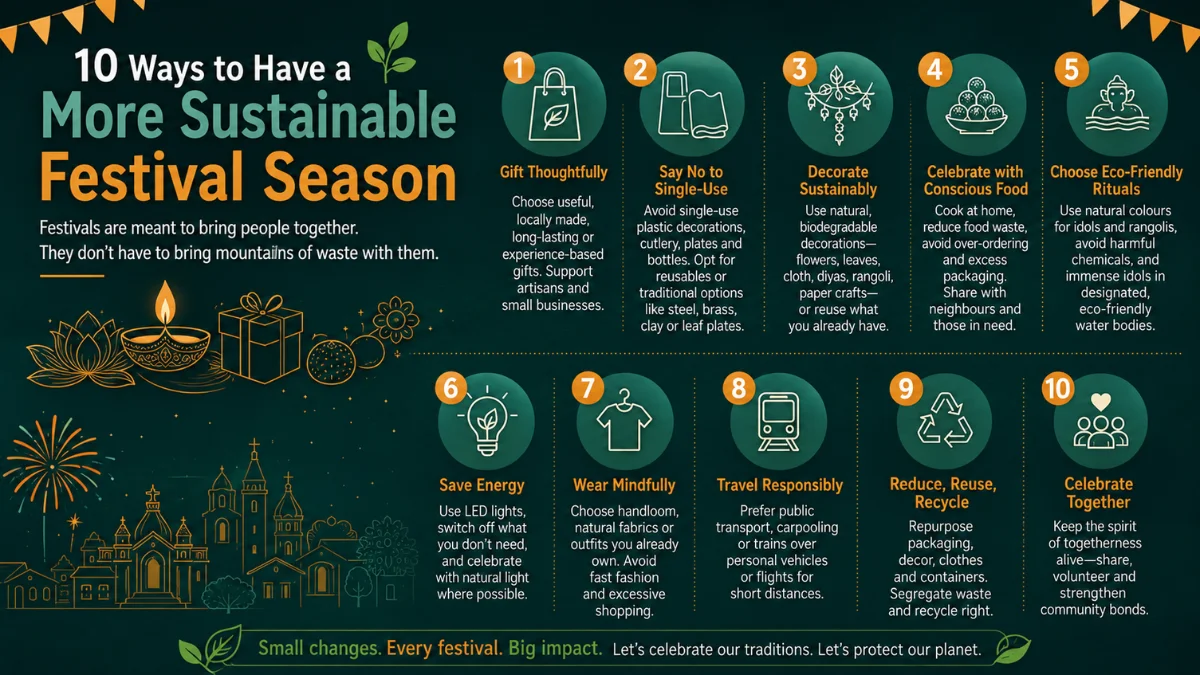
10 Ways to Have a More Sustainable Festival Season
Festivals are meant to bring people together. They don’t have to bring mountains of waste with them.
India’s festival calendar is one of the world’s great celebrations of culture, community, food, family and faith.
And from August onwards, the festive season gathers momentum.
Raksha Bandhan. Janmashtami. Ganesh Chaturthi. Navratri. Durga Puja. Dussehra. Diwali. Govardhan Puja. Bhai Dooj. Chhath. Guru Nanak Jayanti. Christmas.
Each has its own traditions, rituals and ways of celebrating. But collectively, they also create a significant spike in consumption—from gifts and decorations to clothing, travel, food, packaging and energy.
That doesn’t mean we should celebrate less.
Perhaps we simply need to celebrate differently.
The good news is that sustainable celebration doesn’t have to mean giving up traditions. In fact, many traditional Indian practices were inherently low-waste: reusable decorations, natural materials, seasonal food, sharing within communities and making things rather than buying everything ready-made.
The challenge is that modern consumption has added layers of packaging, disposability and excess to many of these traditions.
So rather than asking, “How can I make my festival completely eco-friendly?”, a better question might be:
“What is one thing I can change this festival season that reduces my footprint without reducing my joy?”
Here are 10 ways to do exactly that—festival by festival.
The 2026 dates used below follow Indian festival calendars; local observances can vary by region and tradition. (Time and Date)
1. Raksha Bandhan: Gift Experiences, Not Just Things
August 28, 2026
Raksha Bandhan celebrates one of India’s most enduring relationships—the bond between siblings.
Traditionally, the festival was wonderfully simple: a rakhi, a blessing, some sweets and time together.
Today, the celebration can involve elaborate gift boxes, plastic packaging, imported products, online deliveries and multiple layers of wrapping.
Make the rakhi sustainable
Choose:
- Handcrafted rakhis
- Cotton, jute or thread-based rakhis
- Seed-paper rakhis
- Locally made products
- Rakhis without plastic packaging
And perhaps rethink the gift itself.
Instead of buying something simply because “it’s Rakhi”, consider:
- A shared meal
- A book
- A plant
- A locally made craft
- A class or experience
- A donation to a cause your sibling cares about
- Something made by a local artisan
The most sustainable gift is often the one that doesn’t become another thing sitting unused in a cupboard.
Festival footprint question
Can this gift create a memory rather than create more material consumption?
2. Janmashtami: Let Food Be the Celebration
September 4, 2026
Janmashtami is deeply associated with food traditions, devotional offerings and community celebration.
It is also an opportunity to rethink one of the biggest sustainability challenges during Indian festivals:
food waste.
We often prepare more than we need because abundance is considered part of hospitality.
But there is a difference between abundance and waste.
Make the feast sustainable
Try:
- Planning portions based on actual guests
- Using seasonal and locally available ingredients
- Serving smaller portions initially and allowing seconds
- Avoiding excessive disposable tableware
- Storing leftovers properly
- Sharing excess food with neighbours or community organisations
- Composting unavoidable food waste
And don’t underestimate the environmental impact of what we eat.
Food has a footprint associated with land, water, energy, transportation and waste.
So a sustainable festival plate isn’t necessarily about eating less.
It’s about wasting less.
Festival footprint question
How much of the food we prepare will actually be eaten?
3. Ganesh Chaturthi: Bring Home a Ganpati, Not a Pollution Problem
September 14, 2026
Few Indian festivals demonstrate the sustainability conversation more visibly than Ganesh Chaturthi.
The idol itself has become a symbol of the environmental choices we make during festivals.
The traditional idea of immersing a clay idol in water is inherently connected to nature.
The challenge comes when idols are made using materials that do not easily return to the environment, or when paints and decorations introduce pollutants into water bodies.
Choose the idol consciously
Look for:
- Natural clay idols
- Locally made idols
- Natural or low-impact colours
- Minimal decorative material
- Appropriate size for the space and immersion arrangements
And consider the entire lifecycle—not just the idol.
What happens to:
- The decoration?
- The flowers?
- The thermocol?
- The plastic?
- The synthetic cloth?
- The packaging?
Go beyond the idol
A sustainable Ganesh Chaturthi can include:
Smaller idol + natural materials + community celebration + responsible immersion + proper waste segregation.
Because the true spirit of the festival is not measured by the size of the idol.
Festival footprint question
If everything used for the celebration had to return safely to nature, what would we change?
4. Navratri and Durga Puja: Reuse the Celebration
Navratri begins October 11; Durga Puja festivities begin October 17, 2026. (Time and Date)
Navratri and Durga Puja bring together music, dance, community gatherings, elaborate decorations, food, clothing and travel.
They also present one of the biggest opportunities for reuse.
Think about how much festival infrastructure is created every year and then discarded.
Decorative fabrics.
Lighting.
Backdrops.
Banners.
Props.
Temporary structures.
The sustainable approach: design for reuse
Before buying something new, ask:
Can last year’s decoration be used again?
If not, can it be:
- Repaired?
- Repurposed?
- Shared?
- Rented?
- Donated?
For community celebrations, organisers can create a festival inventory—a shared collection of reusable lights, fabrics, decorations, utensils and signage.
The same material can then serve multiple festivals and multiple years.
And what about the outfit?
Festival fashion can become a major consumption cycle.
Instead of buying a new outfit for every occasion:
Repeat. Re-style. Borrow. Swap. Rent.
There is nothing unsustainable about wearing the same beautiful clothes more than once.
In fact, that may be the most fashionable thing you can do.
Festival footprint question
How much of this celebration can we reuse next year?
5. Dussehra: Celebrate the Message, Not the Material Excess
October 20, 2026 (Time and Date)
Dussehra is associated with the triumph of good over evil.
Perhaps that makes it an ideal occasion to rethink another modern festival habit:
excess.
Excessive decoration.
Excessive consumption.
Excessive packaging.
Excessive waste.
The symbolic burning of effigies also creates an opportunity for communities to think about the materials being used and the emissions and waste generated by large-scale celebrations.
Make the symbolism meaningful
Community organisers can:
- Minimise non-essential materials
- Avoid plastic-based decorations
- Use reusable structures
- Ensure post-event waste segregation
- Communicate the environmental impact of the event
- Encourage public transport or shared mobility
And perhaps create a new tradition:
Burn less. Give more.
A community could redirect part of its festival budget towards:
- Tree planting
- Local schools
- Community kitchens
- Waste management
- Local artisans
- Environmental restoration
The victory of good over evil can have a contemporary interpretation:
Good for people. Good for communities. Good for the planet.
6. Diwali: Light Up Your Home, Not the Waste Stream
November 8, 2026 (Time and Date)
If there is one festival where sustainability conversations are unavoidable, it is Diwali.
And for good reason.
Diwali combines:
- Lighting
- Firecrackers
- Sweets
- Gifts
- Shopping
- Travel
- Decorations
- New clothes
- Corporate gifting
It is perhaps India’s ultimate consumption festival.
But Diwali doesn’t have to become a choice between tradition and sustainability.
Light smarter
Choose energy-efficient lighting and switch off decorative lights when they aren’t needed.
Use diyas thoughtfully and consider reusable lamps and decorations that can return year after year.
Rethink gifting
Corporate and family gifting can generate enormous quantities of packaging.
Instead of a large box filled with individually wrapped products, consider:
- Locally sourced products
- Artisan-made gifts
- Food with minimal packaging
- Reusable containers
- Plants
- Experiences
- Charitable contributions
And the crackers question
For those who choose to celebrate with fireworks, reducing the scale and duration of fireworks can reduce pollution and waste.
But the bigger opportunity is cultural.
Can we make light, food, family and community the centre of Diwali rather than consumption?
Festival footprint question
How much of my Diwali spending will create lasting value—and how much will become waste within days?
7. Govardhan Puja and Bhai Dooj: Make Sharing the Sustainability Habit
November 10 and 11, 2026 (Drik Panchang)
The days following Diwali offer a useful reminder that sustainability isn’t just about materials.
It is also about sharing.
Govardhan Puja has strong associations with nature, agriculture and gratitude for the natural world.
Bhai Dooj celebrates sibling relationships.
Both offer an opportunity to move away from the idea that every celebration needs to involve a new purchase.
Try a “share before you shop” rule
Before buying something new:
- Share what you already have.
- Exchange.
- Repair.
- Borrow.
- Donate.
- Support someone who needs it.
For families, this can become a simple festival tradition.
One thing in, one thing out.
If you receive something you don’t need, pass something useful on to someone who does.
This turns the festival season from a cycle of acquisition into a cycle of circulation.
And that is the essence of the circular economy.
Festival footprint question
Can celebration create sharing rather than accumulation?
8. Chhath Puja: Let Water and Nature Be Part of the Respect
November 15, 2026 (Time and Date)
Chhath Puja is deeply connected with the Sun, water bodies and nature.
That makes it a particularly powerful reminder that environmental sustainability isn’t an abstract concept.
It is about the very ecosystems that sustain us.
Make the celebration water-conscious
Where community celebrations involve rivers, ponds or other water bodies:
- Avoid plastic materials near the water
- Minimise disposable items
- Ensure offerings and packaging don’t become litter
- Provide waste collection points
- Separate organic and non-organic waste
- Use natural materials wherever appropriate
- Ensure post-event clean-up
The message is simple:
If a festival is an expression of gratitude towards nature, the celebration should not leave nature carrying the waste.
Festival footprint question
Are we protecting the very ecosystem we are celebrating?
9. Guru Nanak Jayanti: Make Community Service the Greenest Celebration
November 24, 2026 (Time and Date)
One of the most powerful ways to make any festival sustainable is to move the emphasis from consumption to contribution.
Guru Nanak Jayanti—and the tradition of seva associated with Sikh communities—offers a powerful reminder of this principle.
Community kitchens and collective service demonstrate that celebration can be about feeding people, serving communities and bringing people together rather than simply consuming more.
Take the idea of seva into sustainability
A festival-season seva initiative could include:
- Community clean-ups
- Food redistribution
- Tree care
- Waste segregation drives
- Donation of reusable items
- Support for local artisans
- Helping community kitchens reduce food waste
Imagine replacing one shopping trip with one afternoon of community service.
That could be a festival tradition worth keeping.
Festival footprint question
What if every celebration left behind more value than waste?
10. Christmas: Buy Less, Share More, Waste Less
December 25, 2026 (Time and Date)
Christmas marks the end of this festival journey—and it brings its own familiar consumption patterns.
Trees.
Decorations.
Lights.
Gifts.
Food.
Travel.
Wrapping paper.
And increasingly, online shopping.
Make Christmas circular
Choose a reusable artificial tree that can be used for many years, or explore locally appropriate alternatives.
Use decorations that can be stored and reused rather than replaced annually.
Wrap gifts in:
- Fabric
- Reusable bags
- Recycled paper
- Newspapers
- Old maps
- Children’s artwork
And perhaps introduce a new family tradition:
Secret Santa with a sustainability rule.
For example, the gift must be:
- Second-hand
- Locally made
- Handmade
- An experience
- Repairable
- Consumable without excessive packaging
Christmas can also be a wonderful opportunity to support local artisans and small businesses rather than defaulting to mass-produced products.
Festival footprint question
Can the gift be loved, used and remembered long after the wrapping paper is gone?
The 10 Sustainable Festival Rules
Looking across the festival calendar, a pattern emerges.
Sustainable celebrations don’t require perfection.
They require better choices, repeated consistently.
Here are ten rules to carry through the entire season:
1. Buy Less
Don’t confuse celebration with consumption.
2. Choose Local
Support local artisans, producers and businesses while reducing unnecessary transport and packaging.
3. Reuse
Decorations, clothes, bags, containers and gifting materials don’t need to be single-use.
4. Avoid Single-Use
Especially plastic cutlery, cups, plates, decorations and packaging.
5. Waste Less Food
Plan portions, store leftovers and share surplus.
6. Measure Your Footprint
Use carbon, water, plastic and waste footprint calculators to understand where your biggest impacts come from.
7. Travel Smarter
Walk, carpool, use public transport or combine trips where possible.
8. Gift With Purpose
Choose useful, durable, local or experiential gifts.
9. Celebrate Together
A shared celebration can often have a smaller footprint per person than multiple individual celebrations.
10. Leave No Trace
Before you close the door, switch off the lights, clean up the venue and ask:
“What are we leaving behind?”
The Festival Season Could Become India’s Biggest Sustainability Classroom
Perhaps the most interesting thing about festivals is that they offer something that sustainability campaigns often struggle to create:
participation.
People are already emotionally invested.
Families participate.
Children participate.
Schools participate.
Communities participate.
Businesses participate.
Cities participate.
That makes festivals a powerful platform for changing behaviour.
Imagine if every school ran a Sustainable Rakhi Challenge.
Every Ganesh mandal measured its waste.
Every Durga Puja committee published its material footprint.
Every housing society ran a Zero Waste Diwali.
Every corporate office measured the footprint of its festive gifting.
Every family tracked its food waste during the festival season.
Suddenly, sustainability would no longer be a lecture.
It would be lived.
A New Festival Habit: Know Your Footprint
There is one habit that can connect all ten suggestions:
Measure.
Before the festival:
What are we planning to consume?
During the festival:
What are we actually using?
After the festival:
What did we waste?
And over time:
What can we do differently next year?
Carbon footprint calculators can help us understand emissions associated with energy, travel and consumption.
Water footprint calculators can help us understand the water embedded in what we consume.
Plastic footprint calculators can reveal how much plastic enters our lives through everyday purchases.
Event footprint calculators can help communities, schools and businesses understand the impact of celebrations.
Because once we know our footprint, we can begin to reduce it.
The Most Sustainable Festival Is Not the Smallest One
Sustainability shouldn’t mean stripping festivals of their joy.
It should mean removing the unnecessary impact while preserving what makes the celebration meaningful.
Keep the family.
Keep the music.
Keep the food.
Keep the rituals.
Keep the colours.
Keep the laughter.
But perhaps lose the unnecessary packaging.
Lose the disposable decorations.
Lose the food waste.
Lose the pressure to buy something new every time.
Lose the idea that bigger automatically means better.
Indian festivals have survived for centuries because their meaning is deeper than their material expression.
Perhaps the future of sustainable celebrations lies in going back to that essence.
Celebrate More. Waste Less.
From the thread tied around a sibling’s wrist during Raksha Bandhan to the lights of Diwali and the candles of Christmas, India’s festival season is ultimately about something remarkably simple:
connection.
Connection with family.
Connection with community.
Connection with culture.
And, in many traditions, connection with nature.
That connection is worth protecting.
So this festival season, before buying, ask.
Before discarding, ask.
Before ordering, ask.
Before decorating, ask.
Do we really need this?
And if the answer is yes, ask one more question:
Can we do it better?
Because sustainability doesn’t ask us to stop celebrating.
It asks us to celebrate with greater awareness.
And perhaps that is the best festival tradition we can start this year.
Celebrate fully. Consume mindfully. Waste less. Leave the planet a little better than we found it.
Frequently Asked Questions
What is a sustainable festival?
A sustainable festival is a celebration that consciously reduces unnecessary environmental impact through responsible choices around energy, water, food, materials, transport, waste and consumption while preserving the cultural and social meaning of the occasion.
How can I celebrate Diwali sustainably?
Use energy-efficient or reusable lighting, reduce unnecessary packaging, choose thoughtful and locally sourced gifts, minimise waste, reuse decorations and consider reducing the scale of fireworks.
How can Ganesh Chaturthi be celebrated sustainably?
Choose appropriately sized natural clay idols, avoid harmful materials and paints, reduce disposable decorations and ensure responsible immersion and waste management.
How can festivals reduce food waste?
Plan portions carefully, serve smaller quantities initially, store leftovers safely, share surplus food and compost unavoidable organic waste.
Does sustainable celebration mean spending less?
Not necessarily. It means spending more thoughtfully. Supporting local artisans, buying durable products, choosing experiences or investing in reusable items can sometimes cost more initially but create greater long-term value.
Can children be involved in sustainable festivals?
Absolutely. Festivals are excellent opportunities for children to learn sustainability through activities such as making reusable decorations, measuring household waste, creating eco-friendly crafts, planning food portions and participating in community clean-ups.
About Climatora
At Climatora, we believe climate action should not be something we do once a year.
It should become a habit.
Our work in sustainability education, GHG Accounting, ESG Reporting and environmental footprint measurement is built around a simple idea: when people understand the impact of their choices, they are better equipped to make better ones.
This festival season, start small.
Measure one footprint. Change one habit. Influence one more person.
Because the most sustainable festival is not the one with the least celebration.
It’s the one that leaves behind the most meaning—and the least waste.
For more such blogs click here