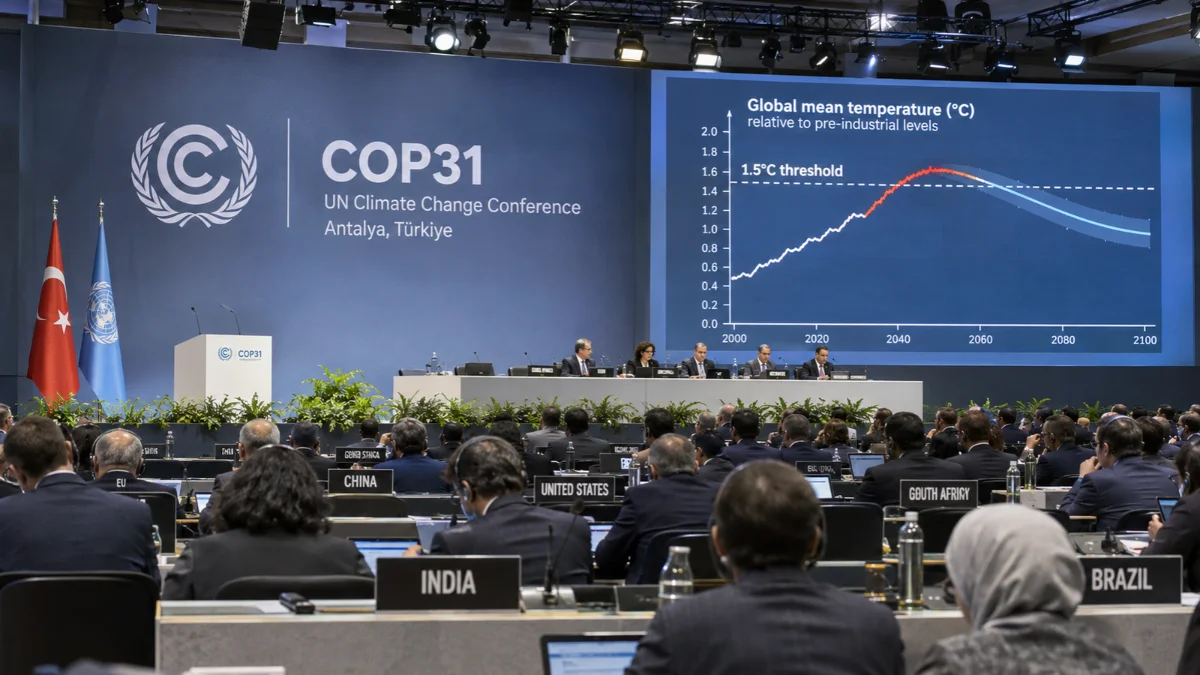
Guterres Demands 6% Annual Emission Cuts as Overshoot Fight Splits COP31
The dispute over a UN overshoot report at COP31 is a proxy fight over who carries the cost of 6% annual emission cuts, and India sits inside the bloc resisting it.
Global emissions would have to fall by roughly 6% every year to 2035 to keep the breach of 1.5C short and shallow. The negotiating bloc India belongs to is now working to keep the UN analysis behind that number out of COP31’s headline decision.
Talks Stall at the Antalya Midpoint
Ministers arrived in Antalya for the second week with little movement on the cover decision, the summit’s main negotiated text. The European Union, the UK, the Least Developed Countries and small island states want the response to overshoot made a central priority of that text.
Resistance has come from two directions. In closed consultations, the Arab Group, led by Saudi Arabia, argued that UNEP’s Limiting Overshoot report had not been peer reviewed. The Like-Minded Developing Countries, a bloc that includes India and China, asked that the cover decision avoid citing reports produced outside the UN climate process. Observers read that request as aimed at the same UNEP document.
What the Overshoot Numbers Require
The Limiting Overshoot report, published in September, is the first UN assessment to state plainly that exceeding 1.5C can no longer be avoided. Its best case has warming peaking near 1.7C to 1.8C around mid-century before declining.
UNEP’s Emissions Gap Report 2026, released on 21 October, puts numbers on that pathway. Global emissions would need to fall 18% by 2030, 45% by 2035 and 69% by 2040, all against 2025 levels. Even full delivery of current pledges leaves the world heading for about 2.6C by 2100.
UN Secretary-General António Guterres turned those findings into a political ask at the Leaders’ Summit: 6% annual cuts, an end to unabated coal use by 2040 and a one-third reduction in oil and gas use. He said current national plans deliver only about a third of the reductions needed. When the gap report launched, he framed the task in four words: “Overshoot is not surrender.”
The report’s authors have rejected the peer review charge. Debra Roberts, former co-chair of IPCC Working Group II and a member of the report’s core team, said it went through internal review, external peer reviewers and a UNEP check.
Why the Procedural Fight Matters for India
The objection to “outside” reports is procedural in form but substantive in effect. If the cover decision anchors to UNEP’s benchmarks, quantified 2030 and 2035 targets could shape the second global stocktake, which formally begins at this COP. A coal end date of 2040 sits uneasily with India’s power planning, which still includes new coal capacity such as the projects Climate Watch has tracked in Uttar Pradesh.
India’s stated position rests on equity rather than on disputing the science. In India’s opening statement, Narendra Bhooshan, Secretary at the Ministry of Environment, Forest and Climate Change, said the prospect of crossing 1.5C makes equity more urgent. He reaffirmed Common But Differentiated Responsibilities and called public finance from developed countries central to action in developing economies. The LMDC bloc has argued that addressing overshoot requires deep cuts by developed countries first.
The risk is reputational. India, Saudi Arabia and Russia have also resisted a faster timeline for the next IPCC assessment, citing limited capacity among developing-country scientists. A legitimate equity argument loses force when it appears alongside efforts to narrow the evidence base, and small island states may not draw a distinction between the two.
The finance backdrop sharpens the bargain. UNEP’s Adaptation Gap Report 2026 found developed countries provided about USD 28 billion in public adaptation finance in 2024, roughly USD 1 billion more than the year before. An African Group bid to add tripling adaptation finance to the COP31 agenda failed to reach consensus.
What to Watch
The cover decision text expected before the summit closes on 20 November will show whether “magnitude and duration” of overshoot survives as language, and whether the UNEP report is named or only paraphrased. The second test is whether quantified 2035 benchmarks enter the stocktake process. For India, the signal to track is whether its negotiators trade softer overshoot language for firmer finance commitments, or hold both lines and risk isolation alongside the Arab Group.
For more climate news click here