E20 Petrol Dispute Exposes Testing Gap
A state laboratory and the oil companies’ own labs have produced incompatible readings on the same fuel, and India’s E20 programme has no designated arbiter to decide between them.
India’s ethanol blending programme now faces a dispute about measurement rather than policy. Karnataka says petrol at its outlets carried up to 31.2% ethanol; the three public sector oil marketing companies (OMCs) say 893 samples nationwide, 56 of them from Karnataka, sat inside the permitted 19 to 21% band.
A Closed Supply Year Raises the Cost of Doubt
The timing sharpens the stakes. The 2025-26 ethanol supply year ended on October 31, 2026, with IOCL, BPCL and HPCL blending 1,134 crore litres of ethanol into roughly 5,673 crore litres of petrol, an average close to the 20% target. Petroleum Ministry data credit the programme since 2014-15 with foreign exchange savings above ₹1.97 lakh crore and the displacement of about 316 lakh tonnes of crude oil.
Those headline numbers rest on an assumption motorists rarely test: that the blend at the nozzle matches the blend in the ledger. Karnataka’s Department of Food, Civil Supplies, Consumer Affairs and Legal Metrology has now contested that assumption publicly, with a cabinet minister fronting the findings.
Two Datasets, Two Methods, No Reconciliation
Minister Rizwan Arshad’s department reports that 11 of 14 samples from seven districts, tested in October 2026, exceeded the E20 ceiling. An Indian Oil sample recorded the highest level at 31.2%, followed by an HPCL Power sample at 30.5% and a BPCL Speed sample at 26.5%. Coverage of the state’s exercise is inconsistent on scale: some reports cite 63 samples collected, others 14 tested, and the state has not publicly explained the gap.
The state further alleges that IOCL and BPCL laboratories omitted ethanol percentages from results on samples it submitted, prompting it to commission outside tests.
The OMCs point instead to a nationwide exercise run with the Centre for High Technology (CHT), a body under the Petroleum Ministry, covering 27 states and Union Territories. Every sample met BIS specification IS 17021, they say, and the Karnataka subset averaged 19.30%.
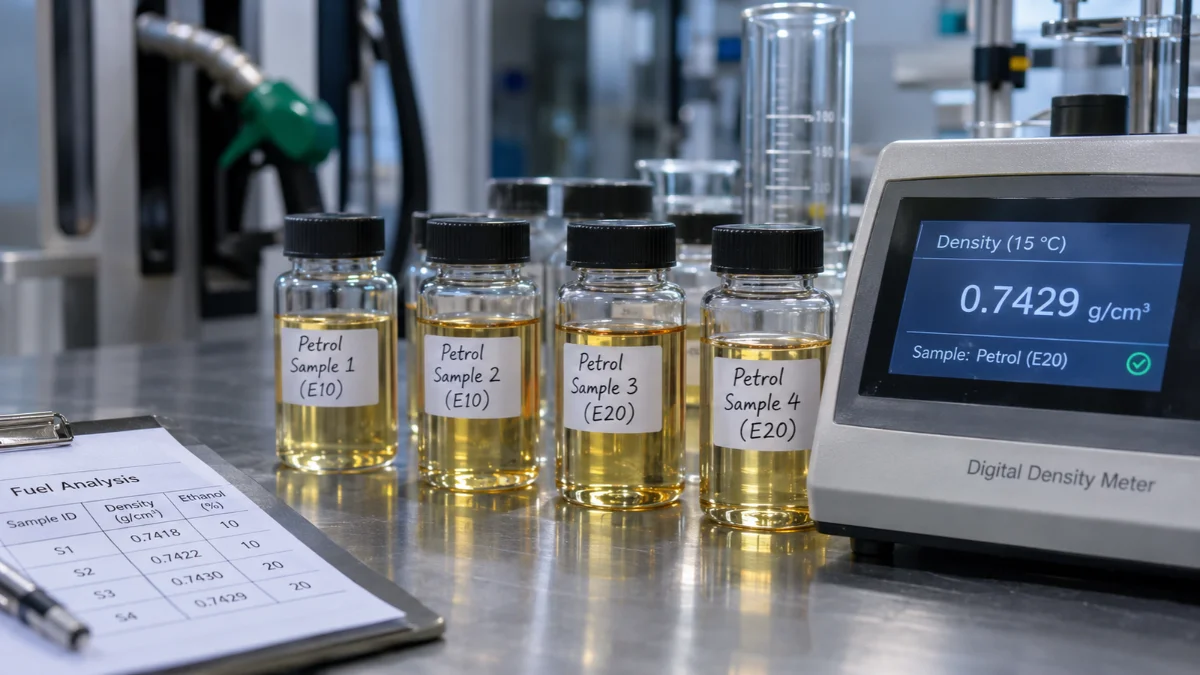
Their strongest rebuttal is physical. Karnataka’s certificates reportedly list densities of 0.742 to 0.749 g/cm³ for samples said to hold 26 to 31% ethanol, lower than the 0.752 to 0.760 range in OMC tests of standard E20. Because ethanol is denser than petrol, a heavier blend should normally read denser, not lighter. The companies have requested the state’s sampling records and independent verification.
The Exposure Is Liability, Not Only Quality
What the dispute reveals matters more than what either side has proved. The CHT exercise was conducted by an arm of the ministry that runs the programme, alongside the companies whose fuel is under question. The state’s tests come from a government pressing a consumer grievance. Neither qualifies as a neutral referee, and IS 17021 prescribes the test method without naming who adjudicates conflicting results. That gap carries a price. Karnataka wants a compensation mechanism for vehicle owners, which builds on a cost the Centre has already conceded: the ministry’s August 2025 assessment put mileage losses at 1 to 2% for E20-calibrated vehicles and 3 to 6% for others. If over-blending were established, those losses would move from an accepted policy cost to a supplier liability. For automakers and fleet operators, the question is whether blend variability, and not only the nominal blend level, belongs in warranty and calibration terms. For policymakers, any step beyond E20 would inherit an enforcement question that remains unanswered.
What to Watch
The immediate test is whether Karnataka hands over its sampling and chain-of-custody records, and whether either side accepts retesting by a laboratory outside both the state and the ministry’s orbit. A formal response from the Petroleum Ministry itself, rather than through the OMCs, would signal how seriously the Centre treats the challenge. The next marker is whether other states commission their own pump-level tests, which would turn a single-state dispute into a national verification problem.
For more climate news click here