74% of Maharashtra Under Drought; 63.8 Million Rabi Hectares Face El Niño
A failed kharif is now official in Maharashtra. The Centre's El Niño warning means rabi, the season meant to absorb that loss, is exposed too.
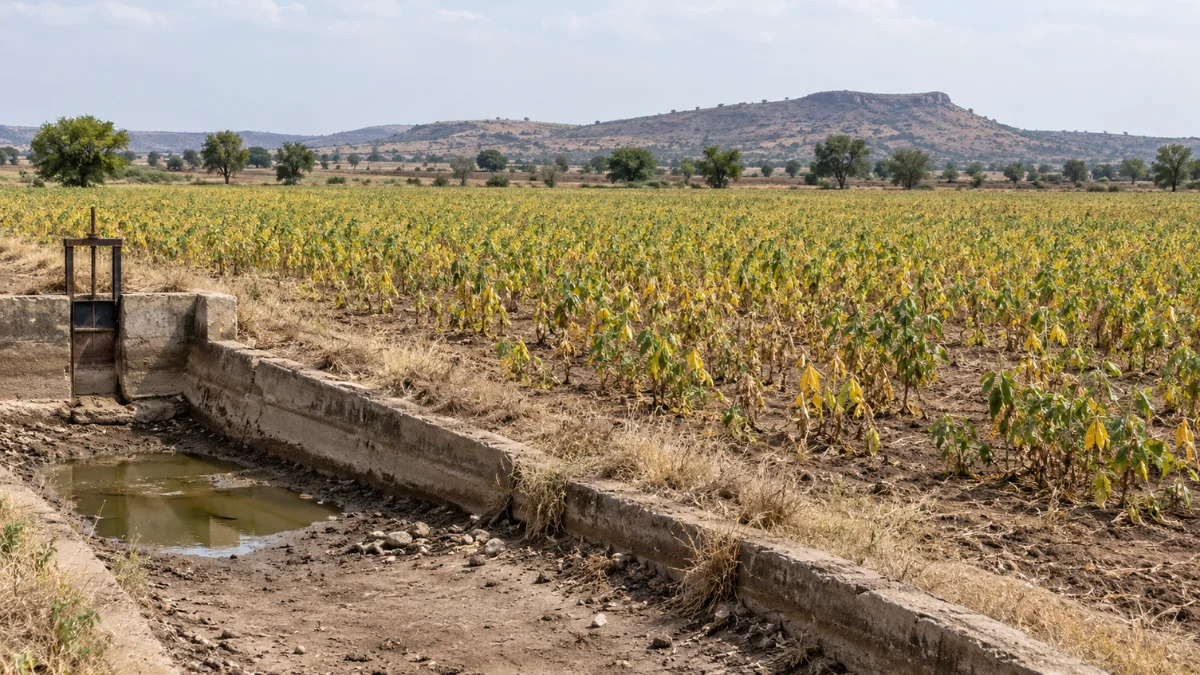
Three-quarters of Maharashtra is now formally in drought, and the Union government is signalling that the next crop cycle offers little cushion. The state notified drought in 265 of its 358 talukas on September 26. Two days later, the Union Agriculture Secretary warned that El Niño puts rabi output in rainfed regions at risk.
Two Announcements Compound Into One Agricultural Risk
Read separately, the announcements look routine: a state responding to a weak monsoon, and a ministry issuing a seasonal caution. Read together, they describe a farm economy that may lose the very season it relies on to recover. Rabi sowing draws on residual soil moisture and reservoir storage built up during the monsoon, and a deficient kharif depletes both before planting begins.
The timing matters for policy. Relief designed around one lost season, such as loan restructuring and fee waivers, assumes the following harvest restores farm income. That assumption is now in question.
Maharashtra's Declaration Reaches Beyond Marathwada and Vidarbha
According to the state government, rainfall between June 1 and September 18 totalled 755.9 mm against an average of 932.3 mm, a shortfall of 18.8%. The declaration spans 32 districts. By revenue division, Chhatrapati Sambhajinagar accounts for 74 talukas, Amravati 56, Nashik 49, Nagpur 39, Pune 35 and Konkan 12.
The Pune division figure stands out. Western Maharashtra is usually the state's better-irrigated belt, with sugarcane and horticulture drawing on canal and reservoir water. Its inclusion indicates the deficit extended well past the historically drought-prone regions.
Chief Minister Devendra Fadnavis directed a relief package covering crop loan restructuring, land revenue concessions, subsidies on agricultural pump electricity bills, examination fee waivers, expanded rural employment work, water tankers and fodder supply.
El Niño Puts 63.8 Million Rabi Hectares in Play
India normally sows rabi crops across 63.8 million hectares, according to the Union agriculture ministry: 30 million hectares of wheat, 14 million of pulses, 8.7 million of oilseeds and 5.5 million of coarse cereals. The International Research Institute for Climate and Society forecasts a very strong El Niño through late 2026 and early 2027.
Agriculture Secretary Atish Chandra described the pace of change as no longer theoretical: "now we see the changes happening, and they are happening at a fast pace." The Centre will send high-level teams to Maharashtra and Karnataka to assess drought impact.
Banks, State Budgets and Import Bills Share the Exposure
Rainfed farmers carry the direct loss, but the financial chain runs further. Cooperative and commercial banks will absorb the cost of restructured crop loans, while state finances take on pump subsidies and tanker operations. Central team assessments typically precede any additional support from the National Disaster Response Fund, so the size of Maharashtra's eventual claim on the Centre remains open.
Pulses and oilseeds are the more sensitive rabi crops for national policy. Both are grown heavily on rainfed land, and India already depends on imports to meet edible oil demand. A weak rabi in these crops would widen that dependence, not just reduce farm income.
The unresolved question is whether drought relief frameworks, built for single-season shocks, can handle consecutive failures of the kind climate variability is making more frequent.
What to Watch
The central teams' findings on Maharashtra and Karnataka will set the scale of any NDRF release. Rabi sowing progress data from the agriculture ministry will show whether planted area holds near the 63.8 million hectare norm or falls short in rainfed states. Central Water Commission reservoir bulletins will indicate how much irrigation buffer remains for the season. Updated El Niño outlooks through November will determine whether the Centre's caution turns into revised foodgrain output estimates.
For more climate news click here