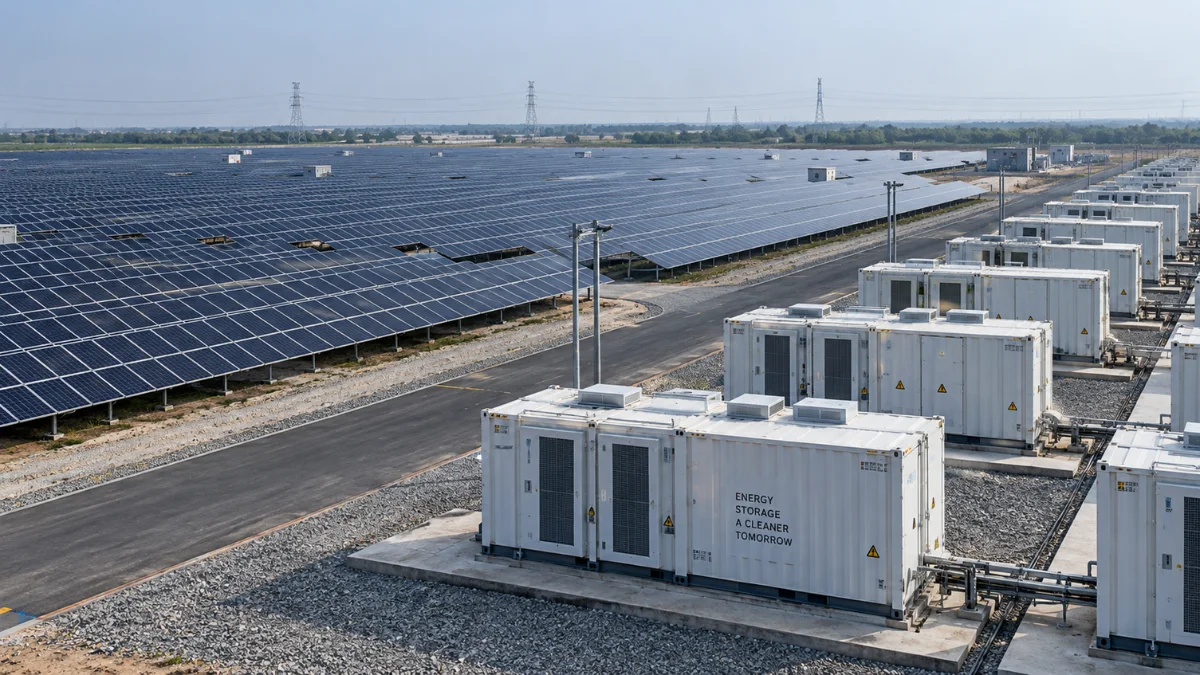
Waaree's Solapur Deal Matches 700 MW Solar to 4-Hour Storage
A single letter of award pairing 700 megawatts of solar with 2,800 megawatt-hours of battery storage shows how far India's round-the-clock renewable tenders have moved from pilot projects to routine procurement.
India's push for renewable power that keeps running after sunset has produced its latest large-scale test case. Waaree Energies has received a letter of award from the Solar Energy Corporation of India for a 700 MW solar plant paired with 700 MW of battery storage rated at 2,800 megawatt-hours, to be built in Solapur, Maharashtra.
The pairing matches battery power capacity to solar capacity on a one-to-one megawatt basis, with storage sized to discharge for roughly four hours at full rated output. That ratio has become close to a default specification for India's firm and dispatchable renewable energy tenders, which require developers to supply power on a fixed schedule rather than whenever the sun happens to be out.
The Storage Ratio Matters More Than the Headline Capacity
What distinguishes this award from a standalone solar tender is the storage ratio: a full megawatt of battery capacity for every megawatt of solar capacity, discharging for close to four hours at rated output. That specification moves the asset toward a conventional power plant's dispatch profile, which is the underlying logic behind firm and dispatchable renewable energy procurement: paying for reliability, not just for installed capacity.
For Maharashtra's grid operator, that dispatch profile matters more than the identity of the winning developer. Renewable capacity that can be called on for a fixed block of hours each day is easier to schedule alongside coal and gas plants than solar that disappears at dusk, which is the logic behind pairing storage duration requirements with solar capacity in a tender like this one.
Neither Tariff Nor Timeline Has Been Disclosed
Neither of the two sources reporting the letter of award, pv magazine USA and PV Tech, disclosed the tariff Waaree bid to win the contract or a commissioning date for the project. Both numbers matter more than the topline capacity figures for judging whether the deal is commercially attractive at scale: a storage-heavy bid can win a tender and still be uneconomic if the tariff does not reflect the added cost of four-hour batteries.
The award also arrives as Waaree is expanding manufacturing capacity elsewhere in its business, including a $37 million upgrade to its Arizona module plant that will lift its capacity there to 1.6 GW. Taken together, the two moves point to a company sizing its balance sheet to both build modules at scale and take on multi-year project development risk in the same period, a combination not every developer in India's crowded solar market can support.
What to Watch
Whether SECI publishes the tariff and commissioning schedule for the Solapur project will determine how the market reads this deal. Watch also for how closely other winners in SECI's current round of storage-linked tenders match Waaree's one-to-one megawatt ratio, since a consistent specification across awards would confirm that four-hour storage has become the working standard for India's firm renewable procurement rather than a one-off requirement for this site.
For more climate news click here