India Reverses Course on Transmission Waivers to Rescue Delayed Renewables
A draft rule from India's power regulator would let renewable and battery storage developers recover transmission charges on projects stalled by grid bottlenecks, partially reversing a phase-out that has strained project financing since 2025.
India's Central Electricity Regulatory Commission has proposed transmission charge waivers of up to 100% for renewable and battery storage projects delayed by a lack of interstate transmission capacity, with comments open until August 31, 2026.
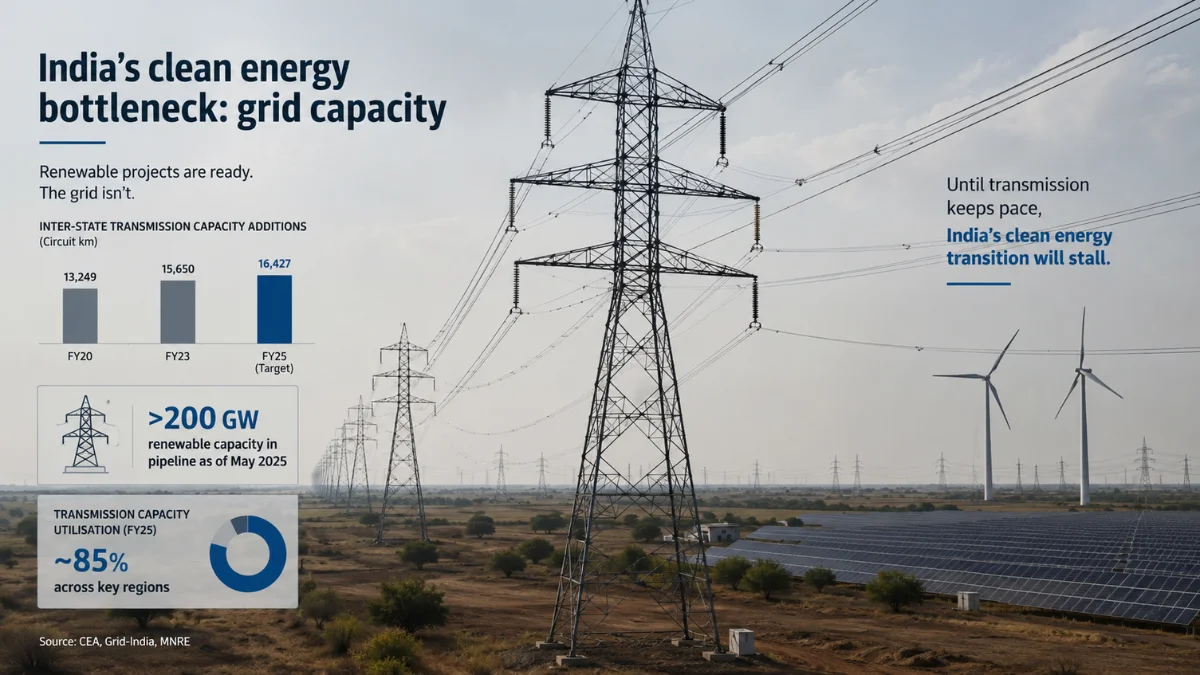
CERC began phasing out interstate transmission system waivers for new renewable projects from July 2025, aligning tariffs more closely with actual grid costs. That shift raised financing costs for developers whose projects were already delayed, not by their own execution, but by transmission infrastructure that has not kept pace with renewable capacity additions.
The regulator's own framing acknowledges the bind. Several clean energy projects have stalled specifically because transmission infrastructure was not ready when the generation assets were. The draft Fifth Amendment to the ISTS Sharing Regulations, 2026 is CERC's attempt to separate that structural delay from developer non-performance.
Waiver Scales From 100% Down to 25% by Connectivity Date
Under the draft, projects lose their full waiver progressively based on when they secure firm grid connectivity. Projects with earlier scheduled connectivity dates get the fullest relief, and any project connecting after June 30, 2028 is excluded entirely. Eligible projects must hold at least a seven-year power purchase agreement signed by December 31, 2026, and must reach commercial operation within two months of General Network Access becoming available to them.
Developers have until January 31, 2027 to submit signed contracts to the Central Transmission Utility and the National Load Despatch Centre. Where a waiver is granted, it runs for up to 25 years from the commercial operation date. The relief covers solar, wind and hybrid renewable generating stations, plus battery storage systems built alongside them, including projects scheduled as a single combined entity. CERC has said implementation procedures will follow within 60 days of the regulation's final notification.
Relief Addresses Charges, Not the Curtailment Losses Behind Them
The waiver targets one specific cost: the transmission charges developers pay whether or not their plant can actually dispatch power. It does not compensate for revenue lost to curtailment itself, which developers have separately flagged as a larger and growing drag on project economics as transmission buildout lags capacity additions.
India needs an estimated ₹5-6 trillion in transmission investment through FY2032 to keep pace. This waiver does not close that gap. It only softens who bears the cost while the buildout catches up.
For lenders and equity investors in delayed renewable and battery storage assets, the proposal reduces one source of balance sheet strain without addressing the underlying bottleneck. That distinction matters for how the sector reads the move: relief for the financing side of stalled projects, not a fix for the grid capacity shortfall driving the stalls in the first place.
What to Watch
Whether the August 31 comment window produces changes to the sliding scale or the June 2028 connectivity cutoff before final notification. Whether industry bodies press CERC to extend relief toward curtailment-related revenue losses, not just transmission charges. And whether the 60-day implementation timeline holds once the regulation is finalised, given transmission capacity itself remains the constraint the waiver works around rather than resolves.
For more climate news click here