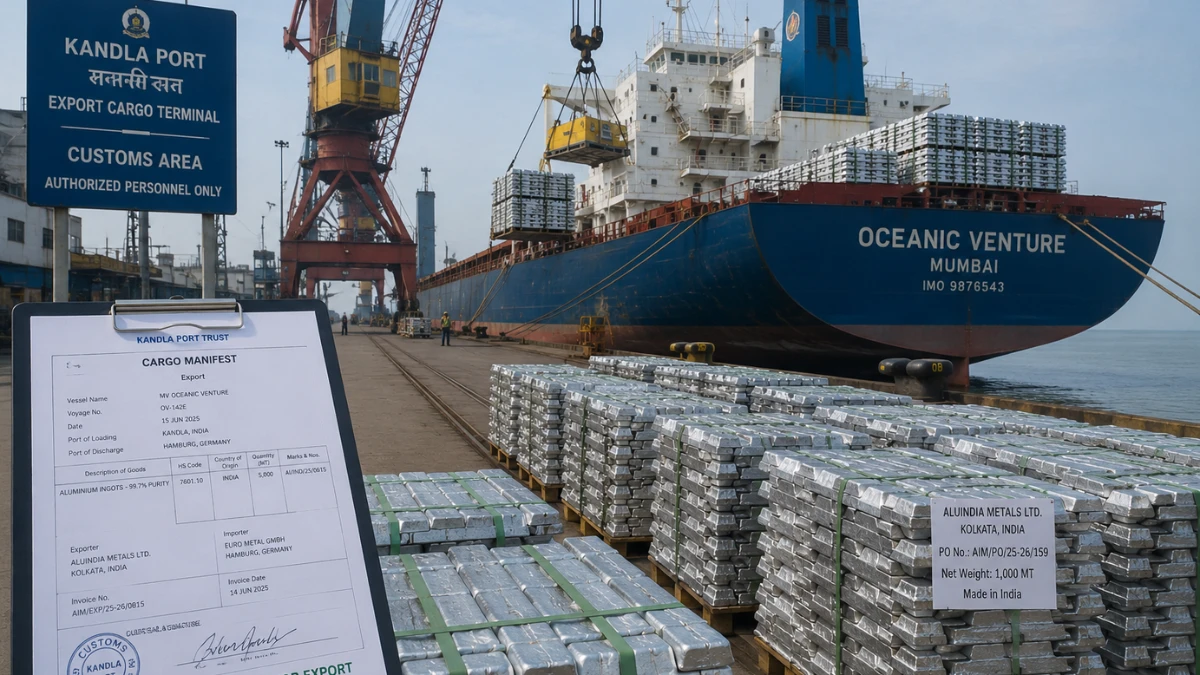
India Faces 25% CBAM Tax Burden With No Carbon Tax Offset
As Europe's carbon border tax completes its first full year, the cost is already showing up in a specific trade number rather than a projection.
A carbon levy the European Union began charging on January 1 has already cut India's unwrought aluminium shipments to the bloc by more than 40 percent in a single year, and the country has no domestic carbon tax to offset it.
India's exports of unwrought aluminium to the EU fell to 10,874.72 tonnes in the year to January 2026, down from 18,653.8 tonnes a year earlier, a decline of 41.7 percent, as the EU's Carbon Border Adjustment Mechanism began pricing the carbon embedded in imported metal.
The mechanism, which took effect January 1, 2026, charges importers for the emissions embedded in iron, steel, cement, aluminium, fertilisers, electricity and hydrogen entering the EU, with the certificate price tied to the bloc's own emissions trading allowances, currently trading between 87 and 90 euros per tonne of carbon dioxide. Where an exporting country already charges a domestic carbon price, EU importers can deduct it. India has no such mechanism, which means the full CBAM cost currently lands on Indian exporters rather than being partially offset.
A 41.7 Percent Drop in a Single Trade Category
The volume decline is specific to unwrought aluminium, the raw form of the metal before further processing, and reflects year-over-year, January-to-January trade data. Indian Chamber of Commerce figures put total CBAM-covered Indian exports to the EU above 6 billion euros, with iron and steel the largest exposure and aluminium second. The European Parliament's environment committee is separately weighing an expansion of CBAM's scope to roughly 180 additional aluminium and steel products starting January 2028, which would widen the exposure further.
GTRI Sees Exporters Absorbing the Cost Through Price Cuts
The Global Trade Research Initiative estimates that Indian aluminium and steel exporters may need to cut prices by 15 to 22 percent for EU buyers to absorb the carbon levy within existing margins rather than pass the full cost downstream. That is a direct hit to exporter profitability, not a cost that gets distributed across the supply chain evenly.
CSE Ties the Squeeze to a Documented 25 Percent Burden
A 2024 Centre for Science and Environment study, using three years of trade data, estimated that at a carbon price of 100 euros per tonne of carbon dioxide, CBAM could impose an average additional tax burden of 25 percent on India's affected exports. The same study found CBAM-covered goods made up 9.91 percent of India's total exports to the EU in 2022-23, equivalent to about 0.2 percent of India's GDP that year.
The immediate loser is exporter margin: with no domestic carbon price to credit against the EU levy, Indian aluminium producers are absorbing a cost European producers largely don't face on the same terms, at least until the EU's own free allowances phase out further. The open question is whether India's new Carbon Credit Trading Scheme, which set its first compliance targets this year, could eventually give exporters a domestic carbon price the EU would recognize for a CBAM deduction. Nothing published so far confirms the EU would treat CCTS certificates as equivalent, and the schemes were not designed with that alignment in mind.
Trishant Dev, deputy programme manager for climate change at CSE, linked the finding directly to the trade data now emerging: "an estimated 25 per cent price burden on exports."
What to Watch
Watch whether the European Parliament finalizes the CBAM scope expansion covering additional aluminium and steel products for 2028, and whether India's CCTS develops a credible link to CBAM's carbon-price deduction mechanism. Also watch the next full-year trade data release, which will show whether the 41.7 percent drop in unwrought aluminium exports is a one-off adjustment period or the start of a sustained decline.
For more climate news click here