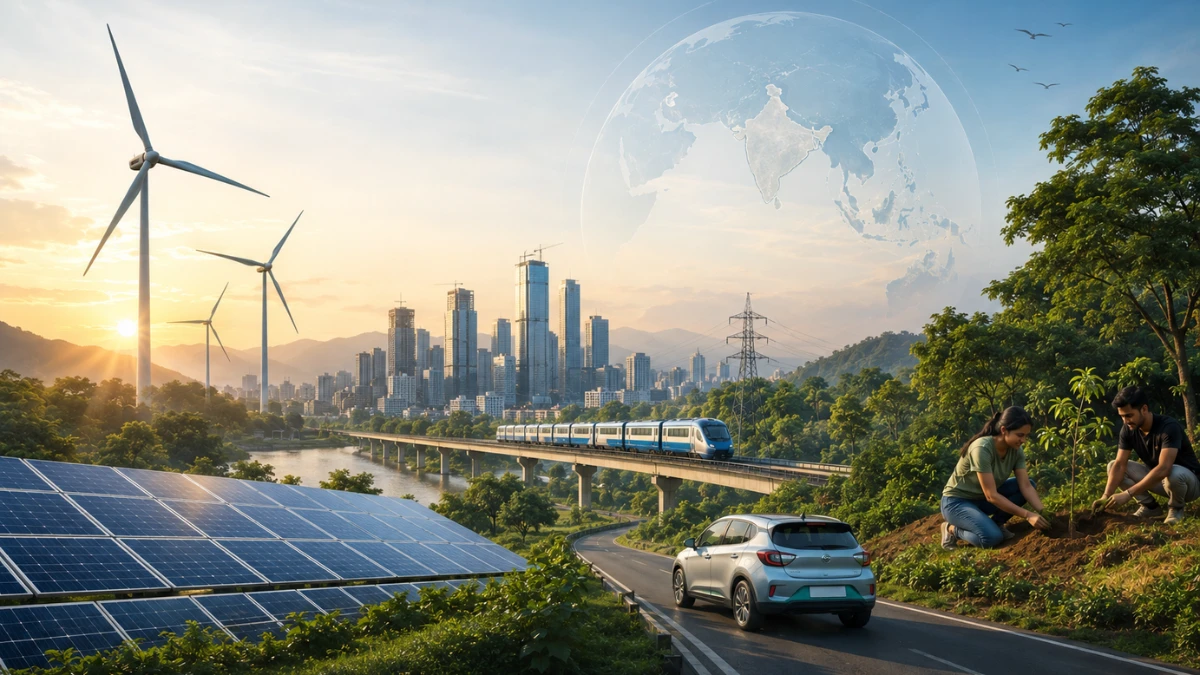
India’s net-zero ambition is no longer just a distant climate aspiration.
It is becoming a defining economic, technological and social transformation. India has committed to achieving net-zero emissions by 2070, while its updated climate commitments have established important milestones along the way. In March 2026, India approved its 2031–2035 Nationally Determined Contribution (NDC), including a target to reduce the emissions intensity of GDP by 47% from 2005 levels by 2035, achieve 60% cumulative installed electricity capacity from non-fossil sources, and create a 3.5–4.0 billion tonne CO₂-equivalent carbon sink through forest and tree cover. (Press Information Bureau)
India has already made significant progress. As of June 2026, non-fossil sources accounted for 54.18% of installed electricity capacity, while the country had achieved a 37.38% reduction in GDP emissions intensity from 2005 levels in 2022. (Press Information Bureau)
But reaching net zero is fundamentally different from reaching an interim milestone.
It requires a transformation across energy, industry, transport, buildings, agriculture, finance, technology and—perhaps most importantly—human behaviour.
So how can India ensure that its 2070 net-zero target remains achievable rather than merely aspirational?
Here are five priorities that could make the difference.
1. Move From Renewable Energy Capacity to a Truly Clean Energy System
India has demonstrated remarkable progress in expanding non-fossil electricity capacity. The country crossed the 50% non-fossil installed-capacity milestone in June 2025, more than five years ahead of the original 2030 target. (Press Information Bureau)
But installed capacity is only one part of the story.
India’s growing economy will require substantially more electricity in the coming decades as transport, industry, buildings and other sectors become increasingly electrified.
The next challenge is therefore to ensure that clean electricity is:
- Available when needed
- Affordable for consumers and businesses
- Supported by adequate transmission infrastructure
- Backed by storage and grid flexibility
- Integrated with distributed energy systems
- Reliable enough for industrial-scale use
Solar and wind will remain critical, but India’s transition will require a diversified portfolio that includes storage, hydro, nuclear, green hydrogen and other low-carbon technologies.
The bigger opportunity
India should aim not simply to add renewable capacity, but to build a resilient, flexible and increasingly decarbonised energy ecosystem.
The goal should be:
More clean electricity → more electrification → lower fossil-fuel dependence → lower emissions.
That requires coordinated planning across generation, transmission, distribution, storage and demand.
2. Decarbonise the Hard-to-Abate Sectors
Power-sector decarbonisation alone will not deliver net zero.
Some of India’s largest emissions challenges lie in sectors where electrification is difficult or where industrial processes themselves generate emissions.
These include:
- Steel
- Cement
- Chemicals
- Fertilisers
- Heavy transport
- Shipping
- Aviation
- Mining
- Construction
India therefore needs to accelerate the adoption of technologies such as green hydrogen, energy-efficient industrial processes, electrification, alternative fuels, circular production systems and carbon management.
The National Green Hydrogen Mission is already designed to position India as a global hub for green hydrogen production, utilisation and export. (Press Information Bureau)
But technology adoption needs to be accompanied by market creation.
Businesses need clear signals about:
- Future carbon costs
- Green procurement
- Product standards
- Financing mechanisms
- Infrastructure
- Long-term demand
Make decarbonisation commercially attractive
The transition will happen faster when low-carbon products are not merely environmentally preferable but also economically competitive.
Green steel, low-carbon cement, sustainable aviation fuels and green hydrogen need markets.
Government procurement, private-sector purchasing commitments and appropriate financial incentives can help create those markets.
3. Make Green Skills a National Workforce Priority
Technology cannot deliver the net-zero transition without people who know how to deploy it.
This may be one of India’s most underestimated climate challenges.
A net-zero economy requires professionals who understand:
- GHG accounting
- Carbon footprint measurement
- ESG reporting
- Climate risk
- Renewable energy
- Energy efficiency
- Circular economy
- Sustainable finance
- Green construction
- Waste management
- Sustainable supply chains
- Climate technology
And these skills will not be required only by environmental specialists.
An engineer will need to understand carbon implications.
A finance professional will need to understand climate risk.
An architect will need to understand energy performance.
A procurement manager will need to understand sustainable sourcing.
An HR professional will need to understand the changing green workforce.
A business leader will need to understand transition risk.
Green skills must move from the margins to the mainstream
India’s net-zero transition is also an employability opportunity.
Just as digital literacy became essential across professions, green literacy and green skills can become foundational capabilities across India’s workforce.
This is where universities, vocational institutions, professional bodies and businesses have a critical role.
If India wants to build a net-zero economy by 2070, it needs to start building the net-zero workforce today.
4. Make Every Business Part of the Transition
India’s net-zero target cannot be delivered by government alone.
Large corporations have an important role—but so do India’s millions of MSMEs.
Small and medium enterprises form a critical part of manufacturing and supply chains. Their energy use, resource consumption, waste generation and emissions can therefore have significant cumulative impact.
The next phase of India’s climate journey must move from:
“What is the government’s climate target?”
to:
“What is my organisation’s contribution to that target?”
Businesses can begin by measuring:
- Scope 1 emissions
- Scope 2 emissions
- Relevant Scope 3 emissions
- Energy consumption
- Water consumption
- Waste generation
- Material use
- Supply-chain impacts
Measurement should then lead to action.
From ESG reporting to ESG performance
ESG should not become another reporting exercise.
The objective should be to use sustainability data to make better business decisions.
A manufacturing company that measures energy consumption can identify efficiency opportunities.
A logistics company that measures fuel consumption can optimise routes.
A retailer that measures packaging waste can redesign its supply chain.
An MSME that understands its carbon footprint can become better prepared for sustainability requirements from larger customers and export markets.
This is how climate action becomes a business strategy rather than a compliance burden.
5. Turn Climate Action Into an Everyday Habit
The final piece of the net-zero puzzle is often overlooked:
people.
India’s transition will ultimately be shaped by millions of decisions made every day.
How we travel.
What we eat.
What we buy.
How much energy we consume.
How much waste we generate.
How we use water.
Whether we repair or replace.
Whether we choose reusable or disposable.
Government policy and corporate action are essential, but behavioural change can amplify both.
India’s LiFE—Lifestyle for Environment initiative explicitly recognises the role of sustainable lifestyles and seeks to make environmental responsibility part of everyday behaviour. (Press Information Bureau)
Make sustainability measurable
One way to make this behaviour meaningful is to help people understand their own environmental impact.
Carbon footprint calculators.
Water footprint calculators.
Plastic footprint calculators.
Waste calculators.
Event footprint calculators.
These tools transform an abstract climate problem into something personal and measurable.
And what gets measured can be improved.
Imagine a culture where people periodically ask:
“What is my carbon footprint?”
in the same way they ask:
“How many steps did I take today?”
That is when climate action moves from awareness to habit.
The Missing Ingredient: Accountability
India’s net-zero journey needs milestones between now and 2070.
A long-term target can easily become distant unless it is translated into measurable five-year and annual outcomes.
India’s new 2031–2035 NDC provides an important bridge. Its targets include a 47% reduction in GDP emissions intensity by 2035, 60% non-fossil installed electricity capacity and a 3.5–4.0 billion tonne carbon sink. (Press Information Bureau)
The next step is to ensure that progress is:
Measured → Reported → Reviewed → Corrected → Accelerated.
India already has tools such as NITI Aayog’s India Energy Security Scenarios and India Climate & Energy Dashboard to support data-driven transition planning and monitoring. (NITI Aayog)
The challenge now is to make climate performance increasingly visible at every level—from national and state governments to cities, businesses, institutions and citizens.
India’s Net-Zero Journey Is Also an Economic Opportunity
There is a tendency to view net zero primarily through the lens of what India must give up.
But the transition can also create enormous economic opportunities.
It can accelerate:
- Renewable energy
- Battery manufacturing
- Electric mobility
- Green hydrogen
- Climate technology
- Sustainable infrastructure
- Circular economy businesses
- Green finance
- Carbon management
- Green jobs
- Sustainable manufacturing
NITI Aayog’s 2026 work on pathways towards Viksit Bharat and net zero highlights the importance of energy efficiency, electrification, technology upgrades and cleaner production methods in reducing energy intensity over the long term. (NITI Aayog)
The objective, therefore, should not be to choose between economic growth and climate action.
It should be to build an economy in which economic growth increasingly creates less environmental damage and greater resilience.
The Five-Part Net-Zero Formula
If India’s 2070 target is to remain on schedule, the transition needs to happen simultaneously across five fronts:
1. Clean Energy
Build a reliable, affordable and increasingly fossil-free energy system.
2. Green Industry
Decarbonise hard-to-abate sectors and create markets for low-carbon products.
3. Green Skills
Build the workforce capable of designing, implementing and managing the transition.
4. Green Business
Make every company—from the largest corporation to the smallest MSME—a participant in climate action.
5. Green Citizens
Turn sustainable choices from occasional campaigns into everyday habits.
These five pillars are interconnected.
Clean energy needs skilled people.
Green industries need green finance.
Green businesses need accurate data.
And all of them ultimately depend on people.
2070 Will Be Decided Long Before 2070
India’s net-zero deadline may be 2070, but the decisions determining whether that target is achieved will be made much earlier.
The infrastructure built in the 2030s.
The industries transformed in the 2040s.
The technologies commercialised in the 2050s.
The skills developed today.
The habits adopted tomorrow.
India has already demonstrated that ambitious climate milestones can be achieved ahead of schedule. The country reached 50% non-fossil installed electricity capacity in 2025, five years ahead of the original target. (Press Information Bureau)
The next challenge is much larger.
India must make the transition deep, economy-wide and irreversible.
Net zero cannot remain the responsibility of a climate ministry, an ESG department or a handful of renewable-energy companies.
It has to become a national operating principle.
Government must enable it.
Business must build it.
Institutions must skill for it.
And citizens must live it.
Because if India wants to reach net zero on time, climate action cannot be an event that happens in 2070.
It has to become an everyday habit—starting now.