Alumina Waste Becomes Cement Substitute as Trinity Concrete Moves to Industrial Batching
Construction’s carbon problem and alumina’s waste problem may share one fix, provided the chemistry holds at commercial scale.
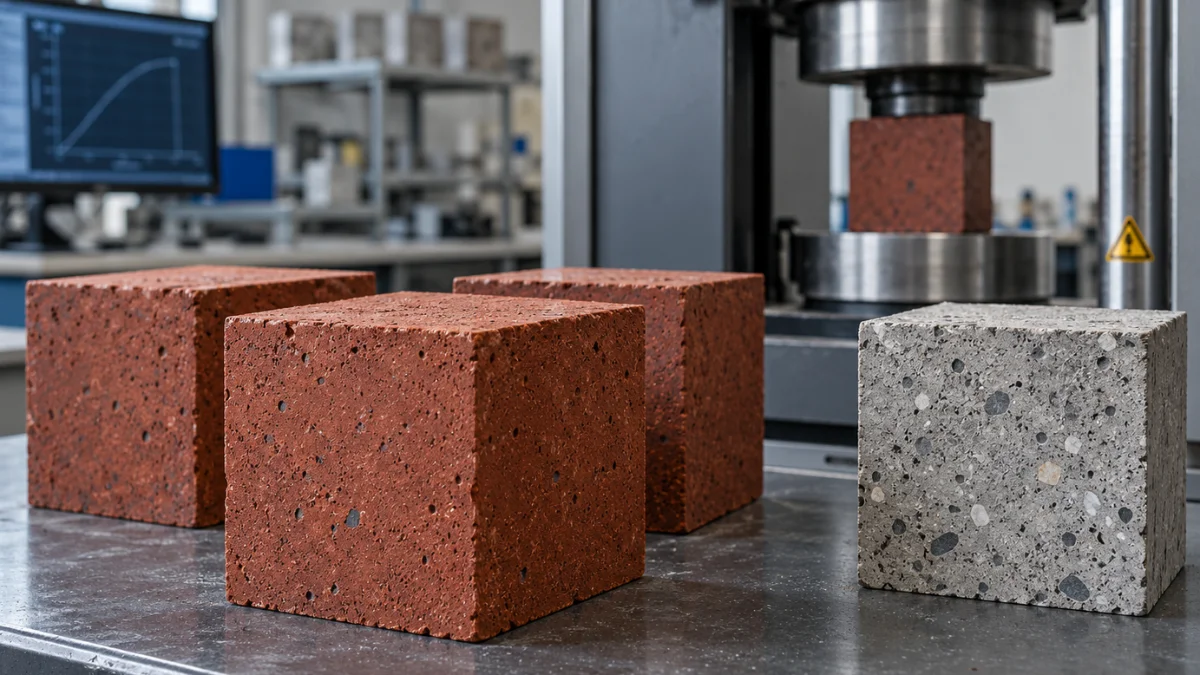
Concrete built on bauxite refining residue produced 67.8% to 79.8% less carbon than a CEM II-A/L cement benchmark across raw materials, transport and manufacture, Trinity College Dublin reported on October 22. The work has progressed from laboratory mixes to industrial-scale production trials.
Durability Holds, but Activator Cost Blocks Commercial Scale
Red mud, the caustic sludge left after alumina is extracted from bauxite, is typically held in long-term storage. Professor Sara Pavia’s team, working with Gannon Eco and McGrath Quarries under Enterprise Ireland’s Innovation Partnership programme, uses it as the base of a geopolymer binder that avoids clinker altogether. Under sulphate exposure, wet-dry cycling and frost, lab samples equalled or outperformed conventional concrete. Trinity names two obstacles: keeping the mix workable through transport and placement, and the expense of chemical activators.
The comparator matters. CEM II-A/L is a Portland-limestone cement that already carries less carbon than ordinary Portland cement. Earlier Trinity geopolymer work cited savings near 70% against Portland cement concrete, so the two figures should not be compared directly.
India’s Cement and Alumina Sectors Both Carry Binding Targets
India’s exposure is sharper. Under the Greenhouse Gases Emission Intensity Target Rules, 2025, notified by MoEFCC in October 2025, 186 cement units and 13 aluminium units carry legally binding intensity targets, with Hindalco, NALCO and Vedanta among the covered companies. A binder built on refinery residue would give cement producers a new abatement lever and alumina refiners an outlet for a costly by-product.
What to Watch
Watch whether Trinity publishes peer-reviewed lifecycle data and activator costs per cubic metre from the industrial trials. Watch also whether an Indian refiner or cement major announces a red mud binder trial before the 2026-27 CCTS compliance year closes.
For more climate news click here