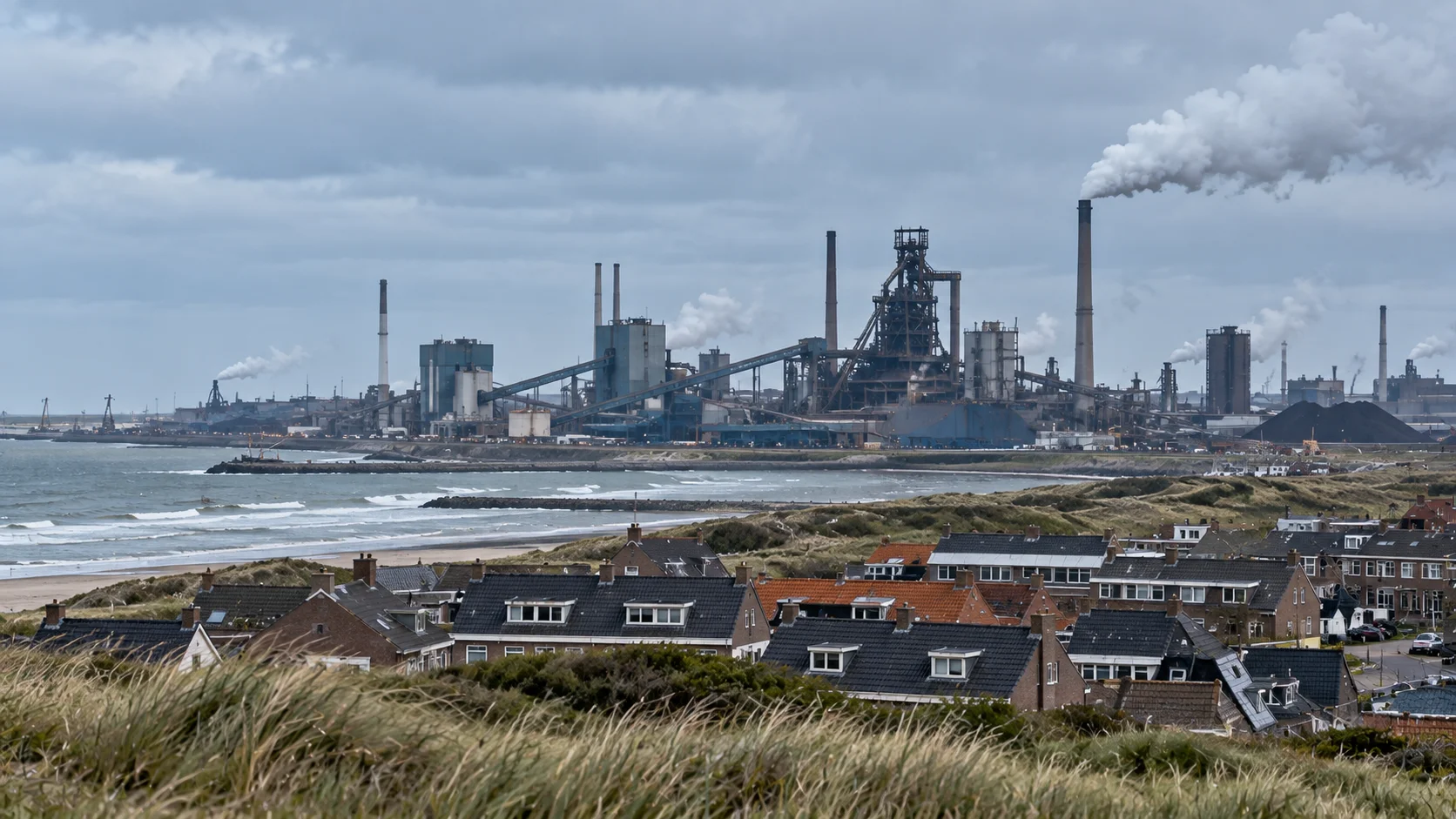
EU Carbon Allowance Rethink Stalls Tata Steel's IJmuiden Decarbonisation Contract
A five-month delay on a €2 billion subsidy deal shows EU carbon policy repricing Europe's green steel transition, with an Indian balance sheet carrying the gap.
The Dutch state and Tata Steel now have until 1 March 2027 to turn a non-binding pledge of up to €2 billion into a final contract to decarbonise the IJmuiden steelworks. The five-month extension, announced on 25 September, leaves Europe's most closely watched green steel subsidy unsigned a year after its outline was agreed.
The Deadline Slipped Because the Economics Moved
The Joint Letter of Intent, signed in September 2025 with the Dutch government and the Province of North Holland, was conditional from day one. At signing, Tata Steel named four open points: CO2 levy policy, network tariffs, steel slag regulation and legacy liabilities. None has been settled. A fifth has since been added: the European Commission's revised timeline for phasing out free CO2 allowances.
That fifth item carries the most weight. Free allocation under the EU Emissions Trading System is the cushion that keeps blast furnaces viable while replacement capacity is built. Move the date that cushion disappears and the payback on a new plant moves with it. The parties say they need time to "work towards a realistic approach to the integrated health and decarbonisation project." In deal language, that phrasing usually signals a revised scope or spending profile.
A 43% Emissions Cut, Funded in Three Layers
The plan covers the 7 million tonne per annum IJmuiden site. Phase 1 retires Blast Furnace 7 and Coke and Gas Plant 2, replacing them with a direct reduced iron plant running initially on natural gas and an electric arc furnace. According to Tata Steel Nederland, this would cut Scope 1 emissions by about 5.4 million tonnes a year against a 12.6 million tonne baseline, a 43% reduction. Carbon capture in depleted North Sea gas fields (0.6 Mt) and a later switch to biomethane or hydrogen would take the cut to 57%.
The funding stack has three layers. The Dutch state offers up to €2 billion. Tata Steel has applied for roughly €0.3 billion from the EU Innovation Fund. The balance comes from Tata Steel Nederland's cash flow, project finance debt and contributions from Tata Steel Limited in India.
The package also carries local health targets for Wijk aan Zee, including a 35% cut in particulate matter against 2019 levels. That linkage raises the political cost of delay: Dutch prosecutors are separately pursuing a long-running pollution case against Tata Steel Nederland executives, according to media reports.
Why the Delay Lands on an Indian Balance Sheet
The last funding layer is the one to watch from India. Any gap between the state subsidy and the project's true cost falls on Tata Steel's consolidated accounts, which also fund the group's domestic expansion.
The trade exposure runs the same way. The EU's Carbon Border Adjustment Mechanism entered its definitive phase in January 2026, and Britain's version follows in 2027. As Climate Watch reported on 21 September, iron and steel were left out when the UK recognised India's carbon credit scheme. A lower-carbon plant inside Europe's border wall is a hedge for the group. A delayed one leaves Tata holding high-carbon capacity on both sides of that wall.
Who Gains Time, and Who Pays for It
The Dutch government gains room to settle tariff and slag rules before committing capital. Tata Steel gains leverage to renegotiate the size or sequencing of Phase 1. Wijk aan Zee residents, whose health measures ride on the same agreement, bear the cost of waiting. The unresolved question is whether the revised allowance timeline makes the project uneconomic at €2 billion or simply more expensive.
What to Watch
The 1 March 2027 deadline is the hard marker, but the scope of the final agreement matters more than its date. A smaller or re-phased Phase 1 would signal that the subsidy no longer covers the gap. Watch for the EU Innovation Fund decision on the €0.3 billion application, Dutch network tariff rulings for large industrial users, and the Tata Steel board's final investment decision.
For more climate news click here