Haryana Battery Storage Tariff Jumps 19% as NLC Wins 265 MW Tender
As discoms lean on batteries to cover evening peaks, the price of two-hour storage in India has stopped falling, even with a central subsidy attached.***
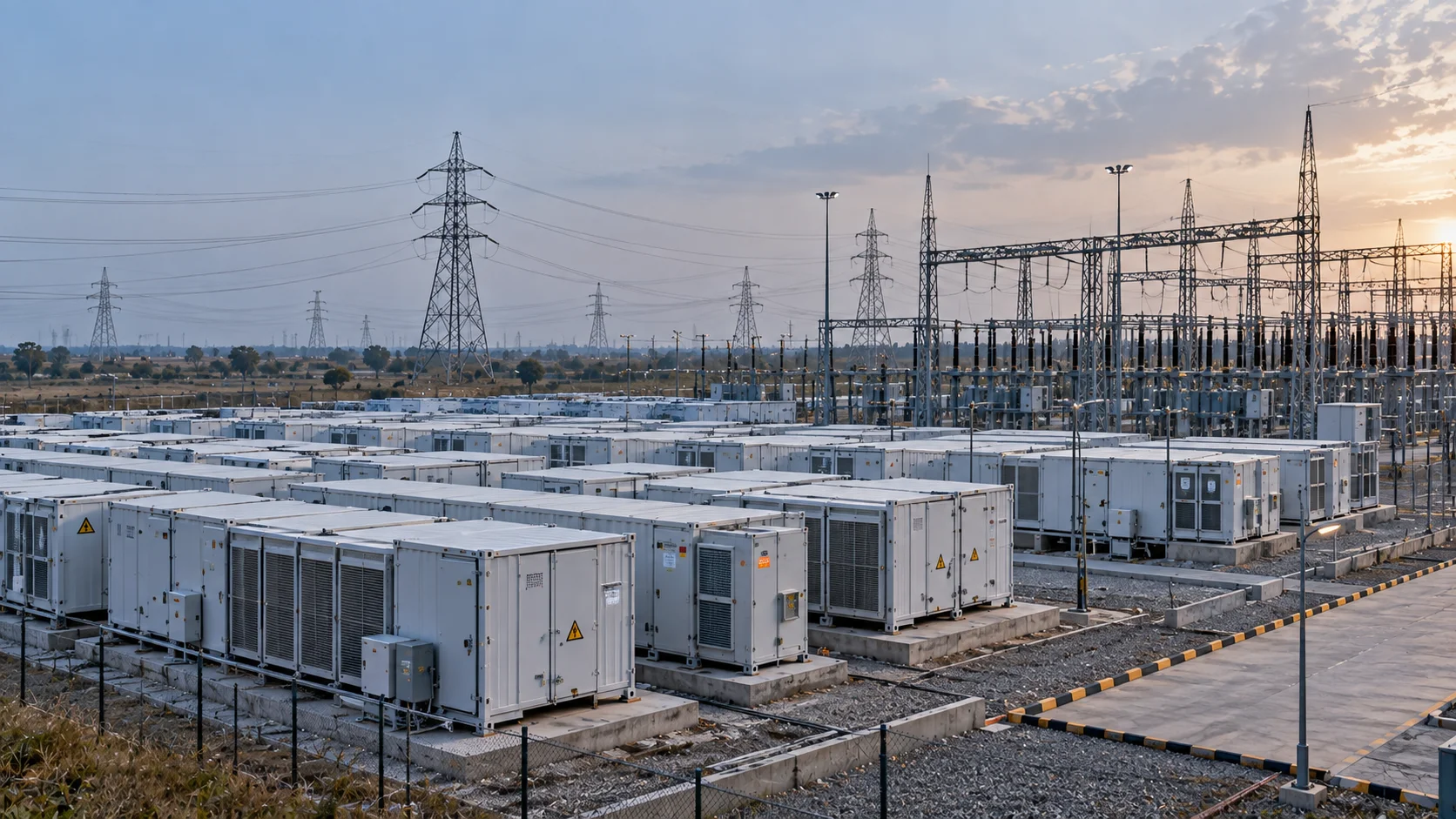
Two-hour battery storage for northern Haryana will cost ₹2.35 lakh per MW per month, roughly 19% more than the ₹1.97 lakh that SJVN's previous Haryana auction discovered in February 2026. The winning bidder for the 265 MW/530 MWh contract is NLC India Renewables Limited (NIRL), the clean energy subsidiary of state-owned NLC India.
Standalone Storage Has Become a Discom Peak-Management Tool
Indian distribution companies are increasingly buying storage as a service rather than as an add-on to solar parks. The model is simple: a developer builds and runs the batteries, and the discom pays a fixed monthly charge for the capacity, drawing on it when evening demand outruns daytime solar output.
Uttar Haryana Bijli Vitran Nigam Limited (UHBVNL) is the buyer here. SJVN acted as the implementing agency and ran the process through tariff-based competitive bidding, with bids closing on August 21, 2026.
What the Contract Covers
The award bundles two projects: a 250 MW/500 MWh system and a smaller 15 MW/30 MWh unit. Both carry viability gap funding (VGF) of up to ₹18 lakh per MWh. The larger project draws on the Power System Development Fund, while the smaller one falls under the state component of the VGF scheme, capped at the same per-MWh figure or 30% of capital cost.
By Climatora's calculation, the maximum subsidy across all 530 MWh comes to about ₹95 crore. At full contracted capacity, UHBVNL's capacity payments would run near ₹75 crore a year.
NIRL finished ahead of a field that included Rama Reflection India, SolarWorld Energy, Pace Digitek, Sun Drop Energia and Oriana Power, according to Saur Energy.
Same Agency, Same State, Higher Price
The comparison with February is unusually clean. Both auctions were run by SJVN, for the same Haryana discom, for two-hour systems, with viability gap funding from the same PSDF window. Seven months apart, the discovered tariff rose by ₹38,000 per MW per month.
The new figure also sits close to recent Maharashtra outcomes. MSEDCL tenders, won by Oriana Power and GK Energy, cleared between ₹2.38 lakh and ₹2.40 lakh per MW per month. That places February's ₹1.97 lakh as the outlier, not the new baseline.
The implications extend beyond one contract. Because the VGF cap is fixed per MWh, any rise in project cost flows straight into the tariff the discom pays. For UHBVNL, a fixed monthly charge raises the price of peak cover whether or not the batteries are fully dispatched. For MSEDCL, which supplies Pune and most of Maharashtra, the Haryana result indicates its recent storage contracts were priced at the market rate rather than above it.
The winner also matters. A public sector bidder with a large parent balance sheet can accept thinner margins on long-tenure storage contracts than smaller private developers. The question is whether state-owned players will increasingly set the price in this segment.
What SJVN has not disclosed is why the price moved. Cell costs, financing terms, bidder mix and site-specific grid charges are all candidates, and none has been confirmed.
What to Watch
Signing of the storage purchase agreement between NIRL and UHBVNL, and the commissioning deadline it sets. The next SJVN, SECI or NHPC two-hour auction, which will show whether ₹2.3 lakh to ₹2.4 lakh is the new national band. Whether the Ministry of Power revisits the ₹18 lakh per MWh VGF cap as discovered tariffs climb.
For more climate news click here