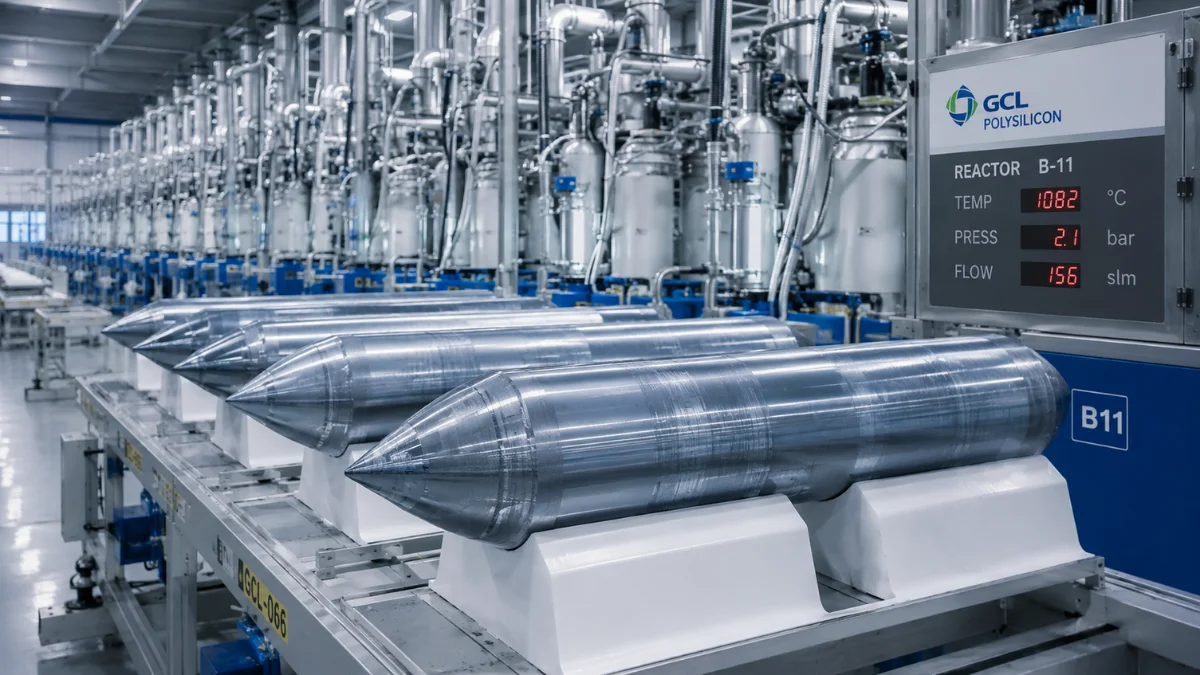
India Has Zero Polysilicon Capacity Despite 200 GW Module Output
India's solar industry can assemble 200 GW of modules a year but cannot produce a gram of the polysilicon those modules start from. The government is now weighing whether dedicated incentives can close that gap.
The Ministry of New and Renewable Energy is preparing a production linked incentive scheme aimed at more than 10 GW of domestic polysilicon manufacturing capacity, MNRE Secretary Santosh Kumar Sarangi disclosed at a Confederation of Indian Industry event on August 7. The financial size of the incentive has not been made public, and the scheme has not gone to Cabinet for approval.
Why Now
India's downstream solar manufacturing base has scaled quickly under existing incentives: module capacity now exceeds 200 GW and cell capacity is above 32 GW, built largely on roughly Rs 24,000 crore ($2.5 billion) in prior PLI support. Polysilicon, the upstream feedstock every wafer and cell depends on, sits outside that buildout entirely. India currently imports all of it, overwhelmingly from China, leaving the newly built downstream capacity exposed to a single foreign supply chain.
What Is Being Proposed
The scheme under preparation would target upward of 10 GW of polysilicon capacity, according to Sarangi. It sits alongside a separate government target of 80 GW of ingot and wafer manufacturing capacity by June 2028, part of a broader push toward full vertical integration of the solar supply chain, from polysilicon through ingots, wafers, cells and modules.
Reporting on India's current capacity is not fully consistent. PV Tech and IANS both report zero existing domestic polysilicon capacity and roughly 2 GW of wafer capacity. The Week cites a domestic polysilicon figure of roughly 2 GW, which appears to describe the wafer stage rather than polysilicon itself. Climate Watch is flagging the discrepancy rather than resolving it silently.
The gap matters because polysilicon is the most capital intensive and technically demanding stage of the solar supply chain, requiring purity levels and reactor investment far beyond cell or module assembly. China currently supplies close to the entire global market and has used export licensing and pricing as leverage in past trade disputes, which is part of why India's ministry is treating the missing stage as a strategic exposure rather than a simple manufacturing gap.
So What
A polysilicon PLI would benefit manufacturers positioned to build a stage of the supply chain none of India's incumbents currently operate at scale. It would also test whether incentive design alone can offset China's cost advantage in polysilicon, built over a decade of state backed capacity expansion. For policymakers, the open question is sequencing: whether incentives arrive before or after the 2028 ingot and wafer targets they are meant to feed, and whether a 10 GW polysilicon target is even sized correctly against 200 GW of downstream module capacity already installed.
"A further push towards vertical integration of India's solar manufacturing supply chain," was how Ankita Chauhan, an analyst at Wood Mackenzie, described the proposal's intent.
What to Watch
The scheme has not been approved by Cabinet and no financial outlay has been disclosed. Watch for whether MNRE brings a formal proposal to Cabinet in the coming budget cycle, and whether any incentive figure, when released, is sized to compete with landed Chinese polysilicon prices rather than merely subsidize a token capacity.
For more climate news click here