PM Surya Sarovar Yojana Backs 5 GW Floating Solar by FY31
India's floating solar potential has sat at roughly 100 GW on paper for years while installed capacity crept to just 700 MW; the government is now backing an attempt to close that gap with a subsidy that ties every supported megawatt to two hours of storage.
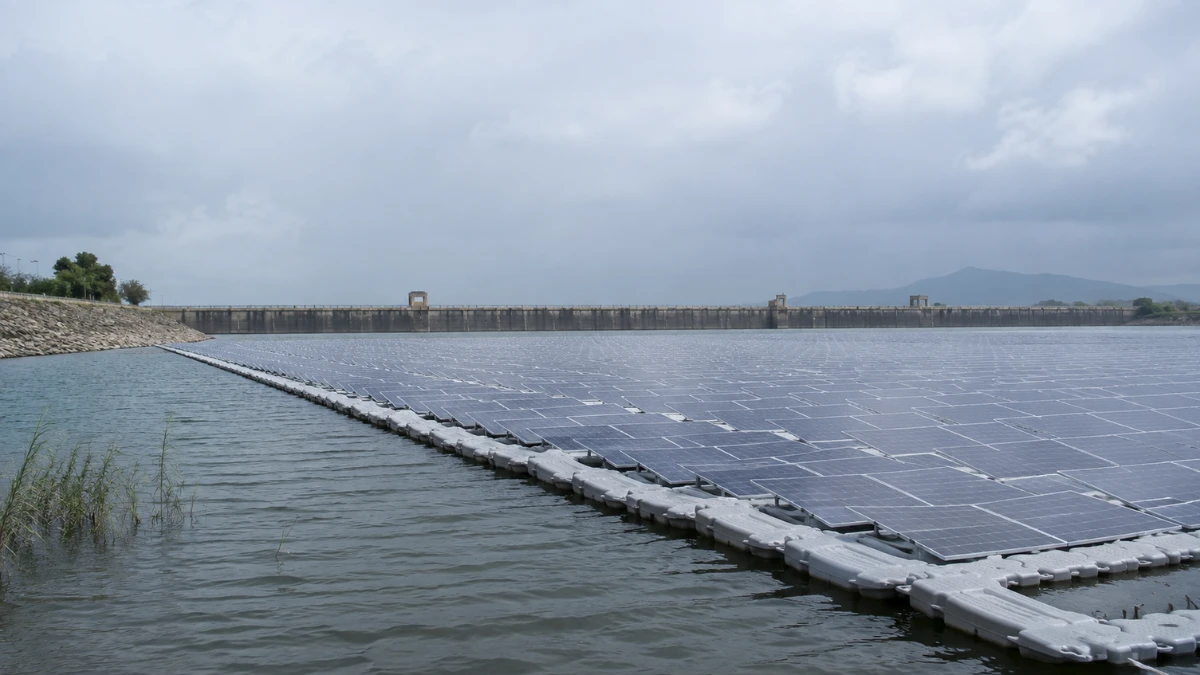
The Union Cabinet has approved Rs 5,070 crore (about $532 million) for the Pradhan Mantri Surya Sarovar Yojana, a scheme to add 5,000 MW of floating solar capacity paired with a mandatory 10,000 MWh of co-located storage, with projects sanctioned between FY2026-27 and FY2030-31.
The scheme responds to a resource assessment, not a hunch. The National Institute of Solar Energy has estimated floating solar potential of around 102.18 GWp across India's reservoirs and other inland water bodies, more than 100 times the roughly 700 MW currently installed. That gap between technical potential and deployed capacity has persisted even as land acquisition remains one of the slowest steps in utility-scale solar development, and as grid operators report rising curtailment on new renewable capacity, a dynamic Climate Watch covered following ICRA's late-July assessment of India's transmission gap.
Central Assistance Set at Rs 10 Million Per MW After Commissioning
Under the scheme, developers will receive central financial assistance of Rs 10 million per MW once a floating solar project is successfully commissioned. A separate pool of up to Rs 5 million per project is available for feasibility work, covering bathymetry, hydrography and environmental studies before construction begins. Financial support will continue to be disbursed through FY2032-33, extending well beyond the FY2030-31 sanctioning cutoff. The scheme applies across all states and union territories.
Storage Mandate Requires Two-Hour Minimum Backup at Every Site
Every project funded under the scheme must pair its solar capacity with a minimum two-hour storage duration, the source of the 10,000 MWh figure attached to the 5,000 MW target. That requirement sets the scheme apart from most of India's existing solar capacity, where storage has typically been bolted on later or left to separate FDRE tenders rather than built into the base subsidy structure from the start.
Scheme Targets Land Scarcity and a Stalled Domestic Manufacturing Push
Floating solar sidesteps the land acquisition disputes that slow ground-mounted projects by placing panels on reservoirs and industrial ponds instead. The government has also framed the scheme as an industrial policy tool, citing support for domestic manufacturing of flotation systems, solar cells, modules and storage systems, alongside an estimated 16,000 to 17,000 full-time equivalent jobs and a projected 10 million tonnes of annual carbon emissions avoided, figures drawn from the government's own release rather than independent verification. The open question is execution: whether Rs 10 million per MW is enough to offset the cost premium floating installations carry over ground-mounted solar, and whether project sanctioning can move fast enough across thousands of dispersed reservoir sites to hit 5,000 MW inside a five-year window.
What to Watch
Watch for the first tranche of project sanctions once the FY2026-27 window opens, and how many states compete for the capped feasibility-study funding. Also watch whether the gap between the FY2030-31 sanctioning deadline and the FY2032-33 disbursement cutoff signals the government expects construction delays as the default, not the exception.
For more climate news click here