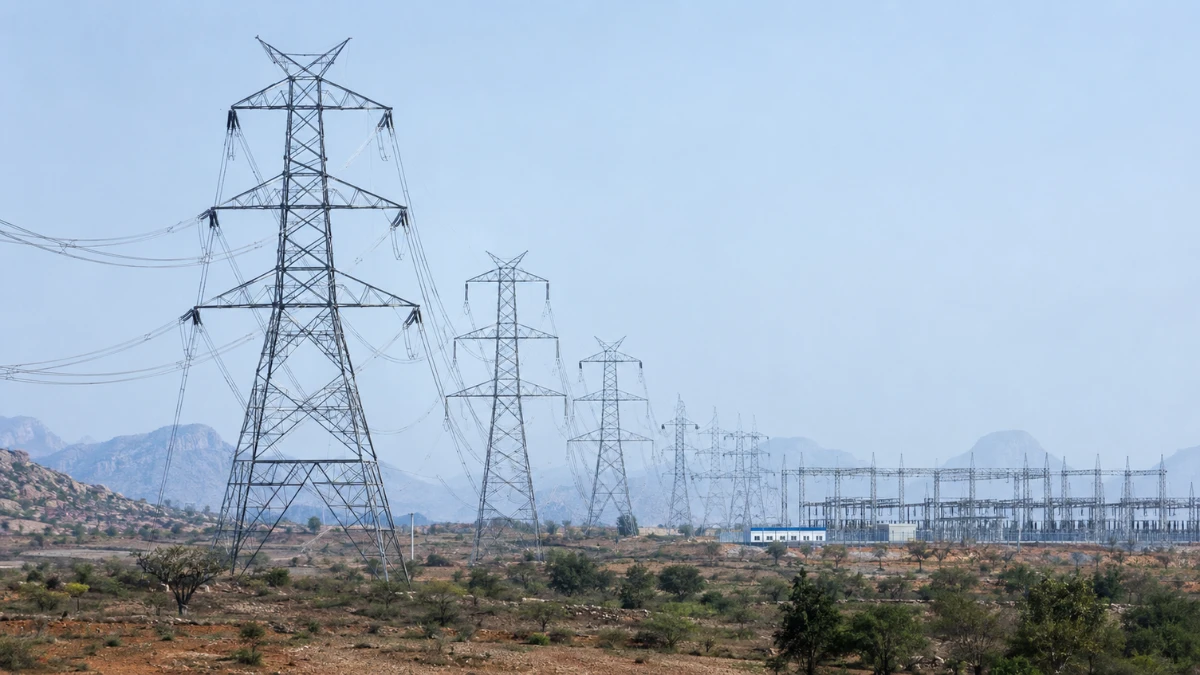
207km Transmission Line Will Evacuate Karnataka's 2 GW Ryapte Solar Park
A solar park needs somewhere for its power to go, and RECPDCL just handed that problem, along with the ₹3,200 crore price tag for solving it, to Tata Power under a competitive tender rather than a negotiated allocation.
Tata Power has taken control of Ryapte Power Transmission Ltd, a project-specific vehicle built to evacuate electricity from Karnataka's upcoming 2,000 MW Ryapte Solar Park, after winning the mandate through REC Power Development and Consultancy's tariff-based competitive bidding process.
Grid curtailment linked to insufficient evacuation capacity has become one of the most closely watched risks attached to India's renewable build-out this year. Dedicated transmission projects tied to a single generation asset, rather than shared regional grid upgrades procured separately, are the sector's most direct answer to that risk, and Ryapte is a concrete example of the model rather than a policy statement about it.
The Handover: RECPDCL to Tata Power, July 30
RECPDCL (REC Power Development and Consultancy Ltd), a wholly owned subsidiary of REC Ltd, formally transferred the Ryapte SPV to Tata Power on July 30, in a ceremony attended by officials from RECPDCL, Tata Power and Karnataka Power Transmission Corporation Limited. Monisha Barua, RECPDCL's general manager and head of department, handed the SPV to Tarun Katiyar, chief executive and managing director of Tata Power Trading Company. Tata Power will now build, own, operate and transfer the asset under a BOOT structure, with development expected to take 30 months once construction begins.
What Gets Built: Two Substations, 264 Kilometres of Line
The project scope includes a 400/220 kV substation at Ryapte and a 400/220 kV gas-insulated substation at Doddathaggalli, near Hosakote. Tata Power will construct a 207-kilometre 400 kV double-circuit line connecting Doddathaggalli, Ryapte and Kolar, plus a separate 57-kilometre 220 kV double-circuit line linking Ekarajapura, Hosakote and Sarjapura, roughly 264 kilometres of new transmission in total.
So What: A Single-Project Fix for a Sector-Wide Bottleneck
The structure matters as much as the size. Tata Power did not negotiate this mandate; it won it through RECPDCL's competitive tender, and it will build, own and operate the asset for a defined period before transferring it, rather than RECPDCL or KPTCL building the line and selling capacity themselves. That shifts construction risk and financing to a private developer with a direct commercial interest in getting the line built on schedule, since delay pushes back the date the 2,000 MW solar park can actually sell its power.
For Karnataka specifically, the project adds intra-state transmission capacity independent of any single generator, which matters because evacuation bottlenecks in India have tended to lag behind generation capacity additions by years, not months. A transmission asset commissioned on a fixed 30-month timeline, tied contractually to a BOOT structure, gives both the state grid operator and future generators in the same corridor a firmer date to plan against than a shared upgrade competing for budget across multiple projects.
What to Watch
Watch construction milestones against the 30-month timeline, since delays would directly delay when the 2,000 MW Ryapte Solar Park can begin exporting power. Watch whether KPTCL or other developers in the Tumkur-Kolar corridor tie additional generation capacity to this same transmission corridor once it is built. And watch whether RECPDCL runs more TBCB-model SPV handovers to private developers for other solar parks awaiting dedicated evacuation infrastructure.
For more climate news click here