Macquarie's Blueleaf Taps $75M Mezzanine Debt for 5 GW India Bet
A UK development bank splitting its own loan with a private institutional investor signals how India's renewable financing gap is being closed: not through bigger checks alone, but through a template for recycling development capital faster.
British International Investment has sold half of a $75 million mezzanine debt facility backing Blueleaf Energy's Indian renewable buildout to the Emerging Africa & Asia Infrastructure Fund, in a syndication designed to free up BII's own balance sheet for its next early-stage bet.
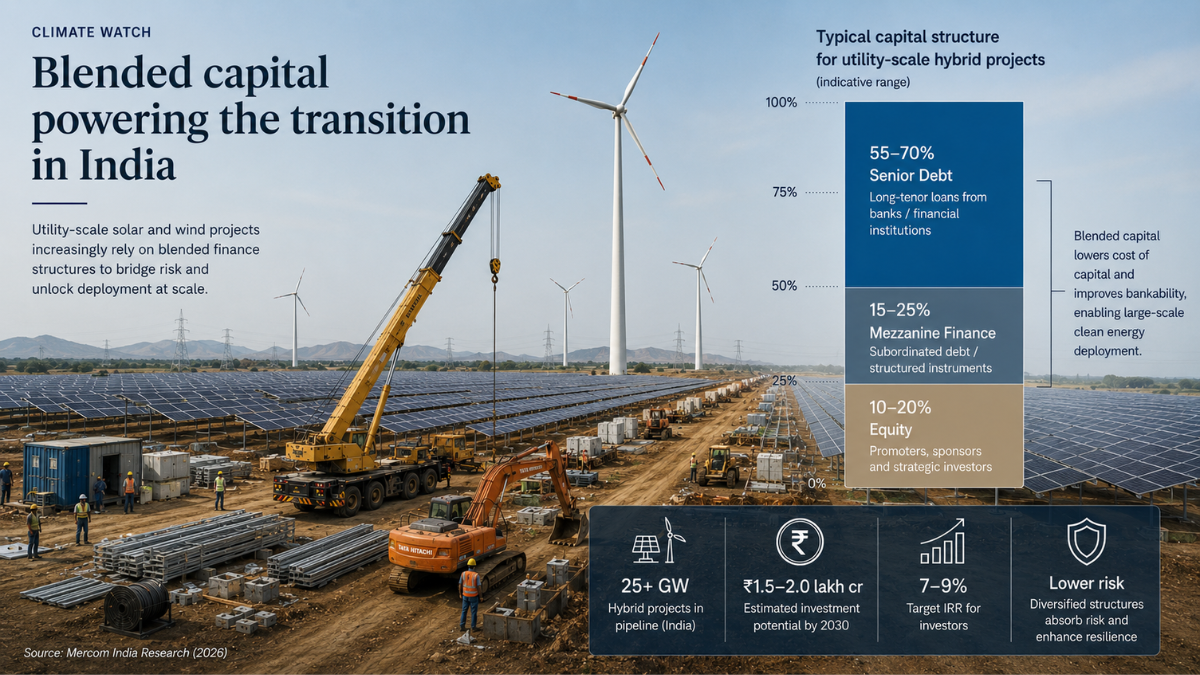
The transaction lands as India targets a 47% reduction in emissions intensity by 2035, a goal that requires far more debt capital than senior lenders alone are willing to extend to renewable developers still building operating track records. Mezzanine debt, priced between senior loans and pure equity, is exactly the layer development finance institutions have used to close that gap, and BII's decision to sell half of its exposure signals confidence the model can scale beyond a single platform.
A $75 Million Facility Gets Split Down the Middle
Under the transaction, EAAIF acquires a 50% participation, $37.5 million, in the mezzanine facility BII originally extended to Blueleaf Energy. BII retains the remaining $37.5 million and stays engaged in the platform's expansion. The facility underwrites 850 MW of greenfield solar, wind and battery storage capacity, part of Blueleaf's target to build a 5 GW India portfolio by 2030.
Blueleaf's pipeline is expected to generate more than 3.2 GWh of renewable electricity annually once operational, avoiding an estimated 3.1 million tonnes of carbon dioxide emissions a year, according to BII.
Macquarie's Regional Platform, a Repeat DFI Bet
Blueleaf Energy is a pan-Asian renewable independent power producer owned by Macquarie Asset Management. This is not BII's first exposure to the company. The mezzanine facility builds on an initial BII investment made in 2025, which the DFI says demonstrated that mezzanine debt works as a financing instrument in India's renewables market. EAAIF, managed by Ninety One, is booking its third India renewable investment through this deal, extending a mandate that formally spans Africa and Asia infrastructure into a market it is treating as central rather than peripheral.
So What: A Template for Recycling Development Capital
The structure matters more than the dollar figure. Rather than holding the full $75 million to maturity, BII originated the risk, proved the deal performs, then sold half to a private institutional investor. That is a repeatable mechanism, not a one-off transaction.
For India's renewable sector, mezzanine debt sits between senior project debt and pure equity, a tranche that has historically stayed thin because few lenders will underwrite that higher-risk layer. A DFI proving out the tranche, then syndicating it to an infrastructure fund, gives other pan-Asian developers a template for unlocking similar capital. It also signals private infrastructure funds are prepared to scale India exposure through debt instruments, not just equity stakes, adding a financing channel that has been comparatively underused against the country's renewable build-out targets.
Leslie Maasdorp, chief executive of BII, described the deal as reflecting the institution's "originate-to-share" strategy under British Climate Partners.
What to Watch
Watch whether BII and EAAIF announce further syndications under this model, particularly with other Macquarie- or DFI-backed platforms scaling India pipelines. Watch Blueleaf's progress toward its 5 GW 2030 target, and whether subsequent tranches attract additional institutional investors beyond EAAIF. And watch whether other development finance institutions active in India, such as the World Bank's IBRD or the Asian Development Bank, adopt similar syndicate-then-recycle structures for their own renewable energy commitments.
For more climate news click here