Solar Additions Surge 43% in India, But 24 GWh a Day Now Goes to Waste
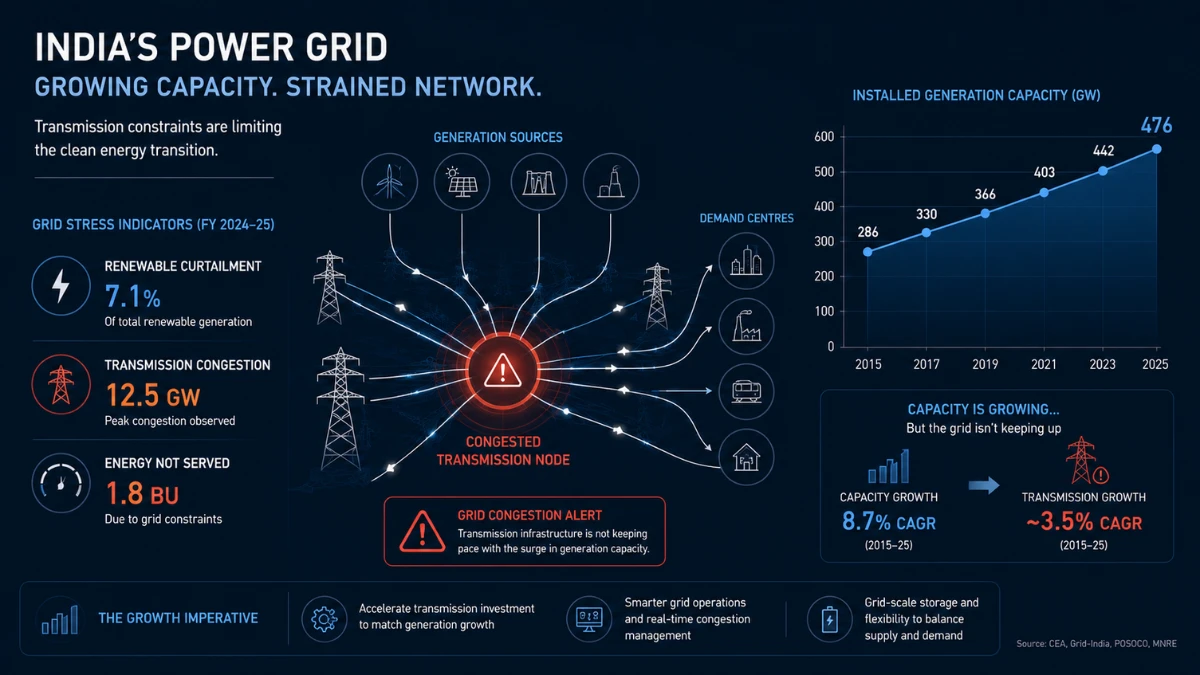
India's renewable buildout is outrunning the grid built to carry it, and the clearest evidence is now showing up as wasted power, not missed capacity targets.
India added 30.6 GW of renewable energy capacity in the first half of 2026, a 25% increase year on year, according to figures cited by New and Renewable Energy Minister Pralhad Joshi. Solar led the growth, rising 43% year on year with 26.34 GW added between January and June. As of June 30, India's total installed renewable capacity, including hydro, stood at 288 GW, accounting for 52% of the country's total power capacity, per Central Electricity Authority data. Solar alone accounts for 162 GW, wind for 57 GW.
A Growth Rate the IEA Calls Unmatched, With a Caveat
The International Energy Agency's latest report places India's 2025 renewable capacity growth, nearly 60% year on year, ahead of every other major market. The country commissioned close to 50 GW of solar PV that year, double the prior year's pace, while wind additions also doubled to more than 6 GW. Offshore wind is the exception to this trajectory: the IEA reports that offshore projects are not materializing in India due to cancellations and delays, a pattern it links to a global slowdown. "Lower expectations have been driven by policy shift in the United States and project cancellations and delays in Europe, India and Japan due to cost and supply chain challenges," the IEA said.
The Grid Is Now the Binding Constraint, Not Capacity
The more consequential finding sits in a working paper from the Economic Advisory Council to the Prime Minister (EAC-PM), which links India's rising solar penetration directly to grid stress. The paper points to fluctuating spot power prices, rising curtailment, and periods of power shortage as the visible symptoms. It estimates that roughly 24 GWh of solar power was curtailed daily in May, meaning that a meaningful share of the capacity India is racing to build is not reaching consumers at all. The same paper found that the grid fell short of evening peak demand on 36 days across April and May, compared with just six days of shortfall during solar-hour peak demand, a gap that shows the problem is concentrated at the hours when solar cannot help.
Why This Changes How the Growth Number Should Be Read
A 25% year-on-year capacity increase is the kind of figure that gets cited as unambiguous progress. The curtailment data complicates that reading considerably. Capacity additions that cannot be reliably delivered to the grid represent stranded investment for developers and lost output for a system that still needs the power. The EAC-PM paper's own framing, that storage expansion and demand-smoothing policy now matter as much as new capacity, points toward where investment and policy attention are likely to shift next: battery storage, transmission buildout, and mechanisms to shift demand into daylight hours, rather than additional gigawatts of solar alone.
What Remains Unresolved
Neither the capacity data nor the EAC-PM paper specifies how much curtailment is recoverable through near-term grid investment versus how much reflects a structural mismatch between where solar is being built and where transmission capacity exists. That distinction determines whether India's next phase of renewable growth requires primarily capital for storage or a slower, more geographically deliberate approach to where new solar capacity gets sited.
For more climate news - https://climatora.com/climate-watch