UP's Rooftop Solar Boom Creates 85,000 Jobs Across 7,000 Companies
A margin of 676 installations has just reordered India's rooftop solar hierarchy, and the state that moved up is not the one most people would have guessed.
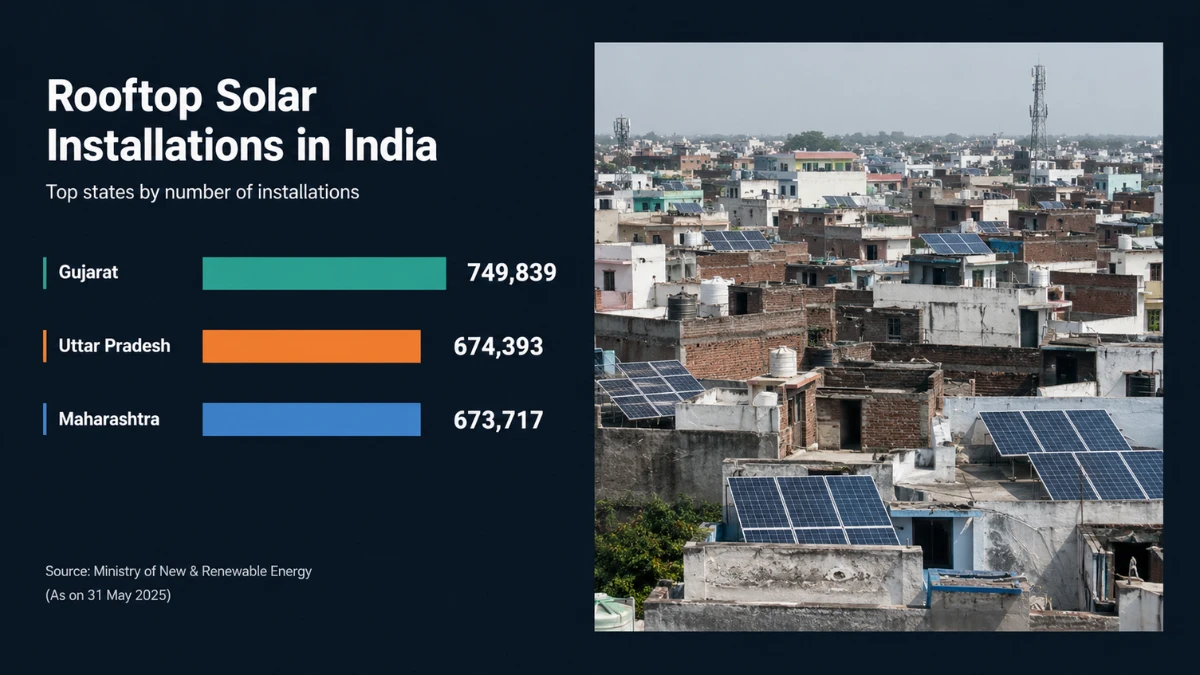
Uttar Pradesh has overtaken Maharashtra to become the second-largest state in India for rooftop solar installations under the PM Surya Ghar Muft Bijli Yojana, the central government's flagship residential solar subsidy program. The state has installed 674,393 domestic rooftop systems, against Maharashtra's 673,717, according to figures released by the Uttar Pradesh New and Renewable Energy Development Agency (UPNEDA) on July 17. Gujarat remains first nationally, with 749,839 installations.
A State-Level Shift With National Implications
The ranking matters less for the specific number than for what it signals about where India's rooftop solar demand is actually concentrating. Gujarat and Maharashtra have functioned as the scheme's traditional strongholds, backed by established solar ecosystems and higher urban rooftop density. Uttar Pradesh's rise indicates the PM Surya Ghar program is now generating comparable uptake in a state with a very different economic base, spread across smaller cities and a larger rural population, rather than remaining concentrated in India's wealthier western corridor.
The Numbers Behind the Ranking
According to UPNEDA director Ravinder Singh, the state's rooftop expansion has brought installed rooftop solar capacity to approximately 2,283.8 megawatts. The agency estimates that participating households are collectively saving around Rs 6.5 crore per day in electricity costs through the scheme's free-power provisions. Separately, UPNEDA reports that more than 7,000 companies now operate in the state's solar sector, employing over 85,000 people across a value chain that spans installation, system design, net metering, logistics, and after-sales operations and maintenance.
A Manufacturing Footprint Is Forming Behind the Installation Numbers
UPNEDA also points to a secondary effect: new manufacturing and assembly lines for solar modules, inverters, mounting structures, and cabling have begun setting up in the state to serve this demand. If that supply chain holds, Uttar Pradesh's rooftop solar growth stops being purely a demand story and starts becoming a manufacturing and employment story, which changes how investors and equipment suppliers should be sizing the state as a market.
What This Doesn't Yet Answer
The figures released are UPNEDA's own, not independently verified against the central Ministry of New and Renewable Energy's national PM Surya Ghar dashboard, and the 676-installation gap between Uttar Pradesh and Maharashtra is thin enough that the ranking could shift again within weeks. What is harder to dispute is the employment and manufacturing data, which suggests the scheme is now doing more in Uttar Pradesh than moving panels onto roofs. Whether that momentum holds, and whether Maharashtra responds with its own acceleration, is the more consequential question the ranking itself does not resolve.
For more climate news - https://climatora.com/climate-watch