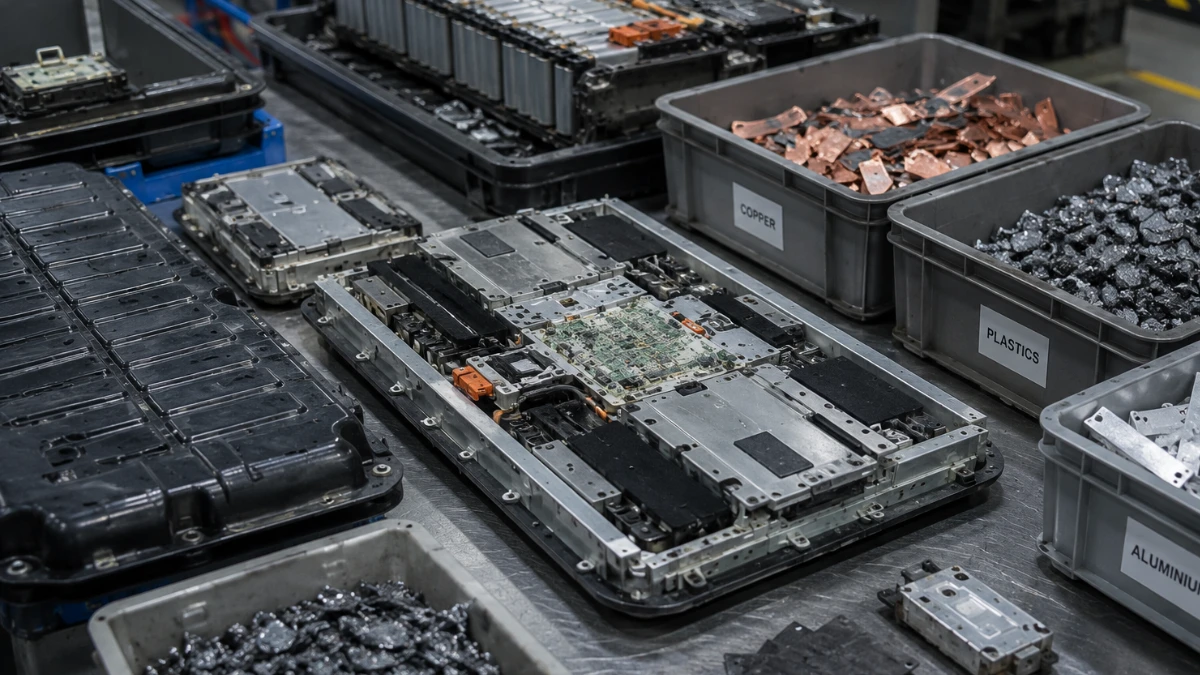
India's Battery Incentives May Expand to Recycling and Minerals
Remarks from a senior Ministry of Heavy Industries official at India Energy Storage Week on July 9-10 point to a coming shift in battery policy, from subsidising cell production alone toward recycling, critical minerals, and components. This is a signal of direction, not a finalised scheme, and it is five days old by the time this runs.
Vijay Mittal, Joint Secretary at the Ministry of Heavy Industries (MHI), told delegates at the 12th India Energy Storage Week in New Delhi that the ministry is considering widening its Advanced Chemistry Cell (ACC) incentive framework to cover more operators, alongside dedicated policies for niche battery technologies. He said the ministry is also evaluating a component-level support mechanism modelled on the Approved List of Models and Manufacturers (ALMM) framework already used for solar modules, which would extend similar quality and sourcing controls to battery parts. Separately, Mittal confirmed that MHI, working with the Office of the Principal Scientific Adviser to the Prime Minister, has partnered with the European Union to launch pilot projects on battery recycling.
The shift in emphasis matters because India's existing ACC support has a visible execution gap. The ₹18,100 crore ACC Production Linked Incentive scheme, approved in 2021 with a target of 50 GWh of domestic cell manufacturing capacity, had only a limited share of that capacity operational by late 2025, according to industry tracking cited alongside Mittal's remarks. Extending incentives downstream into recycling and components is, in effect, an admission that cell manufacturing alone will not close India's battery supply chain gap fast enough, particularly as projected demand rises from roughly 28 GWh in 2025 to 272 GWh by FY2030, with total energy storage requirements reaching an estimated 888 GWh by 2035-36.
Recycling is the more strategically interesting piece of this than the headline manufacturing figures suggest. India currently imports the overwhelming majority of the lithium, cobalt, nickel, and graphite used in domestic battery production. A functioning recycling industry becomes a genuine domestic mineral source only once India's first wave of electric vehicles reaches end-of-life at scale, which MHI's own material puts toward the end of this decade. NITI Aayog has estimated the country could have 128 GWh of recyclable battery capacity by 2030, and a separate MHI call for EU-partnered recycling proposals values the domestic EV battery recycling market at roughly ₹1,380 to ₹3,510 crore today, projected to reach ₹4,14,000 crore by 2035, a scale-up that depends entirely on policy and infrastructure catching up in time.
The caveats matter here more than usual. Everything Mittal described, the widened ACC framework, the ALMM-style component scheme, the recycling partnership's pilot scope, is at the stage of ministerial statements at an industry conference, not notified policy, cabinet approval, or a gazette notification. No timeline, budget outlay, or draft scheme document has been made public. Companies already positioned in this space, Exide Industries through its Exide Energy Solutions ACC subsidiary, Amara Raja through its Giga Corridor project, and specialist recyclers such as Gravita India, stand to benefit if these plans materialise, but "considering" and "evaluating" are the ministry's own words, not commitments with dates attached.
What to Watch
→ Whether MHI issues a draft policy document or cabinet note formalising any of these three initiatives (widened ACC incentives, ALMM-style component framework, EU recycling pilots)
→ Operational capacity updates against the ACC PLI scheme's 50 GWh target, to see whether the underlying execution gap that prompted this policy rethink is closing
→ Details of the MHI-EU recycling pilot projects, including funding, timeline, and which Indian recyclers are selected as partners
For more climate news - https://climatora.com/climate-watch