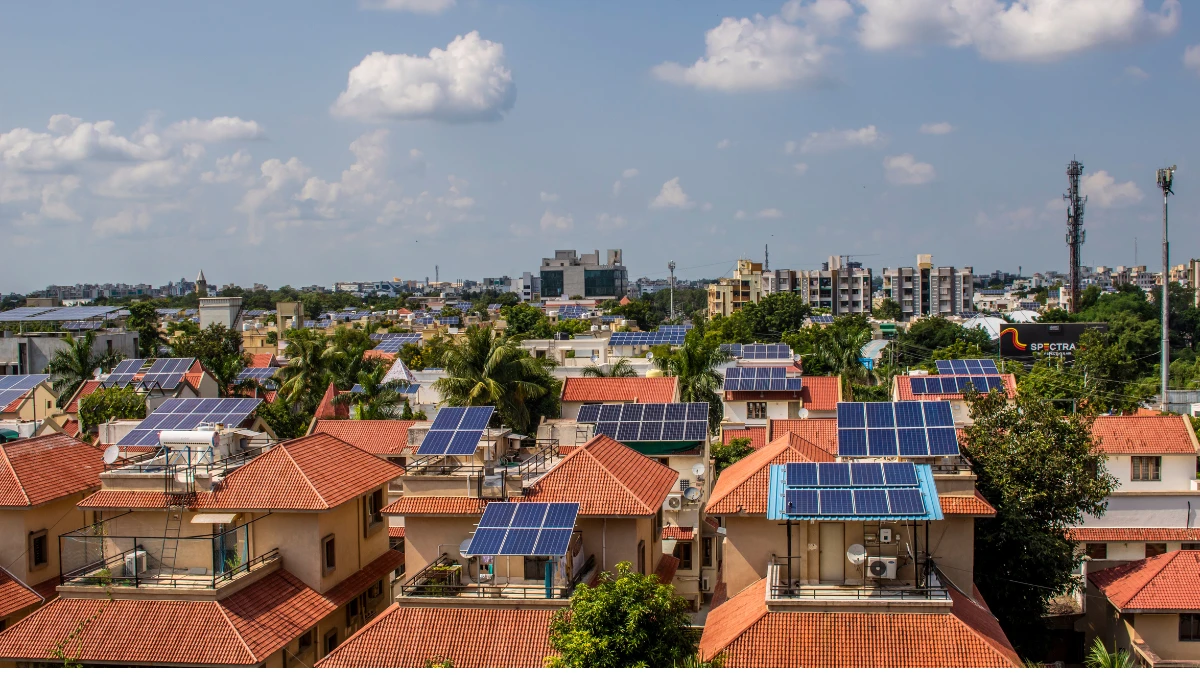
IBRD Loan Anchors $4.2 Billion Push Into India's Rooftop Solar Market
The World Bank's board has approved financing designed to unlock $4.2 billion in private capital for household solar, a segment that has persistently lagged India's utility-scale build-out despite years of subsidy support.
The World Bank's Board of Executive Directors approved an $890 million financing package on July 10 to support India's PM Surya Ghar: Muft Bijli Yojana, the government's flagship scheme targeting rooftop solar installations across ten million rural and urban households. The package combines three instruments: an $820 million loan from the International Bank for Reconstruction and Development, a $60 million concessional loan from the Clean Technology Fund, and a $10 million grant from the IBRD's Livable Planet Fund. The Bank said the structure is intended to mobilise a further $4.2 billion in private commercial lending for household solar installations, well beyond the public financing itself.
Utility-scale solar has carried most of India's renewable capacity additions this decade; rooftop has not kept pace. Government data cited around this announcement put installed rooftop capacity at roughly 9.56 GW as of March 2026, with earlier official figures pointing to about 2.6 million systems deployed and ₹17,967 crore disbursed in central financial assistance. Separate reporting on the same announcement, however, cites 4 million installations under the scheme, a figure neither the government nor the Bank has reconciled publicly. What is not in dispute is the financing logic: pairing concessional capital with a private-lending multiplier is an attempt to make household solar a standard retail lending product for banks and NBFCs, rather than a subsidy-dependent niche they treat cautiously.
The financing arrives as India works toward a 60% non-fossil share of its electricity mix by 2035 and net-zero by 2070, targets that depend on distributed generation reaching households the utility-scale pipeline was never designed to touch. Paul Proccee, the World Bank's Acting Country Director for India, said the institution has mobilised more than $2 billion over the past decade to help grow the broader solar market from 500 MW to over 27 GW of installed capacity, a reference to the sector overall rather than rooftop alone. Moez Cherif, the programme's Task Team Leader, framed the financing as aimed at building distribution company, bank, and vendor capacity to deliver integrated service, addressing the servicing bottleneck rather than only the cost of capital.
That distinction matters more than the headline figure. Commercial lenders have historically stayed cautious on rooftop solar because of inconsistent net-metering enforcement across states and thin collateral value on residential installations, frictions that blended concessional finance does not automatically fix. It is also unclear how quickly the promised $4.2 billion in private capital will actually materialise, since the Bank's statement describes it as a mobilisation target rather than a committed pipeline. Until commercial lenders start issuing standardised rooftop loan products at scale rather than vendor-specific financing, the $890 million functions more as a signal to the market than as proof the servicing gap has closed.
What to Watch
→ Whether commercial banks launch standardised rooftop solar loan products, rather than financing tied to individual vendors
→ Whether the government or World Bank issues a reconciled installation count, resolving the 2.6 million versus 4 million discrepancy
→ State-level net-metering enforcement changes that could accelerate or continue to slow household uptake
For more climate news - https://climatora.com/climate-watch