Legacy Coal Miner Bets R&D Budget on Carbon Capture and Critical Minerals
A legacy coal miner is pouring capital into carbon capture, rare earth recovery, and even nuclear feasibility studies, a hedge against a fossil-fuel core that faces structural long-term pressure.
Coal India Limited (CIL), the state-run Maharatna company, has told exchanges it will invest approximately ₹1,900 crore in research and development by FY30. The plan runs through the newly established National Centre for Coal and Energy Research (NaCCER), created in FY2024-25 on a hub-and-spoke model, with three Centres of Excellence at IIT Hyderabad, IIT Madras, and IIT (ISM) Dhanbad. CIL's R&D spend has already jumped four-fold, from ₹61 crore in FY2023-24 to ₹245 crore in FY2024-25, and the company says 19 projects worth ₹225 crore are currently underway under NaCCER's direct oversight, alongside 13 pilot-scale prototype projects at the CoEs.
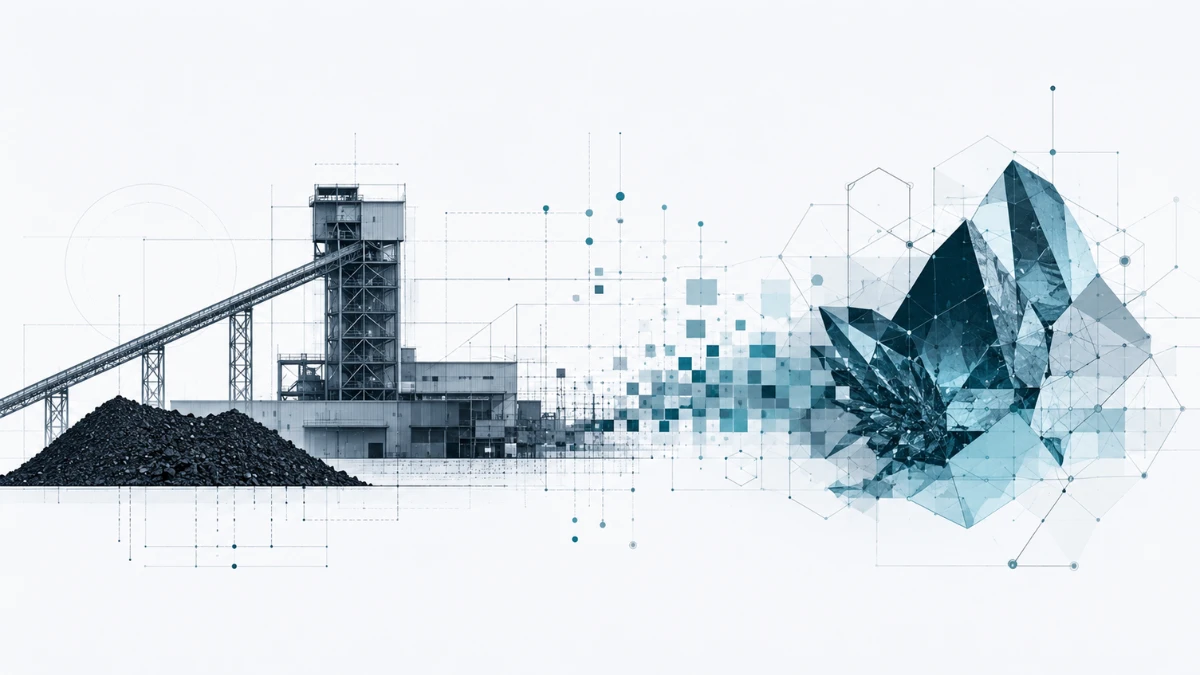
The research portfolio is the real story here. It spans carbon capture, utilisation and storage (CCUS), high-ash coal gasification and syngas utilisation, recovery of rare earth elements and critical minerals from coal waste, mineral beneficiation, circular economy and mine-repurposing work, and a feasibility study on micro modular nuclear reactors. For a company whose core product faces the clearest long-term demand ceiling of any fuel in India's energy mix, this is a coal miner explicitly building technical capability in the two areas that matter most to the clean transition: decarbonising what coal capacity remains, and supplying the critical minerals that renewables, EVs, and grid storage depend on.
The critical-minerals angle is the sharper of the two. Rare earth elements are a binding constraint on India's wind turbine and EV motor supply chains, and recovering them from coal ash and mine waste, if it works at commercial scale, would give CIL a genuine second revenue line independent of coal volumes. CIL has also brought in international partners: Ergo Exergy of Canada on underground coal gasification, Ericsson of Sweden on 5G deployment at its Jhanjra mine, and Australia's CSIRO on broader collaborative research, which suggests this is more than a domestic PR exercise.
The nuance: ₹1,900 crore by FY30 is a company-stated target, not yet a committed capital allocation with a project-by-project budget breakdown, and it follows a base of just ₹245 crore in annual R&D spend, still a small fraction of CIL's overall revenue and capex. Whether "shift R&D to a higher orbit," as a senior CIL official put it in the filing, translates into commercially deployed CCUS or rare earth recovery technology by 2030, rather than research papers and pilot plants, is the open question. TRL-4 prototype development, the stage CIL says it's now targeting, is still several stages short of commercial deployment.
What to Watch
- Whether any of the 19 active NaCCER projects reach pilot-scale commercial deployment before FY30, rather than remaining at prototype stage
- Independent verification of rare earth recovery yields from coal ash, the technical claim with the most direct relevance to India's critical minerals supply chain
- Whether CIL discloses a year-by-year capex breakdown for the ₹1,900 crore target, which would clarify whether this is front-loaded or backloaded against the FY30 deadline