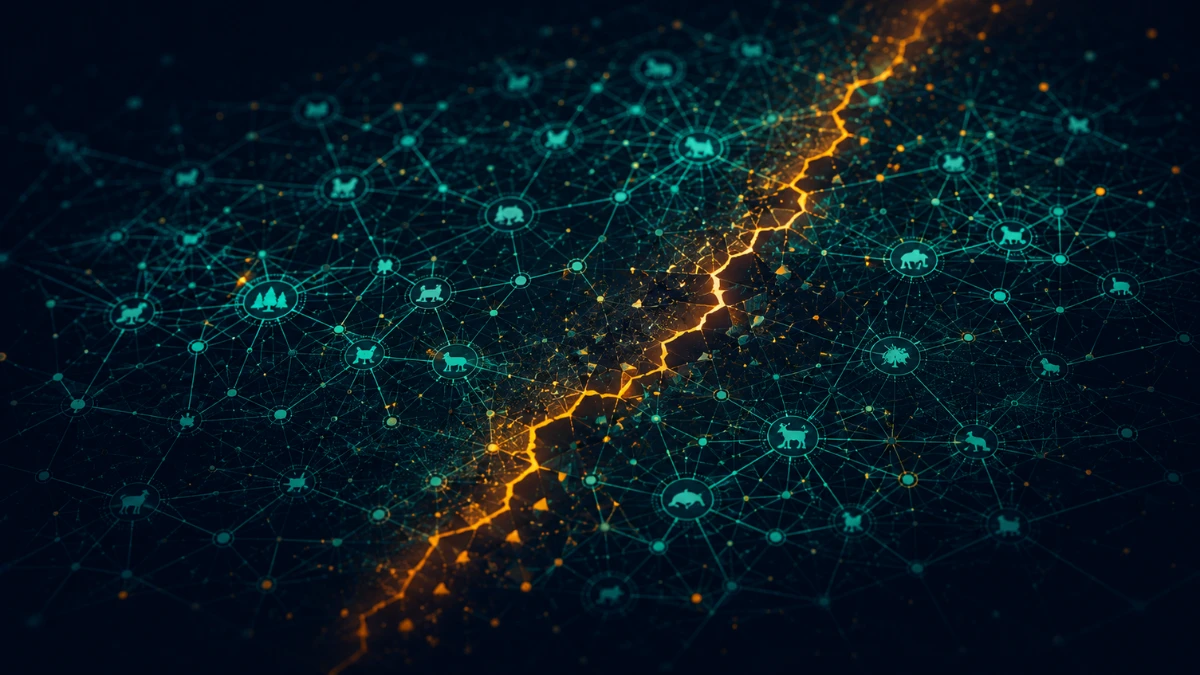
Biodiversity Loss 2026: Why Ecosystem Collapse Is a Global Risk
A new global risk assessment ranks biodiversity loss as the second most dangerous threat the world faces this decade above pandemics, above cyber conflict. Here's what's driving the collapse, and what could still change it.
A Risk Ranking That Should Change the Conversation
For years, biodiversity loss lived in the "nice to protect" column of climate policy — worthy, but secondary to emissions and energy transition. That framing is now outdated. The World Economic Forum's Global Risks Report 2026 ranks biodiversity loss and ecosystem collapse as the second most severe global risk over the next decade, trailing only extreme weather events. It's not a metaphor. It's a risk model, built the same way governments assess pandemics and armed conflict.
The Numbers Behind the Warning
The scale is no longer abstract. The IUCN Red List now classifies more than 48,600 species as threatened with extinction — roughly one-third of all species evaluated. Current extinction rates are estimated at up to 1,000 times higher than background levels before significant human influence, a pace many researchers now describe as the opening phase of a sixth mass extinction. Pollinators alone support 75% of the world's leading food crops; their decline isn't a wildlife story, it's a food security story.
Why This Isn't a Distant Threat
In January 2026, the UK government released a national security assessment — developed with input from its intelligence community — concluding that ecosystem collapse could disrupt food, water, and health systems, and drive migration, resource competition, and geopolitical instability. Researchers at the University of East Anglia and University of Exeter pushed back on parts of the report's migration modeling, warning that framing biodiversity loss primarily as a security threat risks distorting policy and shifting authority toward border and military agencies rather than conservation and adaptation. Both sides agree on the underlying fact: ecosystems failing at scale reshapes economies, not just landscapes.
Recovery Is Possible — But Conditional
This isn't only a story of decline. In October 2025, the IUCN reclassified the green sea turtle from Endangered to Least Concern globally — a direct result of decades of protected nesting sites and fishing bycatch reduction. Wolf reintroduction in Yellowstone remains a textbook case of a single species stabilizing an entire food web. Recovery happens when science-based policy, sustained funding, and international coordination actually converge — not when they're promised.
What Happens Next Depends on Choices Being Made Now
Not every recent policy signal points toward recovery. In March 2026, the U.S. Endangered Species Committee approved an exemption allowing Gulf of Mexico oil and gas operations to bypass key Endangered Species Act requirements — a decision environmental groups are now challenging in court, and one that directly contradicts a 2025 federal analysis warning of harm to whales, sea turtles, and Gulf sturgeon. The pattern is consistent: where governments invest in monitoring, habitat protection, and enforcement, species recover. Where short-term economic exemptions win out, degradation accelerates.
The choice in front of policymakers isn't whether biodiversity loss is a serious global risk — the data and the security establishment now agree it is. The choice is whether it gets treated with the same urgency, funding, and coordination as the other risks in that top tier.